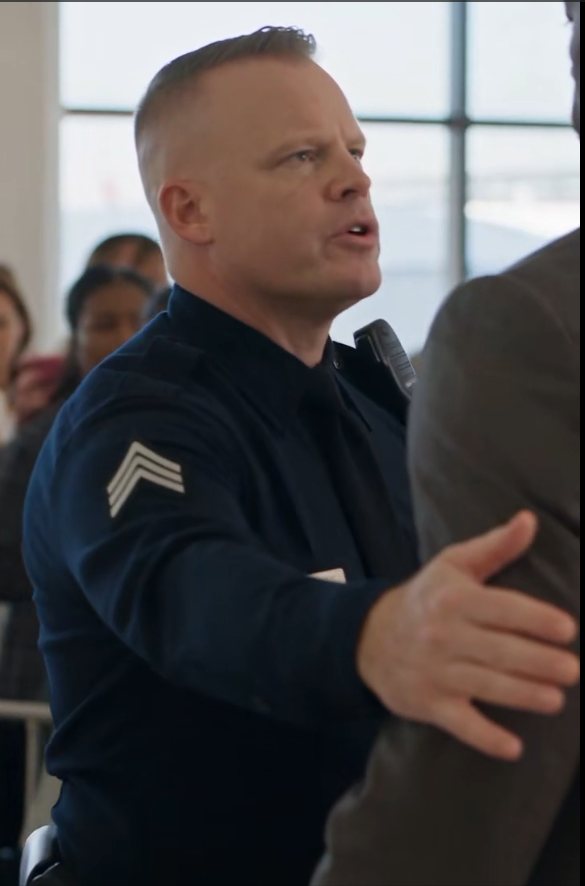
My eyes went to the briefcase.
Davies had taken it from me at the gate.
He had carried it through the terminal.
He had set it on the detention-room counter.
I remembered his hand brushing the latches.
“How bad?”
“Depends.”
“That word needs to leave your vocabulary for the next hour.”
“Marcus, listen. The seal didn’t break or you’d have red. Amber means the controller registered force outside the normal opening sequence.”
“Can we transfer?”
“Yes.”
“Risk?”
“If authentication fails after the drive is removed, the controller may interpret it as tampering.”
“Meaning?”
“It wipes.”
Claire covered her mouth.
The duty manager looked away.
Parker said, “What do you need to prevent that?”
My engineer answered through the speaker.
“A trusted biometric unlock and continuous power before removal.”
I looked at the laptop.
“Can this machine provide continuous power?”
“Yes, but Marcus, once we connect it, do not interrupt the cable. Don’t close the software. Don’t lose power.”
“How long?”
“Until verification completes.”
I checked my watch.
4:03.
“Do it.”
I connected the laptop to the conference-room network.
The duty manager produced an Ethernet cable.
The first handshake failed.
My engineer muttered something I did not hear clearly.
“What?”
“Certificate mismatch.”
“Fix it.”
“Working.”
Parker’s radio crackled.
She stepped into the hall.
Claire remained by the door.
I glanced at her.
“You don’t have to stay.”
“I know.”
“Then why are you?”
She shrugged.
“You asked me to note the time.”
I looked at her.
She gave the smallest smile.
“Figured I’d see how it ended.”
The network icon changed.
My engineer’s voice sharpened.
“We have tunnel.”
“Next.”
“Biometric unlock.”
I placed my thumb on the drive sensor.
Green.
“Continuous power connected.”
The amber indicator blinked.
Then turned green.
For the first time all afternoon, my shoulders loosened.
“Remove it,” the engineer said.
I lifted the drive.
Connected it.
A progress bar appeared.
0%.
Then 1%.
No one in the room spoke.
At 4:08, the upload began.
I sat down.
Claire quietly closed the door.
The first ten percent moved quickly.
Then the speed dropped.
My engineer watched the diagnostic panel.
“Traffic fluctuation.”
“Can you compensate?”
“Already doing it.”
I called legal on a second device the duty manager loaned me.
My chief legal officer answered with, “You are on every local news station.”
“I don’t care.”
“You need to.”
“I need the injunction ready.”
“It is. We file the moment the signatures authenticate.”
“What’s the board status?”
“Three directors are getting nervous.”
“Tell them not to sell fear as prudence.”
“They’re worried the deadline slips.”
“So am I.”
“Marcus, the equity firm has already circulated notice that you failed to deliver the required digital authorizations.”
“They’re early.”
“They’re trying to create the record before we do.”
I looked at the transfer screen.
18%.
“Then we beat them with a better record.”
My legal officer paused.
“What happened at the airport?”
I glanced toward Parker through the glass wall.
“An officer decided I was suspicious.”
“Because?”
“He hasn’t said.”
“You want us to move on it?”
“No.”
“Marcus.”
“Not now.”
“You were detained.”
“And I’m not missing another deadline because somebody else wants to decide what matters most.”
I ended the call.
Claire watched me.
“You’re not going after him?”
“I didn’t say that.”
“It sounded like it.”
I looked at the screen.
21%.
“My employees don’t get paid in outrage.”
That ended the conversation.
At 4:16, Lieutenant Parker reentered.
She closed the door behind her.
“Mr. Hayes.”
“Upload is active. I can’t disconnect anything.”
“I’m not asking you to.”
She pulled out a chair.
“I reviewed Officer Davies’s body-camera footage.”
I waited.
Parker placed her hands on the table.
“The initial contact is a problem.”
“How much of one?”
“He had no documented security trigger before approaching you.”
“I knew that.”
“There’s more.”
The progress bar moved to 29%.
Parker continued.
“His camera was recording before you reached the scanner.”
I looked at her.
“He spoke to the gate agent approximately ninety seconds before boarding began.”
Claire’s face changed.
“I remember.”
Parker looked at her.
“You were wearing a headset. You may not have heard all of it.”
She turned back to me.
“He asked whether Seat 1A was actually assigned to you.”
I said nothing.
“He had already seen you standing near the priority lane.”
Claire frowned.
“He asked me if the first-class manifest had changed.”
Parker nodded.
“Then he asked whether you were traveling with someone.”
I remembered Davies’s expression.
Slow.
Measuring.
“Why?”
Parker’s mouth tightened.
“He has not provided an adequate explanation.”
I looked at the screen.
31%.
“Was he looking for a specific person?”
“No.”
“Any active bulletin?”
“No.”
“Any reason to question my boarding pass?”
“No.”
“Then we know why.”
Parker did not answer.
That restraint made me respect her more.
She was not going to claim what she could not prove.
But she was not pretending the pattern meant nothing.
“There is another issue,” she said.
“What?”
“The detention report.”
I turned from the screen.
“He completed it?”
“Started it.”
“And?”
“He wrote that you became physically resistant when he attempted to inspect the bag.”
Claire immediately said, “That isn’t what happened.”
Parker looked at her.
“I know.”
“How?”
“Body camera.”
There it was.
Not prejudice.
Not suspicion.
Not interpretation.
A factual lie.
Small enough to fit in a report field.
Large enough to destroy a career.
Mine or his, depending on who had evidence.
I leaned back.
“What happens now?”
“I’ve removed Officer Davies from active terminal duty pending review.”
“Where is he?”
“Still in the detention office.”
“Does he know you found the report?”
“Yes.”
I looked at Parker.
“And?”
“He says he wrote it quickly and intended to revise it.”
Claire gave a disbelieving breath.
I did not.
I had spent fifteen years reading contracts written by people who always discovered their mistakes after someone caught them.
Parker continued.
“Professional standards has been notified.”
I looked toward the laptop.
37%.
“Fine.”
She watched me.
“That’s all?”
“What would you like me to do?”
“Most people in your position would have more to say.”
“I have more to do.”
She nodded once.
Then her radio crackled again.
Parker listened.
Her face changed.
“What?”
She did not answer immediately.
Then she looked at the duty manager.
“How many reporters?”
He glanced at his phone.
“Outside security? Maybe twelve.”
“And passengers?”
“More.”
Parker looked at me.
“The video has spread.”
My phone buzzed again.
Then again.
Then continuously.
I turned it face down.
“Let it.”
Parker stood.
“You may have to leave through a service corridor.”
“No.”
“Mr. Hayes—”
“I walked into this terminal through the public entrance.”
“There is a crowd.”
“I’m not sneaking out.”
“This isn’t about appearances.”
“It is now.”
I held up a hand before she could respond.
“But I’m not leaving until this transfer finishes.”
42%.
My engineer’s voice came through the speaker.
“Marcus, we just lost throughput.”
I turned back.
“How bad?”
“Bad enough.”
The bar stopped moving.
Everyone in the room became still.
“What caused it?”
“Network congestion or shaping. I’m switching routes.”
“Can you?”