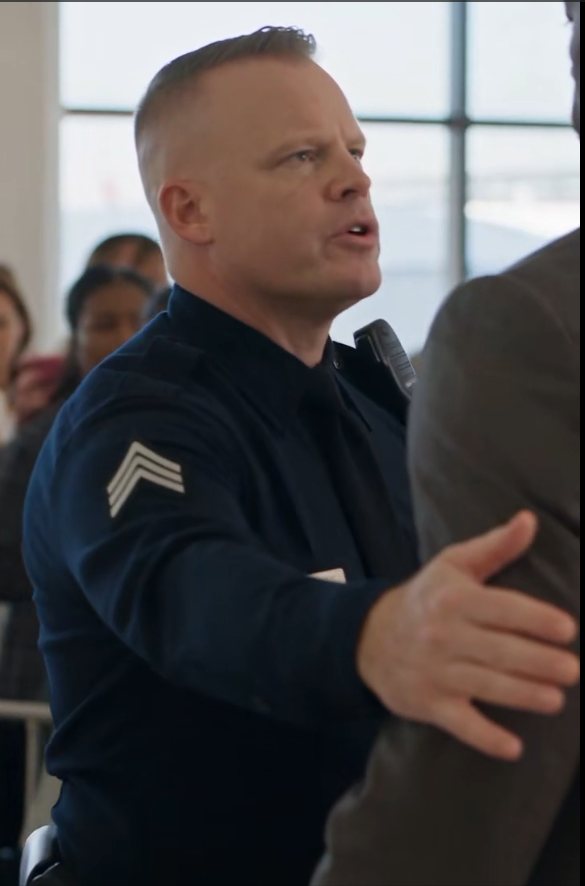
“Physical force against the case registered as an intrusion event.”
The equity attorney said, “This is all anecdotal unless documented.”
Parker stepped forward.
I had not asked her to.
She looked at the camera.
“Lieutenant Parker, airport police watch commander. The chain interruption and condition of the case are documented on department video, property logs, and supervisory review.”
The attorney blinked.
That was satisfying.
Briefly.
But satisfaction was not the same as winning.
Exception review: 74%.
My lawyer received something off-screen.
“Board members, we have also filed our objection to any vote before the contractual deadline.”
The equity firm’s attorney responded immediately.
“The board has independent emergency authority.”
A director said, “Not to manufacture default before one exists.”
Another voice answered.
“We are losing time.”
“So is everyone,” I said.
The argument began to fracture into procedure.
Motions.
Objections.
Notice provisions.
Voting thresholds.
I looked at the authentication screen.
81%.
My phone buzzed.
A message from engineering.
DON’T TOUCH ANYTHING. SYSTEM RECHECKING TAMPER LOG.
I placed the phone down.
The green indicator on the drive blinked.
Then amber.
My engineer’s face changed on the small monitor.
“Marcus.”
“What?”
“Second integrity challenge.”
“What does it want?”
He typed rapidly.
“I don’t know yet.”
The board call continued behind him.
My lawyer was arguing over Section 9.4 of the acquisition agreement.
Parker watched the drive.
Claire stood near the door.
Amber.
Amber.
Amber.
Then the security program displayed a new message.
PHYSICAL EVENT TIMESTAMP CONFLICT.
My engineer went silent.
I leaned closer.
“What conflict?”
“The drive’s intrusion timestamp doesn’t match the custody log.”
“How far off?”
“Three minutes.”
Parker frowned.
“That’s impossible.”
“Why?”
“Davies took the bag at the gate at 3:21.”
My engineer looked at the data.
“The drive registered force at 3:18.”
I stopped.
3:18.
Before Davies took the briefcase.
Before I was restrained.
Before he physically controlled it.
I replayed the gate in my head.
Final boarding announcement.
Davies stepping close.
His hand reaching.
Me moving the case behind my leg.
His grip on my left arm.
The briefcase still in my right hand.
Then—
My mind caught on something.
The navy sleeve.
The first moment.
The arm across my chest.
“Claire.”
She looked at me.
“When he stopped me at the scanner, did he touch the case?”
She frowned.
“No. I don’t think—”
Then her expression changed.
“He bumped you.”
“Yes.”
Davies had stepped directly into my path.
His utility belt had struck the side of the briefcase.
A small impact.
Meaningless at the time.
Enough to register.
Before the seizure.
Before the detention.
The system saw the case as compromised while it was still in my physical custody.
My engineer understood.
“That’s why the timestamps conflict.”
“Can we reconcile it?”
“If we document the impact.”
“Body camera.”
Parker was already opening the footage.
She scrubbed backward.
3:18:42.
There.
The angle was imperfect, but visible.
Davies moved between me and the scanner.
His hip hit the case.
The briefcase shifted.
I looked down.
At the time I had barely noticed.
Now fifteen years of software engineering depended on it.
My engineer said, “We can add the event.”
“How long?”
“If the exception packet allows amendment, five minutes.”
The equity attorney on the board call said, “Mr. Hayes, are you still with us?”
I looked at the wall screen.
“Yes.”
“Then perhaps you can confirm that authentication remains incomplete.”
I looked at the amber light.
Then at Parker’s footage.
Then at the board.
“Yes.”
My lawyer closed his eyes.
The attorney nodded.
“Thank you.”
“I can also confirm why.”
I shared the evidence feed.
The gate video appeared on the board screen.
Officer Davies stepping into my path.
His belt contacting the case.
Timestamp.
3:18:42.
Then audio.
“Hold it right there.”
Everyone watched.
I did not need to explain much.
The video continued.
Davies asking for ID.
Questioning Seat 1A.
Asking what was in the bag.
Me telling him it had cleared security.
Then the sentence I had nearly forgotten because so much happened afterward.
Davies:
“I don’t care what TSA did.”
The equity attorney said nothing.
Parker stopped the footage.
My engineer added the impact to the chain record.
The drive turned green.
Exception review restarted.
92%.
93%.
94%.
My lawyer whispered, “Come on.”
95%.
The equity firm’s attorney interrupted.
“This does not cure Vanguard’s failure to perform by the board’s emergency meeting time.”
One director answered.
“The deadline is eight.”
“Pacific,” another added.
The attorney’s composure finally cracked.
“The operational transfer was required earlier.”
“No,” my lawyer said. “That language is not in the agreement.”
The progress bar reached 98%.
Then stopped.
I stared at it.
Nobody on the call spoke.
My watch ticked.
One second.
Two.
Five.
Ten.
My engineer leaned toward his monitor.
“System’s finalizing signature chain.”
The equity attorney began, “The board cannot reasonably—”
The screen changed.
AUTHENTICATION COMPLETE.
DIGITAL SIGNATURES VALIDATED.
TRANSFER VERIFIED.
My engineer slapped both hands against his desk somewhere two thousand miles away.
Claire let out a breath that sounded almost like a laugh.
My lawyer said, “Filed.”
The board call filled with overlapping voices.
I remained seated.
For several seconds, I did nothing.
No victory speech.
No raised fist.
No dramatic declaration.
I looked at my watch.
6:47 Central.
4:47 Pacific.
We had beaten the actual contractual cutoff by more than three hours.
And for the first time since Davies stepped in front of me, time belonged to me again.
The equity attorney was speaking.
“We reserve all rights—”
My lawyer answered him.
“Reserve whatever you like.”
The board chair called for order.
The hostile takeover motion was withdrawn pending legal review.
The emergency vote was canceled.
Our injunction was accepted for filing.
It was not the end of the corporate battle.
Nothing real ends that neatly.
But the deadline that could have handed away Vanguard’s control had passed safely.
I closed the laptop.
Claire smiled.
“You saved it.”
I looked at the drive.
“No.”
I thought about the engineer who built the exception system.
The lawyers ready to file.
The gate agent who documented the time.
The lieutenant who preserved evidence instead of protecting embarrassment.
The employees whose work made the company worth fighting over.
“We saved it.”
Then the door opened.
Officer Davies stood outside.
This time, he was not wearing a badge.
He held it in his hand.
Part VI — After the Gate
Parker stood when she saw him.
“Why are you here?”
Davies looked at her.
“Professional standards released me.”
“Released you to leave.”
“I know.”
He looked at me.
“I heard the company made its deadline.”
I closed the laptop.
“Yes.”
For a moment, nobody moved.
Then Davies stepped inside.
He placed his badge on the conference table.
The metal struck the wood with a small, flat sound.
Not dramatic.
Not loud.
Still, everyone heard it.
Parker’s expression hardened.
“What are you doing?”
“I’ve been suspended.”
“That doesn’t require you to surrender your badge to him.”
“I know.”
He looked at me.
“I’m not giving it to him.”
He turned the badge once with his fingers.
“I’m resigning.”
Parker studied him.
“That decision doesn’t happen here.”
“It already did.”
She looked at him for a long moment.