Part I — The Sidewalk
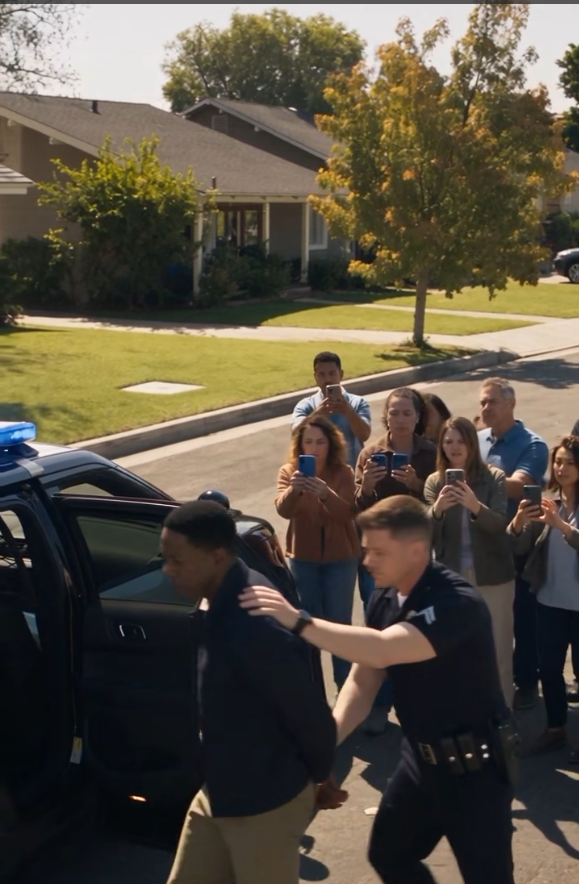
The first thing Marcus Reed noticed after Officer Daniel Miller pushed him toward the police cruiser was not the pressure of the handcuffs against his wrists.
It was the number of cameras.
At least fifteen phones were pointed toward the curb.
A woman stood barefoot on the porch across the street, one hand braced against a white column while the other held her phone at eye level. Two teenagers had stopped their basketball game in the middle of the driveway. The ball had rolled beneath a parked sedan and stayed there. Farther down the block, a man wearing a work shirt was narrating a livestream in a low, urgent voice.
Marcus heard the same question moving through the crowd.
“What did he do?”
Officer Miller tightened his hand around Marcus's forearm.
“Keep moving.”
Marcus took another step. His shoe caught the edge of the pavement, but he recovered before Miller could use the stumble to force him harder against the car.
He looked toward the faces around him, then toward the small red light on Miller's body camera.
Still recording.
Good.
Ten minutes earlier, Marcus had been walking back toward his dark SUV after speaking with an elderly neighbor near the end of the block. He had known her for years. She had wanted to ask whether the city had finally approved repairs to a drainage channel behind her property, and Marcus had spent several minutes explaining that he didn't work for the city and couldn't speed anything along.
He had been smiling when the patrol car rolled up.
Miller stepped out and asked what Marcus was doing near the vehicle.
Marcus answered.
“It's mine.”
Miller wanted identification.
Marcus provided it.
Then came another question, followed by another, and Marcus noticed the subtle shift that experienced people recognized long before voices were raised. The questions stopped sounding like requests for information and began sounding like tests of compliance.
Miller asked where Marcus had been.
Marcus told him.
Miller asked whether the elderly woman knew him.
Marcus said yes.
Miller asked whether he could look inside the SUV.
Marcus said no.
There had been no sarcasm in it. No challenge.
Just no.
Miller's expression changed.
“Turn around.”
Marcus had looked at him for a second.
“Am I being detained?”
“I said turn around.”
Marcus turned.
He did not pull away when Miller took his wrists. He did not argue when the cuffs clicked shut. He simply looked over his shoulder and asked a question that would later be replayed hundreds of thousands of times.
“Officer, are you sure you want to continue this?”
Miller laughed.
Now he opened the back door of the cruiser.
“I'm done listening to you.”
Then someone shouted from behind the crowd.
“MARCUS!”
He knew the voice immediately.
Kendra Hayes came down the sidewalk at a run, a navy blazer open over a pale blouse, her breathing uneven. In her right hand was a small black presentation case.
Marcus's expression changed.
“Kendra, don't interfere.”
She slowed but did not stop.
“I'm not interfering.”
She pushed through the last two people at the edge of the crowd and stopped several feet from Miller.
“Officer Miller?”
Miller glanced toward her, then briefly toward his own nameplate, as if confirming where she had gotten the name.
“Step away.”
Kendra stayed where she was.
She opened the black case.
A gold credential caught the late-evening light.
It was not shaped like a Richmond police shield. There was no city crest on it. The seal in the center was surrounded by lettering that identified an office at the Commonwealth level.
Kendra held it steady.
“I'm giving you one final opportunity. Remove those handcuffs and call your supervisor.”
Miller looked at the credential.
Or, more accurately, Marcus thought, he looked in its direction.
Then he smiled.
“Lady, I don't care what you've got in that box.”
Several people reacted at once.
Kendra did not.
“You should.”
“Back up.”
“Read it.”
Miller stepped toward her.
“I said back up.”
Marcus watched the distance between them close.
“Miller.”
The officer turned.
Marcus's voice remained quiet.
“Listen to her.”
That seemed to irritate Miller more than anything else Marcus had said.
He pointed toward the open cruiser door.
“You're detained. She's interfering. And I'm the one in charge here.”
Nobody spoke for two seconds.
Then Kendra lowered the case.
Not because Miller had intimidated her.
Marcus knew that look. Kendra had been chief counsel to the Commonwealth Law Enforcement Certification Board for six years. She had questioned police chiefs, county executives, instructors, investigators, and academy directors without once needing to raise her voice.
She lowered the case because she had finished giving Miller an opportunity.
Marcus looked toward the phones.
Then Miller's body camera.
Then Miller himself.
“You keep saying you're in charge.”
“I am.”
Marcus nodded once.
“Then you should probably know whose credential you're refusing to read.”
For the first time, uncertainty appeared in Miller's expression.
Marcus tilted his head toward Kendra.
“Look closer.”
Kendra raised the case again.
One of the teenagers across the street lifted his phone higher and zoomed in.
Miller finally focused on the words around the gold seal.
Before he could finish reading them, a voice came sharply from behind the crowd.
“Miller!”
Sergeant Elena Torres was walking toward them quickly.
Her eyes were not on Marcus.
They were fixed on the credential.
“Miller, step away from him. Now.”
Miller frowned.
“Sergeant, I've got this.”
“No.”
Torres stopped less than ten feet away.
Her voice lowered.
“You really don't.”
Marcus lifted his cuffed hands as far as Miller's grip allowed.
“The credential in that box belongs to the board that reviews police certification in this Commonwealth.”
Miller stared at him.
Marcus continued.
“The board that decides whether an officer remains eligible to wear a badge.”
For the first time since stepping out of his patrol car, Miller stopped talking.
Torres looked at Marcus's face.
Then at the credential.
Then back at Marcus.
Recognition settled into her expression with uncomfortable precision.
She had seen him before.
Not on television. Marcus rarely appeared publicly unless a legislative committee required testimony. Not in campaign material. The certification board was deliberately insulated from electoral politics.
She had seen him at an annual standards conference two years earlier.
He had stood at a plain podium beneath fluorescent lights and spent forty minutes telling a room filled with supervisors that power became most dangerous when its exercise felt ordinary.
Torres remembered the sentence because she had written it down.
Now the man who had said it was standing beside one of her cruisers with his hands cuffed behind his back.
Torres looked at Miller.
“That is Marcus Reed.”
Miller waited.
Torres's jaw tightened.
“Executive director of the Commonwealth Law Enforcement Certification Board.”
The crowd became quiet enough for Marcus to hear the dry click of a phone camera refocusing.
Miller's hand slowly fell away from the cruiser door.
Marcus saw the exact second the situation changed for him.
Not when Torres ordered him to step back.
Not when Kendra displayed the credential.
When Miller understood that the person in handcuffs had institutional power.
That distinction mattered.
“Take the cuffs off,” Torres said.