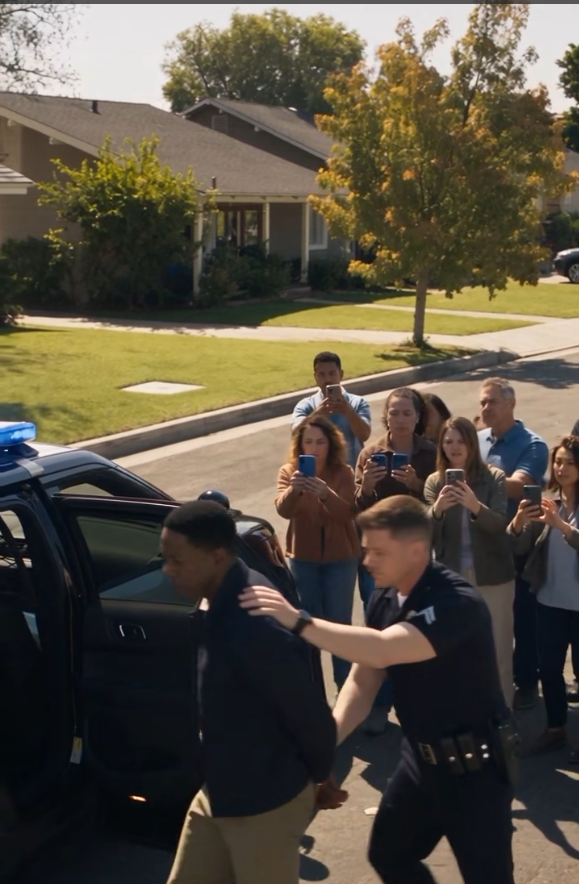
Miller reached toward Marcus's wrists.
Marcus turned slightly.
“Sergeant.”
Torres looked at him.
“I want his camera to remain on.”
“It will.”
“And yours.”
Torres touched the front of her uniform.
“Already on.”
Marcus nodded.
Only then did he turn his back toward Miller.
The key went into the cuff lock. Metal loosened around his left wrist, then his right.
Marcus brought his hands forward and rubbed the red pressure lines without looking at them.
Miller stepped away.
“Sir, I was responding to—”
Marcus raised one hand.
“Don't explain it to me here.”
Miller stopped.
“We'll all give statements. The recordings will speak for themselves.”
Kendra closed the credential case.
Miller's eyes moved toward her.
“You could've just told me who he was.”
Kendra studied him.
“I did something more useful.”
“What?”
“I told you to call your supervisor.”
Miller looked away.
Marcus noticed Torres watching him.
Not Miller.
Him.
There was something beyond recognition in her expression. Something more complicated than embarrassment.
He filed it away.
A middle-aged man near the sidewalk spoke up.
“I got the whole thing.”
Another voice answered.
“Me too.”
Marcus turned toward the group.
“If you recorded anything, please preserve the original file. Don't edit it. Don't add music. Don't crop it.”
The teenager with the phone blinked.
“You want us to send it to you?”
“No.”
Marcus glanced toward Torres.
“If there's an investigation, provide it through the proper channel.”
Miller gave a short, humorless breath.
“So now there's an investigation.”
Marcus looked at him.
“There was going to be an investigation the moment you put me in handcuffs without explaining the basis for the detention.”
Miller's face hardened.
Marcus continued before he could respond.
“Who I work for doesn't change that.”
Torres stepped between them—not dramatically, just enough to end the exchange.
“Miller, return to your unit.”
“Sergeant—”
“Now.”
Miller walked toward the front of the cruiser.
Marcus watched him go.
Kendra moved closer.
“You all right?”
“Yes.”
“You sure?”
He looked down at his wrists.
“Yes.”
She followed his gaze.
“That isn't what I asked.”
Marcus almost smiled.
Almost.
Across the street, someone had retrieved the basketball. The two teenagers still weren't playing.
Marcus looked around the neighborhood.
Front porches. Open windows. Phones in hands. People speaking in low voices to one another.
He had spent fourteen years helping design systems meant to determine whether police officers met statewide standards of conduct. He knew the language of policy, findings, administrative review, mitigation, aggravation, suspension, revocation, reinstatement.
None of those words felt particularly useful while standing beside the cruiser.
Kendra touched his elbow.
“We should leave.”
Marcus looked once more at Torres.
“Sergeant.”
“Yes, sir?”
“Don't call me sir.”
Torres paused.
“Mr. Reed.”
“Better.”
She nodded.
Marcus glanced toward Miller's cruiser.
“Follow your department's process. Don't treat this differently because of my job.”
Torres held his gaze.
For the first time, something like discomfort crossed her face.
“That may be harder than it sounds.”
Marcus waited.
Torres seemed about to say more.
Then she looked at the phones around them and stopped herself.
“I'll make sure the reports are completed.”
Marcus nodded.
“Good.”
He and Kendra walked toward his SUV.
Behind them, Sergeant Torres stood in the middle of the street for several seconds before turning toward Officer Miller.
Neither Marcus nor Kendra heard what she said.
But three separate phones recorded it.
“Don't write one word in that report you can't defend under oath.”
Part II — Pressure
By eight the next morning, Marcus's arrest had become national news despite the fact that he had never actually been booked.
The distinction did not survive social media.
The most widely shared clip lasted thirty-eight seconds. It began with Miller saying, I'm the one in charge here, showed Kendra lifting the credential, and ended with Torres identifying Marcus as executive director of the state certification board.
The title added by the original poster was less restrained:
COP HANDCUFFS THE MAN WHO CAN TAKE HIS BADGE.
Marcus hated it.
He stood barefoot in his kitchen, coffee untouched beside him, and watched the clip once.
Then he closed the tablet.
Kendra sat at the other end of the counter with a yellow legal pad.
“You shouldn't read the comments.”
“I wasn't.”
“You were about to.”
Marcus looked at her.
She tore a page from the pad.
“You have three problems.”
“Only three?”
“For the next five minutes.”
He gestured for her to continue.
“First, Richmond's internal process. That's theirs. You cooperate as a complainant, witness, detained person, whatever classification they use. You do not contact the chief about the substance.”
“I know.”
“Second, our board.”
“I recuse.”
“From everything.”
“Yes.”
“Intake, investigative assignments, interim-certification decisions, hearing assignments, final review.”
“Yes, Kendra.”
She watched him for a moment.
“You're saying that very easily.”
“Because it's obvious.”
“No. You're saying it easily because you haven't seen the problem yet.”
Marcus leaned against the counter.
“What problem?”
“The board receives mandatory notifications whenever a certified officer is suspended for conduct that could affect eligibility. Richmond placed Miller on administrative leave at six twelve this morning.”
Marcus's expression tightened.
“So the notice is coming.”
“It arrived at six forty.”
“You opened it?”
“I'm chief counsel. That's my job.”
“What does it allege?”
Kendra closed her folder.
“You're recused.”
Marcus stared at her.
A small, satisfied look appeared in her eyes.
He exhaled through his nose.
“That was quick.”
“You wrote half the recusal policy.”
“I know what I wrote.”
“Apparently you needed to experience it.”
Marcus picked up his coffee.
It had gone cold.
He poured it into the sink.
Kendra waited until he turned back.
“Third problem.”
“The public circus.”
“Not exactly.”
She pushed her phone across the counter.
The Richmond Police Department had issued a statement fifteen minutes earlier.
Marcus read it silently.
The department acknowledged a “detention involving a state official,” confirmed an administrative review, and asked the public not to draw conclusions from “partial video footage that may not reflect the totality of circumstances.”
Marcus read the final phrase twice.
Totality of circumstances.
Useful language.
Often legitimate.
Frequently abused.
Kendra watched him.
“That's not unusual,” she said.
“No.”
“But?”
“They've already made his employment relevant.”
“How?”
“By calling me a state official.”
Kendra sat back.
“You are a state official.”
“I was also a man standing beside my own vehicle.”
“That headline doesn't work as well.”
“Exactly.”
The doorbell rang.
Marcus looked toward the hall.
“You expecting somebody?”
“No.”
Kendra stood.
“Then don't answer it.”
Marcus gave her a look.
“This isn't a siege.”
“You have four news vans half a block away.”
“Three.”
“You counted?”
“I looked out the window.”
“That counts.”
The bell rang again.
Marcus walked toward the front door anyway.
Through the narrow side window, he saw Sergeant Torres standing alone on the porch.
No uniform.
Dark slacks, gray jacket, hair pulled back.
Marcus opened the door but did not invite her in.
“Sergeant.”
“Mr. Reed.”
Kendra appeared in the hallway behind him.
Torres saw her.
“Ms. Hayes.”
Kendra folded her arms.
“This is a bad idea.”
Torres nodded once.
“I know.”
Marcus studied her.
“Are you here in an official capacity?”
“No.”
“Then it may be a very bad idea.”