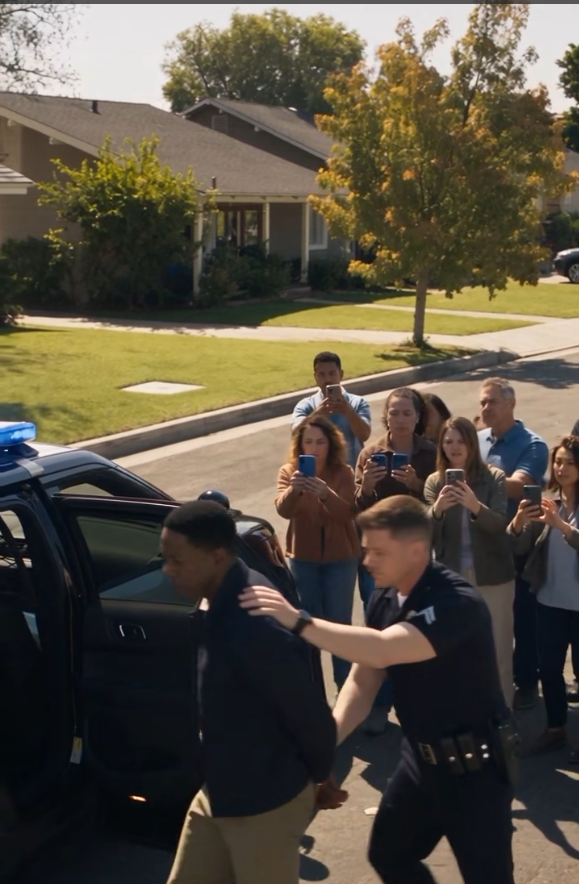
Marcus had never reviewed it because of his recusal.
The neighbor folded her arms.
“You didn't know?”
“No.”
“Well, there you go.”
Marcus almost asked why the board case had not focused on the mismatch.
Then he understood.
It hadn't needed to.
Miller's problem was not that he had initially approached Marcus. Officers responded to imperfect information all the time.
The problem was what happened after the facts began separating Marcus from the call.
The neighbor studied him.
“You look disappointed.”
“No.”
“What, then?”
“Relieved.”
“Why?”
“Because the first question may have been reasonable.”
She frowned.
“You're relieved about that?”
“Yes.”
He looked toward the teenagers.
“The system shouldn't punish an officer for asking a reasonable first question.”
She nodded slowly.
“And the rest?”
“The rest was the problem.”
A car pulled up behind Marcus's SUV.
Kendra stepped out.
She wore jeans, a dark sweater, and an expression suggesting she had already been inconvenienced.
Marcus looked at his watch.
“You're early.”
“You're late.”
“To what?”
“Lunch.”
“You said one.”
“It is one.”
Marcus checked again.
12:57.
“That's not one.”
“For everyone over forty, that's one.”
The elderly neighbor pointed toward Kendra.
“I like her.”
“You've met her for six seconds.”
“Enough.”
Kendra smiled.
“Thank you.”
Marcus shook his head.
They walked toward his SUV.
Kendra glanced toward the curb.
“First time back?”
“Yes.”
“How is it?”
“Smaller.”
“That usually happens.”
Marcus stopped before reaching the vehicle.
“There was an actual call.”
Kendra looked at him.
“About somebody checking car doors.”
She waited.
“Different description.”
Kendra nodded.
“You knew.”
“I was lead counsel on the review.”
“Right.”
Marcus looked at her.
“You couldn't tell me.”
“You were recused.”
He laughed.
“For four months?”
“Especially for four months.”
They continued walking.
Marcus opened the driver's door.
Kendra did not get in.
“What?”
She leaned against the roof.
“Torres called me yesterday.”
Marcus waited.
“She completed her supervisory review.”
He said nothing.
This was no longer part of an active matter. Kendra would not have raised it otherwise.
“She received a formal finding for inadequate follow-through on documented performance concerns. Lost supervisory eligibility for a year. Required training. She stays employed.”
Marcus absorbed that.
“How did she take it?”
“She didn't appeal.”
He nodded.
Kendra continued.
“And Miller filed something too.”
Marcus looked at her.
“An appeal?”
“No.”
“What?”
“Petition to enroll in an approved civilian law-and-policy program before he's eligible to seek reinstatement.”
Marcus was surprised.
“That's not required.”
“No.”
“Who recommended it?”
“Nobody.”
Marcus looked through the windshield.
The gold credential case sat inside the center console.
Kendra had returned it months earlier after the investigation no longer required it.
He had not opened it since.
“Do you think he'll get certified again?”
Kendra shrugged.
“Ask me in a few years.”
“You'll still be here?”
“Unfortunately for you.”
Marcus opened the console.
The black case was exactly where he had left it.
He picked it up.
Kendra watched him.
“What are you doing?”
Marcus opened it.
The gold seal gleamed beneath the afternoon sun.
For months, photographs of that credential had symbolized the story.
The powerful badge.
The object Miller should have recognized.
The thing that supposedly transformed the encounter.
Marcus ran his thumb along the edge of the case.
Then closed it.
“I've been thinking about what Miller said.”
“Which part?”
“That no one told him he was becoming a problem. They kept treating every incident like a small correction.”
Kendra nodded.
“That bothered you?”
“Yes.”
“Why?”
“Because a certification system that only knows how to punish at the end is lazy.”
Kendra smiled faintly.
“You want another policy.”
“I want better feedback.”
“There it is.”
Marcus put the case back in the console.
“We track repeated interventions now. We should require a formal notice when a pattern threshold is crossed. Something clear enough that the officer knows this isn't ordinary coaching anymore.”
“Procedural fairness.”
“Yes.”
“Notice and opportunity to respond before the problem becomes a revocation case.”
“Yes.”
Kendra sighed.
“I knew lunch was a mistake.”
Marcus closed the console.
“You started it.”
“No, Daniel Miller started it.”
Marcus looked at her.
“No.”
Kendra raised an eyebrow.
“The call started it.”
She considered that.
“Fair.”
“The call was reasonable.”
“The first approach may have been reasonable.”
“Yes.”
“And then?”
Marcus looked across the street.
One teenager launched a long shot.
The basketball struck the rim, bounced high, and dropped through the net.
The boy raised both arms.
No one was recording.
Marcus watched him retrieve the ball.
“Then a man decided that being questioned about his authority was the same thing as losing it.”
Kendra said nothing.
Marcus started the engine.
At the end of the block, he stopped at the sign.
A patrol cruiser passed through the intersection.
The officer behind the wheel did not look at him.
Marcus watched it continue until it disappeared behind a row of trees.
For years, he had believed the purpose of certification was to decide who deserved to carry a badge.
After the sidewalk, he understood that this was only half the work.
The harder responsibility came earlier—while there was still time to recognize a pattern, interrupt it, train through it, supervise it, and tell someone clearly that a line was approaching before they crossed it.
And the most important lesson had not come from the gold credential Kendra raised into the evening light.
It had come from the cameras surrounding him before anyone knew his name.
They had recorded an ordinary man being questioned beside an ordinary vehicle by an officer exercising ordinary authority.
Only later had the scene become extraordinary.
Marcus turned onto the main road.
Kendra glanced at him from the passenger seat.
“So where are we eating?”
“You said you had a place.”
“I assumed you did.”
“You invited me.”
“You're the executive director.”
“What does that have to do with lunch?”
“I thought you were in charge.”
Marcus looked at her.
She managed to keep a straight face for less than two seconds.
Then she laughed.
Marcus shook his head and kept driving.
“No,” he said. “I think I've heard enough about who's in charge.”
The city moved past the windows—traffic lights, storefronts, people waiting at bus stops, families crossing at corners, officers in cruisers, workers unloading trucks, ordinary lives passing through systems of authority they rarely thought about until those systems touched them directly.
Marcus drove on.
Behind them, in the neighborhood where the story had begun, the basketball hit the pavement again and again.
No phones were raised.
No credential was visible.
No one important was watching.
And that, Marcus now understood, was exactly when the standard mattered most.