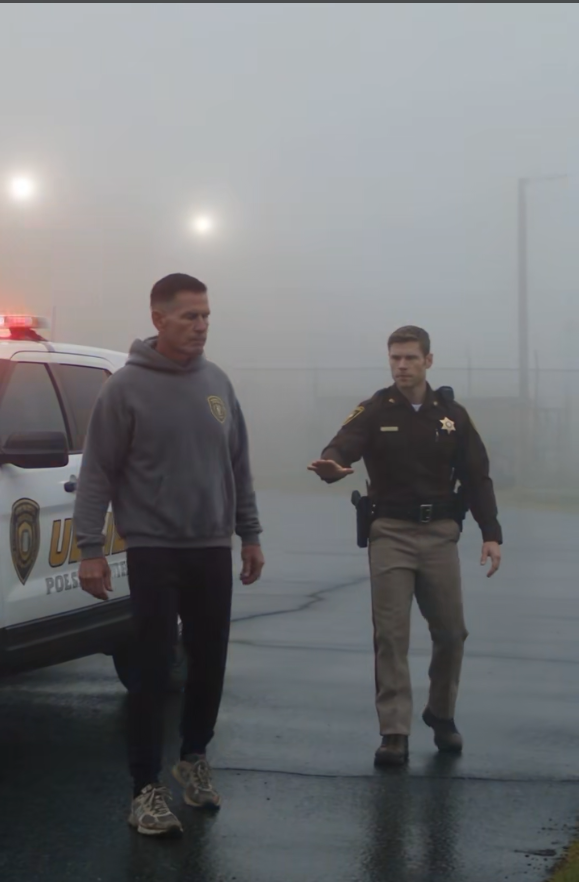
Part I — The Man at the Fence
The deputy pressed my face against the rain-slick hood of his cruiser and told me people like me would say anything if it meant staying out of jail.
I told him one time—and only one time—that a simple radio call would tell him exactly who he had just placed in handcuffs.
He laughed, pulled the cuffs tighter, and without realizing it made a choice that would follow him long after that fog-covered Saturday morning was over.
My name is Daniel Henderson. I was fifty-four years old, and I had spent more than thirty years in the United States Army.
I had deployed three times to the Middle East, led soldiers through combat, buried friends, signed letters to families whose lives had been permanently divided into before and after, and learned something about authority that younger men sometimes misunderstood.
Real authority rarely needs to announce itself.
By that Saturday, I had recently assumed command of Joint Base Lewis-McChord in Washington State. Tens of thousands of service members, civilian employees, buildings, training areas, vehicles, aircraft, families, weapons, and acres of federal property fell somewhere beneath my responsibility.
People imagined generals behind polished desks.
I had never trusted polished desks.
Reports told you what someone had chosen to record. Briefing slides showed you what someone had chosen to photograph. A map could show where a perimeter fence was supposed to run, but it could not tell you that blackberry vines had grown across a camera lens or that a hinge was six months away from failure.
So I walked.
Sometimes I drove.
And when I needed space to think, I ran.
That morning I left before sunrise wearing an old gray hoodie, black sweatpants, and worn running shoes. No uniform. No stars. No driver. No aide.
My military identification was locked inside my Jeep, parked within the installation near a secondary access point.
I was checking the northern annex, a communications and logistics area running along a county road. A security assessment had identified vulnerabilities on that edge of the base. Monday morning, I would sit across from people who would tell me what they thought should be fixed.
I wanted to know what I thought first.
Fog hung low between the Douglas firs. The chain-link fence shone with moisture. Cold had worked through the fabric of my sweatshirt by the time I reached Sector Four.
At a service gate, I found corrosion around the lower hinge.
I pulled a notebook from my pocket.
Gate 4-N.
Lower hinge.
Replace, not repair.
That was all I had written when headlights came through the fog behind me.
A sheriff's SUV took the curve fast and stopped hard on the gravel shoulder. Its light bar came alive, red and blue bleeding across wet pavement and pale tree trunks.
I closed the notebook.
The driver's door opened.
The deputy who stepped out looked young enough that, in another context, I might have mistaken him for one of my captains. He moved quickly, shoulders high, one hand held near his holster.
Later, I would know a great deal about Bradley Lawson.
That morning he was simply an armed stranger giving orders.
“Turn around.”
I did.
“Hands where I can see them.”
They already were.
“Good morning, Deputy.”
He came closer.
“What are you doing out here?”
“Running the perimeter.”
He stopped.
“The perimeter?”
“Yes.”
“This is a restricted military installation.”
“I know.”
His eyes traveled from my wet running shoes to my gray hoodie.
“You casing the place?”
“No.”
“Looking to steal copper?”
“No.”
He brought up a flashlight and shined it into my face.
I turned slightly away from the beam.
“My name is Daniel Henderson,” I said. “I'm authorized to be here.”
“Identification.”
“My ID is in my vehicle inside the installation.”
He gave a short laugh.
“How convenient.”
“You can contact the gate.”
“What'd you say?”
“Call the military police desk or Alpha Checkpoint. Give them my name.”
His expression changed in a way I recognized.
I had seen it in inexperienced officers. Occasionally in senior ones.
It happened when a person stopped gathering information because he had decided he already understood the situation.
“You think I'm an idiot?”
“I think confirming my identity will clear this up quickly.”
“Turn around. Hands on the fence.”
I stayed where I was.
Not to challenge him.
Because I knew precisely where I was standing.
Outside the federal fence line.
On the county shoulder.
“Deputy, I am not trespassing.”
“Hands on the fence.”
“Before you take this further, make the call.”
His jaw tightened.
“You don't give me commands.”
“I'm trying to keep you from making a mistake.”
He stepped closer.
“What mistake?”
I met his eyes.
“I am the commanding general of this installation.”
For about two seconds nothing moved except fog drifting across the road.
Then Lawson smiled.
“The commanding general.”
“That's correct.”
“In sweatpants.”
“It's Saturday.”
He gave a sharp laugh.
“And you expect me to believe that?”
“You don't need to believe me.”
I nodded toward the radio clipped to his vest.
“You need to verify it.”
His hand moved toward his Taser.
That was the moment the encounter changed.
Until then, there had still been room for this to become an awkward story two professionals might later shake hands over.
A deputy sees someone by a fence.
The man has no identification.
Questions are asked.
Identity is confirmed.
Everyone goes home irritated but unharmed.
What I saw in Lawson's face told me we had passed that exit.
This had become something else.
I had been in enough dangerous places to understand escalation.
The most difficult discipline in a confrontation is not knowing how to act.
It is knowing when not to.
I could have told him my rank again.
I could have raised my voice.
I could have reached for the knowledge that I commanded every military police officer on the other side of that fence.
Instead, I put my hands out slightly.
“I'm not resisting you.”
“Then turn around.”
I turned.
He caught my wrist, brought it behind my back, and pushed me toward the cruiser.
My chest struck the hood.
The metal was cold through my sweatshirt.
One cuff closed.
Then the other.
The ratchet bit too far.
“Those are unnecessarily tight,” I said.
“You can complain at the station.”
“Call Alpha Checkpoint.”
“I'm done listening to that.”
He patted me down.
When he found the small notebook, he opened it.
The page contained gate numbers, notes about sight lines, drainage, corrosion, and vegetation around sensors.
His posture changed.
Not toward doubt.
Toward confirmation.
“What is this?”
“A security inspection.”
“Looks like surveillance notes.”
“They are surveillance notes.”
He stared at me.
I added, “For the installation I command.”
He shook his head slowly.
“You really committed to this story.”
I looked at him over my shoulder.
“Deputy Lawson.”
His eyes narrowed.
I had read the name strip on his vest.
“You should radio your supervisor now.”
That irritated him more than anything else I had said.
He pushed me harder against the hood.
“You don't tell me how to do my job.”
“No,” I said. “But somebody apparently should.”
His face changed.