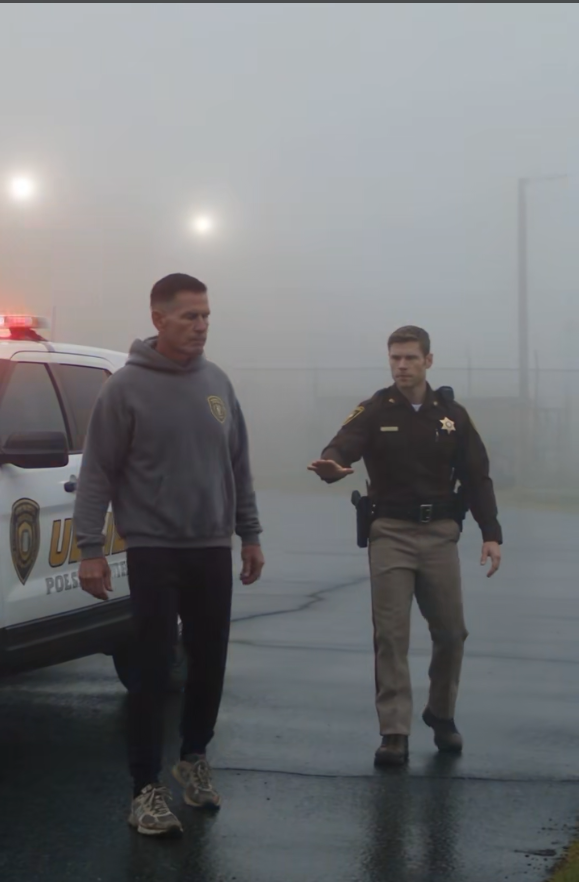
I regretted the sentence as soon as I said it—not because it was untrue, but because it was unnecessary.
I had spent a career teaching officers that humiliation rarely produces good decisions.
Lawson stepped back.
“Stand there.”
There wasn't much else I could do.
He walked several feet away and keyed his shoulder microphone.
“Dispatch, 2-17. One detained male at North Service Road adjacent military property. Possible trespass, suspicious surveillance notes. Stand by for identification.”
A voice answered through static.
He gave my name and date of birth after taking them from me verbally.
Then he waited.
The rain strengthened from mist to a steady fine drizzle.
A truck passed on the county road. Its driver slowed, looked at the flashing lights, then kept going.
Lawson glanced toward me with the quiet confidence of a man expecting the world to prove him correct.
His radio crackled.
“2-17, negative return under state identification with information provided. Can you confirm spelling?”
I almost smiled.
My Washington driver's license had not yet updated in the county system following my move.
Lawson looked delighted.
“Told you,” he said.
“I didn't tell you I had a Washington license.”
He keyed the mic again.
“Dispatch, subject claims he's commanding general of the military installation.”
There was a pause.
A different voice came through.
“Say again?”
Lawson looked at me.
“Claims he's the base commander.”
Another pause.
“Want us to contact installation law enforcement?”
I said quietly, “Yes.”
Lawson ignored me.
“Negative. I'll transport and sort it at county.”
That was the first decision that later mattered almost as much as the arrest itself.
He had been offered verification.
He declined it.
I looked toward the fence.
Somewhere behind the tree line, less than a mile away, soldiers were changing shifts. A military police patrol would be reviewing overnight logs. At Alpha Checkpoint, there would be a duty roster with my photograph.
A five-minute radio call.
That was all.
Lawson opened the rear door.
“Get in.”
I didn't move.
He placed a hand on my arm.
“Deputy, listen carefully. You have a lawful way to verify my identity immediately. Dispatch just offered it. If you transport me without doing that, you need to understand that the decision is yours.”
His mouth tightened.
“Get in the car.”
I got in.
The vinyl seat was cold.
He closed the door.
Through the rain-streaked window, I watched the fence disappear behind us.
I had no idea yet that Bradley Lawson was not the real problem.
He was only the first visible crack.
We made it less than two miles.
Lawson's radio came alive.
“2-17, hold your traffic.”
He answered.
“Go ahead.”
“Installation law enforcement contacted dispatch regarding your location. Military police unit is requesting you stop and stand by.”
Lawson's eyes found mine in the rearview mirror.
For the first time that morning, there was uncertainty in them.
He pulled onto the shoulder.
“What did you do?”
“Nothing.”
“You call somebody?”
“My hands are behind my back.”
He stared at me through the mirror.
“Who are you?”
I leaned against the seat.
“I already answered that.”
Two military police vehicles appeared less than three minutes later.
No sirens.
Just headlights and amber markers cutting through fog.
They parked behind the sheriff's SUV.
Lawson got out.
I could not hear the first exchange clearly.
Then the rear door on the opposite side opened.
A staff sergeant I recognized from the installation's Directorate of Emergency Services stood there.
Staff Sergeant Marcus Bell.
He looked at me.
Then at the cuffs.
The blood drained from his face.
“Sir.”
Lawson came around the vehicle.
“You know this guy?”
Bell didn't answer immediately.
He stepped back from the open door, came to attention, and rendered a salute.
His partner did the same.
“Good morning, General.”
The fog seemed to absorb the words.
Lawson looked from them to me.
Then back again.
I got out carefully.
My hands were still cuffed behind me.
Bell's salute remained raised.
“At ease, Sergeant.”
His arm dropped.
“Sir, are you injured?”
“My wrists hurt. Otherwise I'm fine.”
Bell turned toward Lawson.
“Deputy, remove the restraints.”
Lawson didn't move.
Bell's voice changed.
“Now.”
Lawson stepped behind me.
His hands were less certain this time.
The cuffs opened.
Blood returned to my fingers in hot needles.
I rubbed one wrist.
A narrow red band had already formed around it.
Lawson stared at my face.
“General, I—”
“Not here.”
He stopped.
I looked at Bell.
“My Jeep is at the secondary access lot.”
“Yes, sir.”
“Have someone secure it.”
“Already done.”
That answer told me more than he intended.
News had traveled.
I looked toward Lawson's patrol car.
“Sergeant, did county dispatch request your assistance?”
“Yes, sir. The desk sergeant recognized your name when they called.”
I nodded.
“Good.”
Lawson looked miserable now.
There is a kind of apology that comes from understanding you harmed someone.
And there is another that comes from discovering the person you harmed has power.
I wanted to know which one Bradley Lawson was capable of.
So I did not rescue him from the silence.
Finally he said, “Sir, I apologize. I didn't know.”
I looked at him.
“That is precisely the problem.”
Part II — Pressure
By eight-thirty that morning, three people had already suggested making the incident disappear.
None of them used those words.
Professionals rarely do.
They called it deconfliction.
Informal resolution.
Interagency coordination.
Avoiding unnecessary friction between partners.
Colonel Evelyn Mercer, my chief of staff, met me outside my office with coffee, a legal pad, and the expression of someone who had been awakened by a phone call she would rather have received while fully dressed.
She was forty-seven, precise in everything from her briefings to the way she arranged folders on a conference table.
Her eyes went directly to my wrists.
“You went to medical?”
“No.”
“Sir.”
“I'm fine.”
“You have visible abrasions.”
“I've had worse from luggage.”
“That is not the standard.”
I took the coffee.
“Who knows?”
“Everyone who matters and several people who don't.”
“That fast?”
“Two MPs watched the base commander step out of a county cruiser in handcuffs.”
“Fair.”
We went inside.
My office on a Saturday morning felt larger than it did during the week. No aides moving in and out. No ringing desk phone. Just rain ticking softly against the windows.
Mercer set down her pad.
“The sheriff called.”
“And?”
“He apologized personally. Said Deputy Lawson had responded to a citizen report of suspicious activity near the fence.”
“There was a citizen report?”
“So they say.”
“Who called?”
“They haven't provided that yet.”
I looked at her.
“That's interesting.”
“You think there wasn't one?”
“I think if there was one, Lawson never mentioned it.”
Mercer opened her pad.
“The county wants an informal meeting Monday.”
“No.”
She waited.
I sat.
“Not until we know what happened.”
“Sir, legal's going to say the same thing I'm about to say.”
“Then save them the trip.”
“An arrest of the installation commander by a county deputy is politically sensitive.”
“I'm aware.”
“They're worried about the partnership.”
“So am I.”
She studied me.
I knew what she saw: gray hoodie still damp at the shoulders, faint cuff marks, coffee untouched in my hand.