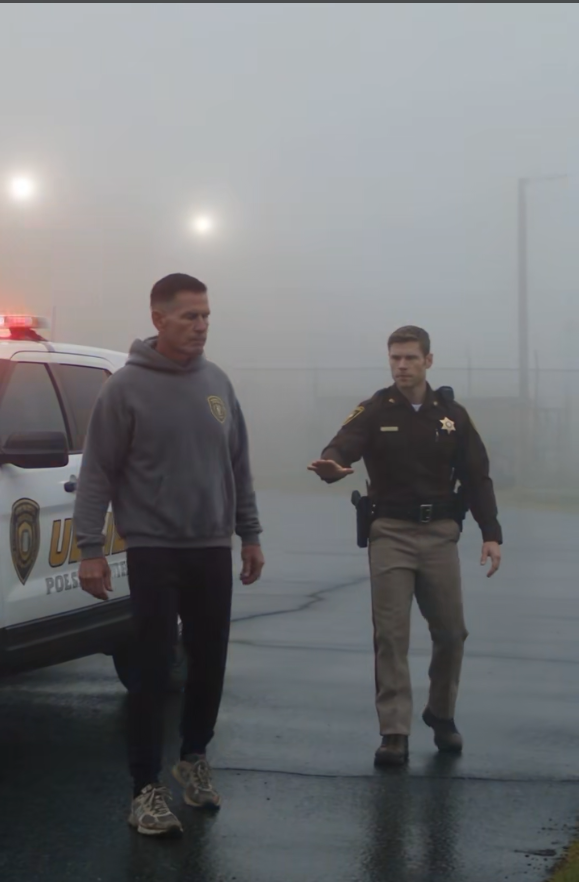
At 01:34, nothing had happened.
At 01:47, nothing.
At 01:58, maintenance began the first stage of the generator transfer.
Banks of monitors showed camera feeds, sensor maps, radio traffic, and road positions.
Lawson was not there.
He had been interviewed that afternoon.
What he told investigators changed the operation.
Voss, during his sheriff's auxiliary interview months earlier, had asked unusually detailed questions about how county dispatch and base law enforcement coordinated when an incident occurred near the boundary.
Lawson had interpreted it as enthusiasm.
Then Voss had asked one question that bothered him enough to note it.
If both agencies received emergencies at the same time, who controlled the road?
At 02:03, the first call came in.
A vehicle fire.
Two miles south of the annex.
County road.
Possible occupant trapped.
Sheriff's units moved.
Not all of them.
Warren had anticipated diversion and held coverage.
At 02:05, a base fire alarm activated in an empty warehouse on the opposite side of the annex.
Two incidents.
Two jurisdictions.
Two directions.
Mercer stood beside me.
“He's doing it.”
“Maybe.”
The fire camera showed smoke.
Real smoke.
Someone had ignited debris outside the warehouse loading area.
At 02:06, Sector Four's outer sensor reported movement.
My eyes went to the screen.
Fog and rain distorted the image.
A figure in dark waterproof clothing moved low along the drainage ditch.
“Contact,” someone said.
No one in the room shouted.
Professionals rarely shout when things become serious.
Voices get quieter.
The figure reached the service gate.
The corroded hinge I had noted one week earlier had been replaced.
He tested it anyway.
Then moved twenty yards north.
Straight toward a section of fence concealed by cedar growth.
A blind spot.
Or what had been one.
A thermal camera installed Thursday tracked him clearly.
He cut the chain-link low.
“Hold,” the operations commander said.
No one moved.
The figure crawled through.
He crossed ten yards of federal property.
Then stopped.
He seemed to sense something.
His head turned.
I leaned toward the monitor.
He backed up.
“Take him.”
Military police moved.
The figure ran.
Fast.
He reached the cut fence just as lights came on from two directions.
“Military police! Stop!”
He dove through the opening.
Onto county jurisdiction.
And kept running.
For one strange second, the entire operation reached the precise problem Voss had been exploiting for months.
The seam.
Military officers stopped at the boundary.
County deputies moved from the road.
Voss cut through the trees between them.
Then a third voice came over the radio.
“Subject moving north toward drainage culvert.”
It was Lawson.
I looked at Mercer.
“What is he doing there?”
Her face was stone.
“I don't know.”
On the county tactical channel, Warren said, “Lawson, hold position.”
No response.
Then:
“I know where he's going.”
Warren's voice sharpened.
“Brad, you are not operational. Hold your position.”
The thermal feed lost Voss under heavy tree cover.
Another camera picked up a man crossing a gravel maintenance road.
Then lost him.
The drainage culvert.
I knew it.
It ran under the county road and emerged near an old utility corridor outside the main security fence.
A person who knew the infrastructure could use it to avoid both patrol lines.
“Move county units to the west culvert exit,” I said.
The operations commander relayed it.
Thirty seconds.
Nothing.
Then a deputy's voice.
“Movement!”
A flash on camera.
A figure burst from the culvert.
County units converged.
The figure turned back.
And froze.
Lawson stood twenty yards behind him.
No uniform.
No weapon visible.
Just rain jacket and jeans.
Voss faced him.
Even through grainy night video, I could see something pass between them.
Recognition.
Voss said something.
Lawson answered.
The nearest microphone did not capture it.
Then Voss pulled an object from beneath his jacket.
Every armed officer raised a weapon.
“Hands!”
“Drop it!”
“Don't move!”
Voss held up something rectangular.
My notebook.
Even at that distance I recognized the black cover.
He laughed.
It was the first uncontrolled sound of the night.
Then he shouted, “You all looked exactly where I told you!”
His other hand disappeared into his jacket.
Lawson moved sideways.
Not toward him.
Away from the officers' line of fire.
“Eric,” he said.
The microphone caught that.
“Don't.”
Voss looked at him.
“You were perfect.”
Lawson stood still.
“You used me.”
“I gave you what you wanted.”
“No.”
“You wanted them to be guilty before you got there. I just gave you a reason.”
The words reached the operations center clearly.
Nobody moved.
Lawson's face on the camera was pale under the road lights.
Voss continued.
“You never checked. That was the beautiful part.”
Lawson looked toward the officers surrounding them.
Then back to Voss.
For the first time, his voice carried none of the certainty I remembered from the roadside.
“I should have.”
Voss smiled.
“Yes.”
“I'm checking now.”
He took one slow step backward.
“What's in your jacket, Eric?”
Voss's smile faded.
“Brad,” Warren warned over the radio.
Lawson stopped.
Voss's hand remained hidden.
The tactical commander was waiting for a clear threat.
I understood why.
One wrong movement could end with a dead man and unanswered questions.
Lawson understood it too.
“Eric,” he said. “You don't want to die for a notebook.”
Voss glanced down at it.
“That what you think this is about?”
“No.”
“What then?”
Lawson swallowed.
“You wanted access.”
Voss's face changed slightly.
“You wanted to prove you could get through.”
Nothing.
“You've been testing response times. Cameras. County coordination. Military patrols.”
Voss tilted his head.
Lawson took another careful step back, increasing distance.
“You weren't stealing.”
“No.”
“You were measuring.”
The word landed.
Voss's eyes shifted toward the tree line.
An escape calculation.
Lawson saw it.
“So what's tonight?”
No answer.
“A demonstration?”
Voss laughed softly.
“You still think too small.”
In the operations center, a technician said, “Sir.”
One of the network monitors had changed.
An unauthorized signal was attempting to handshake with a maintenance receiver near the annex.
Not penetrate the protected network.
Transmit.
“Device,” Mercer said.
Voss had placed something.
“Find it.”
Security teams began searching.
Outside, Lawson kept him talking.
“You needed to get close enough to plant something.”
Voss's attention snapped toward him.
That confirmed it.
The tactical commander keyed the field channel.
“All elements, subject likely deployed device. Maintain containment.”
Voss heard the radios.
He looked around.
His hand came out of his jacket.
Empty.
Every officer held.
“Hands up!”
He raised one hand.
The notebook remained in the other.
Then he dropped it.
The black cover landed in a puddle.
He slowly lifted both arms.
Officers moved.
It should have ended there.
It didn't.
A network technician turned from his screen.
“Transmission source active.”
“Location?”
“Inside Sector Four.”
“Can you isolate?”
“Trying.”
Another technician said, “It's beaconing outward.”
“To where?”
“Unknown endpoint.”
My mind went back to the maintenance diagram.
Backup generator tie-in.
Recent modification.
Visible partially from outside.
Unless you wanted access to the conduit.
Then you needed the service junction.
“Gate 4-N,” I said.
Mercer looked at me.
“What?”
“The hinge.”
I was already moving toward the map.
“He didn't care about the hinge. I did.”
I pointed.
“When I stopped there Saturday, I wrote it down because the lower assembly was corroded. But the conduit for the newer generator tie-in runs beneath that gate.”