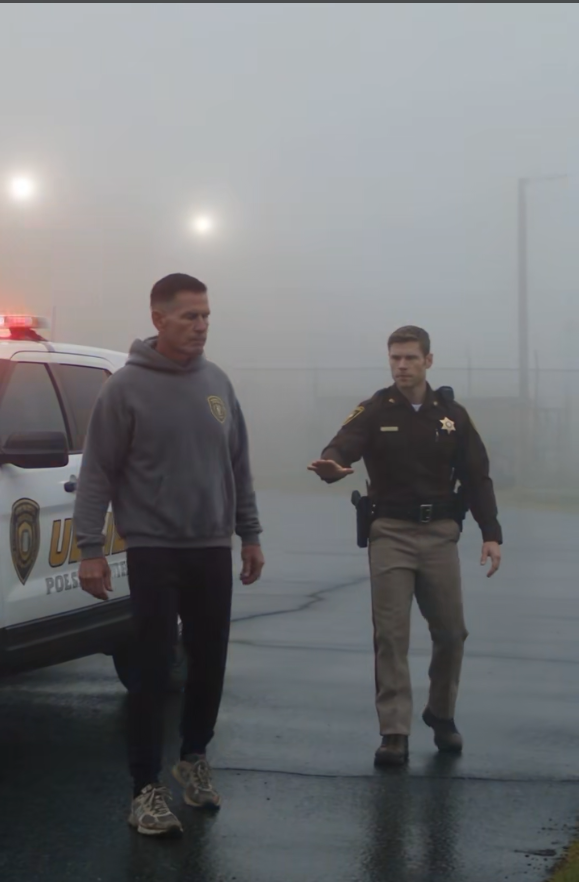
The northern boundary sat exactly where civilian and military authority overlapped.
Someone had discovered that the seam between two systems could be more vulnerable than either system alone.
And Bradley Lawson had become useful because he liked simple explanations.
By Friday, investigators identified the cloned maintenance credential's source.
The legitimate contractor had used his badge six weeks earlier at a temporary service trailer where subcontractors signed in for infrastructure work.
The badge had been briefly out of his possession.
The sign-in sheets narrowed access to seven people.
Six checked out quickly.
The seventh was a former communications subcontractor named Eric Voss.
He had worked on base infrastructure for eleven months before his contract ended after repeated security violations.
Not espionage.
Not theft.
Nothing dramatic.
He had bypassed sign-out procedures, accessed areas outside his work order, and copied internal maintenance diagrams onto an unauthorized personal device.
His contract was terminated.
The event never rose above administrative handling.
That was our failure.
Not because every rule violation predicts something worse.
Because no one connected what happened afterward.
Voss later took short-term jobs maintaining commercial fiber systems in the county.
He knew the roads.
He knew which utility corridors ran near the base.
He knew enough about security systems to understand where a broken camera could look like routine equipment failure.
And he had applied to the sheriff's auxiliary communications unit six months earlier.
His application was rejected.
One of the reviewing deputies had been Bradley Lawson.
Mercer put the report on my desk.
“There.”
I read the interview notes.
Lawson had written that Voss displayed “unusual fixation on patrol response times and radio procedure.”
I looked up.
“He noticed.”
“Yes.”
“And then forgot.”
“Apparently.”
“No.”
I read it again.
“He didn't forget. He separated the information.”
Mercer frowned.
“He saw Voss as an applicant in one context and anonymous calls in another.”
“Exactly.”
That is one of the most dangerous habits inside large organizations.
We divide reality into offices.
Security has one folder.
Police another.
Personnel a third.
Legal a fourth.
Every piece is documented.
Nobody owns the whole picture.
I closed the file.
“Where is Voss?”
“Investigators are looking.”
“Residence?”
“Empty.”
“Vehicle?”
“Not at the property.”
“Family?”
“One sister in Nevada. Says they haven't spoken in a year.”
“Financial?”
“Nothing obvious.”
Mercer sat.
“There's something else.”
I waited.
“They recovered partial security diagrams from a storage unit leased under his name.”
“What areas?”
“North annex. Communications routes. Emergency power feeds.”
“Current?”
“Mostly.”
My chair felt suddenly rigid beneath me.
“Mostly?”
“One diagram includes a maintenance change made three months ago.”
That meant recent access.
“Inside source?”
“Or physical observation.”
“What was the change?”
“A backup generator tie-in.”
“Visible externally?”
“Partially.”
I stood and went to the window.
Below us, soldiers crossed the wet parking lot between buildings.
Routine.
That was always what a secure installation looked like from inside when things were functioning properly.
Routine.
A thousand ordinary movements made possible by people assuming systems would hold.
“What's at the north annex this weekend?” I asked.
Mercer's face changed.
“You're thinking ahead.”
“What's scheduled?”
She checked her phone.
“Signal maintenance. Backup power test Sunday at 0200.”
I turned.
“Who has the schedule?”
“Maintenance, DES, signal operations, contractors.”
“How long has it been set?”
“Two weeks.”
During a backup power test, portions of the communications network would briefly transition between systems.
Normal.
Controlled.
And, in the wrong hands, useful.
“Cancel it.”
Mercer reached for her phone.
I stopped her.
“No.”
She looked up.
“If Voss is watching, cancellation tells him we're onto the timing.”
“What are you proposing?”
I stared at the rain beyond the glass.
“Run the test.”
Her expression hardened.
“As bait.”
“As controlled conditions.”
“You're the one always complaining when people use those phrases to make dangerous ideas sound reasonable.”
“That's why we're going to make it reasonable.”
“Sir—”
“We already know where he's been probing. If we change the schedule, he disappears. If we continue while quietly hardening the site, we may find out what he intends.”
Mercer stood.
“You have a personal connection to this now.”
“Yes.”
“That makes this exactly the kind of decision you should question.”
“I am questioning it.”
“Good. Question harder.”
I looked at her.
She was right to say it.
That was why she had the job.
Finally I nodded.
“Bring Kim and the security commander in. We don't move unless investigators approve the plan.”
Mercer exhaled once.
“Thank you.”
“Don't sound surprised.”
“I wasn't.”
“You were.”
“A little.”
Lawson was suspended Friday afternoon.
Not because he arrested me.
Because internal affairs confirmed a broader pattern of procedural violations.
Unreported detentions.
Incomplete probable-cause documentation.
Selective activation of body camera.
Failure to preserve evidence.
The missing notebook remained unexplained.
Ortega's complaint became formal after investigators re-interviewed him.
Two other soldiers did the same.
Sheriff Warren called me that evening.
“Brad's done on patrol,” he said.
“Permanent?”
“That's up to process.”
“Good.”
“You don't sound satisfied.”
“I wasn't looking for satisfaction.”
“What were you looking for?”
“Accountability.”
“Same thing sometimes.”
“No.”
I looked at the photograph on my desk.
It showed me at twenty-nine, a captain standing with twelve exhausted soldiers after a field exercise years before. Two of those men were dead now.
“Punishment looks backward,” I said. “Accountability has to look forward too.”
Warren was quiet.
“You think I failed.”
“I think both our organizations failed.”
“That diplomatic?”
“No.”
He gave a tired laugh.
“At least you're consistent.”
I told him about the Sunday maintenance operation.
He listened.
Then said, “You want county support.”
“Yes.”
“After all this.”
“Especially after all this.”
Another pause.
“What about Lawson?”
“What about him?”
“He knows Voss. He reviewed him.”
“He's suspended.”
“He might recognize behavior nobody else would.”
I understood what Warren was suggesting.
“No.”
“General—”
“He is a subject in one investigation.”
“Not the federal one.”
“He withheld evidence.”
“And then gave it up.”
“After three days.”
Warren didn't push.
“Fair enough.”
But the question stayed with me after we ended the call.
Not whether Lawson deserved redemption.
That was not mine to grant.
The question was whether refusing information because I distrusted the person carrying it was any wiser than what Lawson had done to me.
I had told myself this entire case was about resisting assumptions.
Now I had one of my own.
At 2200 I called Warren back.
“Have Lawson interviewed by the security task force.”
“As a consultant?”
“As a witness.”
“Difference?”
“A large one.”
“You want him near the operation?”
“No.”
I paused.
“Unless he gives them a reason he should be.”
Part V — The Seam
Saturday night came with harder rain.
The northern annex looked almost abandoned after midnight.
That was intentional.
Normal exterior lighting remained on. Maintenance vehicles were positioned where they would ordinarily be. The scheduled power test proceeded under a reduced crew.
Behind the visible routine, the area had changed completely.
Military police teams occupied concealed positions.
Federal investigators monitored approach roads.
County deputies covered the civilian side of the perimeter.
Network security teams isolated critical systems so that even a successful physical intrusion could not reach operational communications.
I was at the installation emergency operations center three miles away.
Not because I wanted to be.
Because everyone from Mercer to federal investigators had correctly pointed out that the commanding general wandering around as bait twice in one week would constitute evidence of poor judgment.