Adrian sat nearby.
The first paragraph was apology.
The second was explanation.
Celeste wrote that she had felt overwhelmed.
That she had resented Adrian’s attachment to his first family.
That she had convinced herself money from Jonah’s trust was “family money” because she was providing care.
Then she wrote:
I started seeing every disagreement with you as proof that you needed more help than I could give. I know now that I often caused the reaction I later used as evidence against you.
Jonah stopped reading.
“That part is true.”
“Yes,” Dr. Morris said.
He continued.
Celeste apologized for food.
For calling him expensive.
For making him practice answers.
For letting him believe Hawthorne Ridge had already been decided.
Then came a sentence Adrian hated.
I hope someday you can understand that I was under tremendous pressure.
Jonah frowned.
“She’s doing it.”
“Doing what?” Dr. Morris asked.
“Making me understand her.”
Dr. Morris nodded.
“What do you want to do?”
Jonah folded the letter.
“I don’t want to finish.”
“You don’t have to.”
Adrian said nothing.
Jonah looked at him.
“Are you mad?”
“At you? No.”
“At her?”
“Yes.”
“Because I stopped?”
“No.”
Jonah put the letter into the envelope.
“I don’t forgive her.”
Dr. Morris asked, “How does saying that feel?”
“Mean.”
“Is it mean?”
Jonah thought.
“I don’t know.”
Adrian finally spoke.
“You can forgive someone later. Or not. You don’t owe forgiveness because they apologized.”
Jonah nodded.
“What if she gets sad?”
“That belongs to her.”
Dr. Morris glanced at Adrian.
A small smile.
He had learned something.
On the drive home, Jonah asked whether Adrian forgave Celeste.
“No.”
“Will you?”
“I don’t know.”
“Are you mad forever?”
“I hope not.”
Jonah looked out the window.
“Mom said holding hot things burns you.”
Adrian smiled.
“Your mom said a lot of smart things.”
“She meant anger.”
“I know.”
Jonah was quiet.
“Maybe we put it down but don’t give it back.”
Adrian looked at him.
“What?”
“The hot thing.”
Jonah struggled to explain.
“Like... I don’t stay mad every day. But I don’t give Celeste the thing again.”
“Trust?”
“Yes.”
Adrian nodded slowly.
“That makes sense.”
It made more sense than many adult discussions about forgiveness.
Healing did not require restoring access.
The family returned to routine.
Jonah’s weight returned to a healthy range under his pediatrician’s supervision.
Food anxiety faded gradually.
He still occasionally asked whether he could save leftovers.
Adrian always said yes.
Poppy began preschool full time.
Milo’s visits became less frequent as his life settled with his grandmother, but the children remained in contact.
Adrian returned to work with reduced travel.
He did not quit.
He did not become a father who stayed home every minute from guilt.
He changed boundaries.
No calls during dinner.
Two work-from-home afternoons.
Shared school contacts.
No single adult gatekeeping information.
Ordinary reforms.
Powerful because they were ordinary.
One Saturday, Claire helped Adrian clean the garage.
She found Evelyn’s old serving dishes.
“Keep?”
Adrian hesitated.
One large white platter had been used at the old dining table.
He remembered holidays.
Birthdays.
The year Jonah learned to say grace without rushing.
The year Poppy smashed cake into her own hair.
“Keep.”
Claire placed it in a box.
“What about this?”
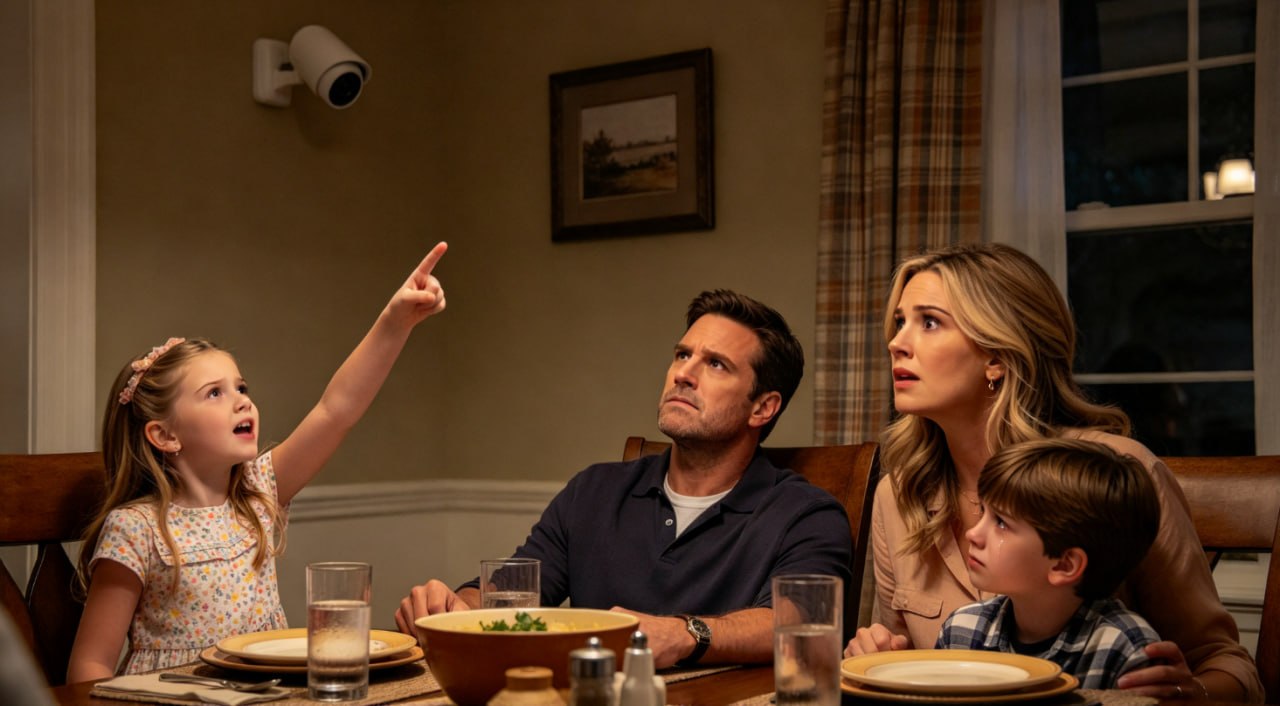
The camera.
Adrian looked at it.
“Jonah wants it.”
“Of course he does.”
“Why ‘of course’?”
Claire smiled.
“Because to you it represents failure.”
“And to him?”
“It represents the moment people finally started paying attention.”
Adrian stood quietly.
That difference mattered.
The next day Jonah asked if he could put the camera in his room.
Adrian hesitated.
“Not plugged in.”
“I know.”
“Why?”
Jonah placed it on a bookshelf.
“It reminds me Poppy is loud.”
From the hallway Poppy screamed, “I AM!”
Jonah laughed.
Adrian shook his head.
The camera stayed.
Not watching.
Not recording.
Just existing.
A powerless object in a house where people had learned to listen.