A $1,250 fine required multiple formal steps.
Written notice.
Opportunity for a hearing.
Board determination.
Notice of decision.
Daniel had received warnings.
He had requested a hearing.
No hearing had occurred.
Yet the fine appeared anyway.
He searched the board minutes.
January.
February.
March.
April.
His name never appeared.
His address never appeared.
No vote regarding his shed.
No motion concerning retroactive invalidation of prior architectural approvals.
No discussion of hiring a security contractor.
Daniel checked the file dates.
The minutes were posted as PDFs.
One month was missing.
He emailed the board again.
Please provide the missing May meeting minutes and identify the meeting at which the board authorized the compliance action at my property.
At 3:46, Patricia answered personally.
Daniel, your repeated demands are becoming disruptive. The board has acted within its authority. Yesterday’s contractor acted independently and outside the scope of the association’s instructions. We will cooperate with any appropriate inquiry. Your financial obligation remains unchanged.
Daniel read the second-to-last sentence three times.
Yesterday’s contractor acted independently and outside the scope of the association’s instructions.
That was Patricia’s story now.
The man had gone too far.
She had merely hired him.
Whatever he did on Daniel’s driveway was his decision.
It was neat.
Plausible.
And if Emily had not recorded Patricia calling him “Officer” and telling him not to debate, it might even have worked.
Daniel typed a response.
Then deleted it.
Instead, he saved Patricia’s email.
At 4:20, his phone rang.
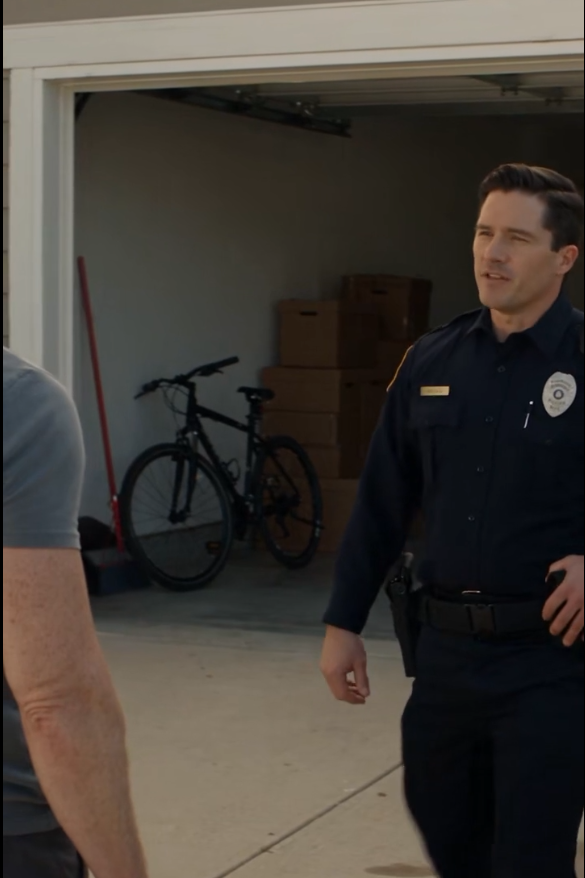
It was the police department.
The officer from the previous day asked whether Daniel and Emily could provide formal statements.
“Yes.”
“Also, Mr. Mercer, did the HOA representative ever tell you beforehand that a private security contractor would be coming to your house?”
“No.”
“Did you consent to a security contractor entering your property?”
“No.”
“Did you owe the security company money?”
“No.”
“Did you have any relationship with them?”
“No.”
The officer paused.
“One more question. Did Mrs. Langford ever tell you the contractor had power to detain residents?”
“Not before yesterday.”
“Okay.”
“What did he tell you?”
“I can’t get into someone else’s statement.”
Daniel understood.
“But you’re still investigating.”
“Yes.”
The officer hesitated.
“Keep the video. Keep the emails. Don’t alter anything.”
Daniel looked at the preservation request on his screen.
“I’m doing that.”
That evening, he and Emily ate dinner at the kitchen island.
She kept checking him.
Finally Daniel put down his fork.
“What?”
“You’re thinking.”
“I do that sometimes.”
“About the HOA.”
“Yes.”
“Are we in trouble?”
The question caught him.
Not are they in trouble?
Are we?
Daniel had been treating the problem as records, rules, emails, and procedures.
Emily had seen a man reach for handcuffs while standing ten feet from her father.
He turned fully toward her.
“No.”
She studied him.
He corrected himself.
“We have a problem. That’s different.”
“Could they take the house?”
Daniel went still.
“Why would you think that?”
“I looked up HOA liens.”
Of course she had.
Daniel rubbed his forehead.
“Okay. First, don’t use random internet searches to build worst-case scenarios.”
“That is literally what the internet is for.”
Despite himself, he smiled.
Then he became serious.
“They can create legal problems if fines aren’t handled correctly. But that does not mean someone gets to take our home because Patricia says so. There are procedures, and we’re going to follow them.”
Emily pushed food around her plate.
“Why doesn’t she just admit the shed was approved?”
That was the same question.
Daniel looked toward the dark kitchen window.
“I don’t know yet.”
Part III — The Version That Didn’t Happen
The HOA scheduled Daniel’s hearing eight days later.
Not because Patricia volunteered one.
Because Daniel copied the entire board on his fourth written request and attached the association rule requiring an opportunity to contest a fine.
The hearing took place in the Willow Creek clubhouse.
Patricia sat at the center of a folding conference table beneath a framed photograph of the neighborhood entrance. Two other board members sat beside her—the treasurer and secretary, both looking as though they would rather be anywhere else.
Daniel sat opposite them.
Rachel attended as a homeowner witness.
Emily stayed home.
Daniel had not asked her to.
She had asked him whether he needed the video.
He told her he already had copies.
Then she said, “Good,” with visible relief.
Patricia opened the hearing with formal language about community standards.
Daniel let her finish.
The treasurer glanced repeatedly at a folder in front of him.
Patricia said, “The purpose of this hearing is to give Mr. Mercer an opportunity to present information concerning his continuing architectural violation.”
Daniel slid three documents across the table.
“My position is simple. There is no architectural violation.”
Patricia did not touch the papers.
“That issue has been reviewed.”
“Then this should be easy.”
Daniel pointed to the first page.
“My shed application.”
Second page.
“The written approval.”
Third.
“The original HOA email transmitting the approval.”
The secretary picked them up.
Patricia said, “As you have already been informed, the prior committee did not have authority to issue that approval in the form presented.”
Daniel looked at her.
“What authority did it lack?”
“The committee failed to complete the proper review.”
“According to what record?”
Patricia’s expression sharpened.
“We’re not going to relitigate internal procedural defects from two years ago.”
Daniel nodded.
“Then show me the decision invalidating the approval.”
“The board reviewed it.”
“When?”
Patricia did not answer immediately.
Daniel opened his folder.
“I’ve read every board minute currently available through the portal. My property is never discussed. There’s no motion to invalidate the approval and no vote imposing the fine.”
The treasurer looked toward Patricia.
She kept her eyes on Daniel.
“Not every administrative matter appears in open minutes.”
“A $1,250 fine against a homeowner does.”
No one spoke.
Daniel continued.
“I requested a hearing months ago. It never happened. Yet the fine was imposed anyway.”
Patricia placed both hands flat on the table.
“You have repeatedly refused reasonable attempts to resolve the violation.”
“I repeatedly asked you to show me the rule I violated.”
“You built a noncompliant structure.”
“I built an approved structure.”
“The approval is defective.”
“Show me the defect.”
Her voice became colder.
“Mr. Mercer, this pattern is precisely why the board has had difficulty working with you.”
Daniel leaned back.
There it was.
Not an answer.
A characterization.
He glanced at the other board members.
“Did either of you vote to invalidate my shed approval?”
The secretary looked at Patricia.
The treasurer cleared his throat.
Patricia said, “Questions should be addressed through the chair.”
Daniel did not look away from the treasurer.
“Did you?”
The treasurer shifted in his seat.
“I don’t specifically recall a vote.”
Patricia turned to him.
“We discussed this in executive review.”
He frowned.
“When?”
Her eyes held his.
He looked down at the folder.
“I’d have to check.”
Daniel opened another document.
“Then let’s check the minutes.”
Patricia’s voice tightened.
“Executive matters are confidential.”
“Fine. Give me the date.”
Nothing.
Rachel leaned slightly forward.