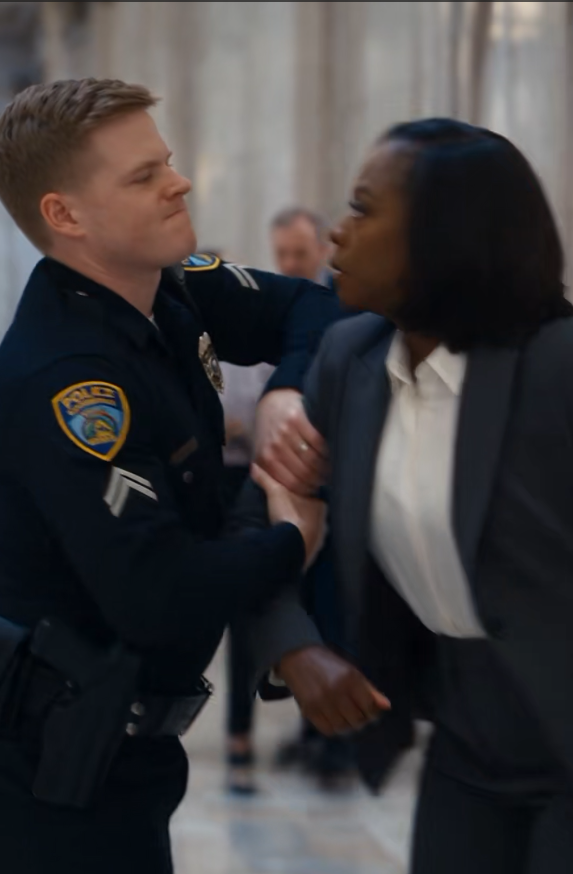
“Did I strike him?”
“No.”
“Push him?”
“No.”
“Threaten him?”
“No.”
Andrea sat across from me.
“What did he think was happening?”
“He thought I was a defendant.”
Thomas frowned.
“Which defendant?”
“Maya Reynolds.”
He stared.
Andrea looked toward the stack of morning files on the side table.
“Maya Reynolds is five-foot-nine.”
“I know.”
“You’re five-five.”
“I know.”
“She has braids.”
“I know.”
Andrea’s jaw tightened.
I lowered the ice pack.
“Miller didn’t know.”
Neither of them said anything.
That silence did more than outrage would have.
Because all three of us understood what it meant.
He had not made a careful mistake.
He had made a quick one.
And he had been willing to use force to defend it.
A knock sounded.
Andrea opened the door halfway.
Chief Judge Raymond Ellis stood outside.
He was seventy-one, silver-haired, cautious in the way men become cautious after decades in institutions that reward continuity.
He took one look at me.
His face hardened.
“What happened?”
I told him.
Not dramatically.
Not emotionally.
I gave him the facts in sequence.
Elevator.
Fourth floor.
Officer.
Misidentification.
Detention.
Physical contact.
Strike.
Thomas’s arrival.
Ellis listened without interrupting.
When I finished, he turned to Thomas.
“You witnessed this?”
“Yes, sir.”
“Enough of it.”
“Yes.”
Ellis nodded once.
Then he looked at me.
“You need medical attention.”
“I need to open court.”
“No.”
“I have a morning calendar.”
“Another judge can take it.”
I knew what he meant.
He meant I had been injured.
He meant the circumstances were extraordinary.
But another thought came almost immediately.
If I disappeared from the bench, the story would be told without me.
Officer attacked judge.
Judge goes home.
Investigation begins.
Courthouse whispers.
Statements.
Rumors.
A version of me would become public property before I had decided what I thought.
“No,” I said. “I’m taking my calendar.”
Ellis stared.
“Josephine.”
“If I become disoriented, if I have vision changes, if I feel worse, I’ll stop. But I am not leaving this building because he decided I didn’t belong in it.”
Andrea’s eyes flicked toward me.
Ellis exhaled.
“This is not about pride.”
“No. It isn’t.”
He studied me for another second.
Then he nodded.
“All right. But you’re getting examined by medical after court.”
“Agreed.”
“And you will not speak to Miller.”
“I already told him that.”
“Good.”
Ellis opened the door.
Then he paused.
“One more thing.”
“Yes?”
“Internal Affairs is on the way.”
I looked at him.
He continued.
“So is the county attorney.”
The hallway outside was quiet.
The building had already begun doing what institutions do after a rupture.
Closing doors.
Making calls.
Protecting itself.
I put the ice pack down.
Andrea looked at the clock.
“You’re twelve minutes late.”
I stood.
“Then let’s not make it thirteen.”
She stared at me.
“You’re really going out there?”
“Yes.”
Thomas moved toward the robing room.
He stopped beside me.
“Judge.”
I looked at him.
His voice dropped.
“You don’t have to prove anything.”
“I know.”
“Then why?”
I glanced toward the door leading to the courtroom.
Because twenty minutes earlier, Bradley Miller had looked at me and believed I was powerless.
Because one title had changed everything.
Because I had spent fifteen years listening to clients tell me versions of that same story.
Because I had privately wondered, more than once, whether some of them had omitted a detail.
Because now I knew how fast a detail could be invented for you.
I picked up my robe.
“I have work to do.”
Part II — Pressure
The robe covered the charcoal suit.
It did not cover the swelling on my face.
When I entered Courtroom 6A, the room rose.
“All rise.”
Thomas’s voice was steady again.
Dozens of people stood.
Attorneys.
Defendants.
Victims.
Family members.
Probation officers.
Police.
For the first time in my career, I wondered how many of them had already heard.
I sat.
“Please be seated.”
Chairs scraped across the floor.
Andrea passed me the first file.
I opened it.
“State versus Collins.”
A prosecutor rose.
The defense attorney rose beside him.
I listened.
I ruled.
Then I called the next case.
And the next.
For nearly two hours, I did what judges do every morning: sorted facts from argument, impatience from urgency, law from assumption.
But the morning had changed me in a way I could already feel.
A young man stood before me on a probation violation.
The prosecutor said he had failed to report.
His lawyer said the probation office had moved buildings and the notice went to an old address.
Normally, I might have treated the explanation as routine.
That morning, I asked for the notice.
The clerk handed it up.
The address was wrong.
A small error.
Almost nothing.
Except small errors become facts when no one checks them.
Later, a woman was accused of violating a no-contact order because her phone number appeared in an outgoing call log.
Her attorney said she had let her sister use the phone.
The prosecutor looked skeptical.
I asked whether the call had been recorded.
It had.
We listened.
The sister’s voice was unmistakable.
Another assumption.
Another near certainty.
By noon, my cheek was visibly darker.
My headache had worsened.
Andrea called recess.
“You’re done.”
“I’m taking the afternoon.”
“No.”
“Yes.”
“You’re stubborn.”
“I’ve been called worse today.”
She did not smile.
“Internal Affairs is waiting.”
I looked toward the side door.
“Now?”
“Now.”
I went back to chambers.
Three people were seated at the conference table.
Captain Elena Ruiz from Internal Affairs.
Deputy County Attorney Martin Shaw.
And Police Chief Daniel Reeves.
Reeves stood first.
He was a large man in his late fifties with a careful voice and a reputation for political survival.
“Judge Caldwell.”
I did not offer my hand.
He sat again.
Ruiz opened a notebook.
“Your Honor, before we begin, I want to be clear. This is an administrative fact-finding interview. Officer Miller has been removed from courthouse assignment pending review.”
“Removed from assignment or suspended?”
Reeves answered.
“Administrative leave.”
“With pay?”
A pause.
“Yes.”
I nodded.
Of course.
Shaw leaned forward.
“We’re also preserving surveillance footage.”
“Good.”
“Unfortunately, the camera covering the western fourth-floor corridor appears to have been offline.”
I looked at him.
“Appears?”
“We’re confirming.”
Thomas had warned me about the cameras two months earlier.
A maintenance contract had changed. Some units had gone down intermittently.
At the time, I had signed a facilities complaint about it and forgotten.
Now the missing video sat in the room like a second injury.
Ruiz asked me to describe what happened.
I did.
Again.
This time, I was more precise.
Exact words where I remembered them.
Physical positions.
Sequence.
When I reached the sentence Miller had used—“You people always think you can argue your way out of everything”—Ruiz stopped writing.
“Those exact words?”
“Yes.”
Reeves shifted in his chair.
Shaw looked at him.
Ruiz asked, “And your response?”
“I said, ‘You people?’”
“What happened immediately after?”
“He reached toward me. I knocked his wrist away. Then he struck me.”
Ruiz nodded.
“Open hand?”
“Yes.”
“Left or right?”