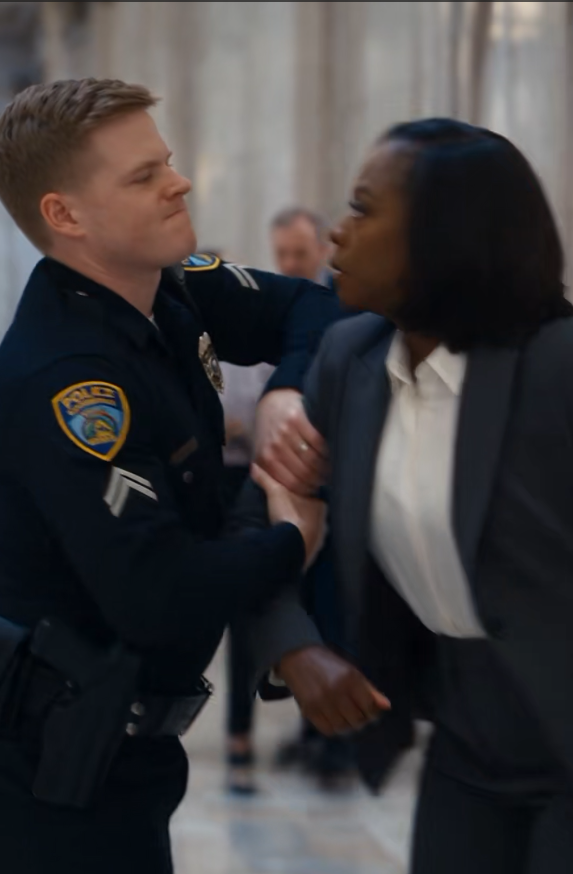
“Right.”
“Where did it land?”
“Left cheek.”
“Did you fall?”
“No.”
“Did you touch him after that?”
“No.”
“Did he say why he believed you were Maya Reynolds?”
“No.”
“Did you resemble Ms. Reynolds?”
“No.”
Ruiz finally looked up.
“Do you know her?”
“I’ve seen her file. She was scheduled in 4B.”
Shaw spoke.
“Judge, you understand this may become public very quickly.”
“It already is.”
He glanced at Reeves.
Reeves cleared his throat.
“We want to handle this appropriately.”
I looked at him.
“What does that mean?”
“It means we need facts.”
“You have a witness.”
“We do.”
“You have my injuries.”
“We do.”
“You have a radio record showing why he was there.”
Ruiz looked at me.
That caught my attention.
“You have his radio?”
“Yes.”
“What did dispatch say?”
She did not answer immediately.
Reeves looked uncomfortable.
“Captain?”
Ruiz flipped a page.
“The call was regarding a female defendant named Maya Reynolds who had not yet appeared in 4B after being transported from pretrial services.”
“What description?”
Ruiz looked at Reeves.
Then back at me.
“Black female. Late twenties. Approximately five-nine. Long braids. Tan coat.”
The room went very still.
I was forty-three.
Five-five.
Shorter hair.
Charcoal suit.
No coat.
I set both hands flat on the table.
“And Miller knew that description?”
Ruiz’s silence answered before she did.
“The dispatch was transmitted over the courthouse channel,” she said. “Officer Miller acknowledged it.”
Reeves jumped in.
“We don’t yet know what portion he heard clearly.”
“Get the recording.”
“We are.”
“No. You already have it.”
Reeves leaned back.
Shaw stared at the table.
Ruiz met my eyes.
“We do.”
“Play it.”
Reeves said, “Judge, I don’t think—”
“Play it.”
Ruiz hesitated.
Then she took out her phone.
She tapped the screen.
Static filled the room.
A dispatcher’s voice followed.
“Unit four-two, be advised, Maya Reynolds, Black female, twenty-seven, five-nine, long braids, tan coat, possible failure to appear from pretrial. Last seen near fourth-floor elevators.”
Miller’s voice came through.
“Four-two copies.”
The recording ended.
No one spoke.
I sat back.
The pain in my cheek had become secondary.
“He knew.”
Ruiz said nothing.
“He knew the description.”
“Yes.”
Reeves leaned forward.
“We still need his statement.”
“Of course.”
I looked at him.
“What has he said so far?”
“Counsel has advised him not to provide a full statement until representation is present.”
“Has he denied striking me?”
Another pause.
Ruiz answered.
“No.”
That mattered.
Not as much as the rest.
But it mattered.
Shaw closed his folder.
“There’s another issue.”
I looked at him.
“What?”
“Miller says you resisted detention.”
Reeves shot him a look.
Shaw continued anyway.
“He says he believed you were interfering with his attempt to identify a wanted defendant, that you pulled away, struck his hand, and that he used what he calls a distraction technique.”
I almost laughed.
I didn’t.
“A distraction technique.”
“That’s his terminology.”
“He slapped me.”
“Yes.”
“He wants to characterize it as training.”
“That appears to be where this is headed.”
I looked at Ruiz.
“Is that an approved technique?”
“No.”
“Under any circumstance?”
“Not as described.”
“Good.”
Reeves rubbed his forehead.
“This is why we investigate before reaching conclusions.”
I turned to him.
“Chief, I spent fifteen years standing next to people while someone in a uniform explained why what happened to them wasn’t what they thought happened.”
His face tightened.
“I’m not minimizing this.”
“Then don’t rename it.”
He held my gaze.
No one spoke for several seconds.
Finally Ruiz closed her notebook.
“We’ll need a formal written statement.”
“You’ll have it.”
“Thomas Gallagher will be interviewed separately.”
“Good.”
“We’re also canvassing witnesses.”
“How many?”
“At least fourteen identified so far.”
Fourteen.
I thought of the hallway.
The young public defender.
The prosecutors.
The clerk.
The people who had seen my title arrive after the injury.
Ruiz stood.
“We’ll be in touch.”
Reeves stayed seated a second longer.
Then he rose.
“I’m sorry this happened.”
It was the first apology anyone from the department had offered.
I believed he meant it.
I also believed he wished it had happened to someone else.
After they left, Andrea stepped in.
“You need medical.”
“I know.”
She folded her arms.
“That means now.”
I stood.
This time I did not argue.
The courthouse clinic documented bruising, a split inner lip, tenderness along the cheekbone, and mild ringing in my left ear. No fracture. No concussion signs. I was told to monitor symptoms.
By four o’clock, a photograph of me leaving the clinic had already appeared online.
By five, a local reporter had identified Miller.
By six, the courthouse incident had become a headline.
By seven, it had become a debate.
Judge says officer struck her after mistaking her for defendant.
Police union urges public to “wait for facts.”
Witnesses describe “shocking courthouse confrontation.”
I sat in my kitchen at home with a cup of tea gone cold in front of me and read none of the comments.
I knew better.
My phone buzzed again.
Thomas.
I answered.
“Are you all right?”
“That depends on your definition.”
He let out a breath.
“They interviewed me.”
“How did it go?”
“I told them what I saw.”
“All of it?”
“All of it.”
I heard hesitation.
“What?”
“There’s something I didn’t tell you this morning.”
I straightened.
“What?”
“I heard Miller before I turned the corner.”
“You said that.”
“No. Earlier.”
I waited.
Thomas lowered his voice.
“I was coming up from three. I heard him talking to another officer near the elevators.”
“What did he say?”
“He was complaining about defendants wandering around. Said people were ‘always testing boundaries.’”
“Anything else?”
Another pause.
“He said, ‘You give them an inch, they think they own the building.’”
I closed my eyes.
“Did you tell Internal Affairs?”
“Yes.”
“Good.”
“Judge…”
“Yes?”
“I should have gotten there sooner.”
“No.”
“I heard the voices.”
“You had no reason to think—”
“I knew his tone.”
That stopped me.
“What do you mean?”
Thomas said nothing for a moment.
Then, quietly, “It wasn’t the first time I’d heard it.”
Part III — Reversal
The next morning, I did not go directly to court.
I went to Thomas.
He was in the bailiff office downstairs, sitting beside a dented metal cabinet with a paper cup of coffee between his hands.
When he saw me, he stood.
I closed the door.
“What did you mean?”
He looked tired.
“Judge—”
“Yesterday you said it wasn’t the first time you’d heard that tone.”
He looked toward the closed door.
Then back at me.
“Miller’s been assigned here eight months.”
“I know.”
“He likes the holding corridors.”
“Why?”
“Control.”
“That’s not an answer.”
Thomas rubbed a thumb along the edge of his cup.
“I’ve seen him stop people who weren’t doing anything. Ask where they’re going. Ask for ID. Mostly defendants. Sometimes family.”
“Complaints?”
“A few.”
My attention sharpened.
“Formal?”
“No.”
“Why not?”
He gave me a look.
The kind of look older courthouse employees learn to use when younger people ask how institutions really work.