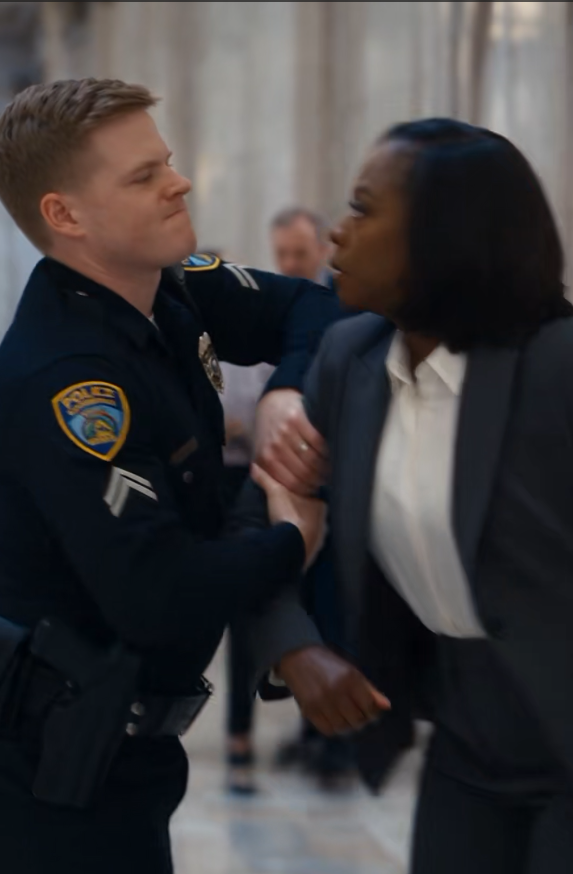
“I’m sorry,” he said.
I did not answer.
Not because I rejected it.
Because it was not my job to make the moment easier.
He sat.
The hearing ended.
Outside, cameras waited.
Reporters called my name.
I walked past them.
Then one question stopped me.
“Judge Caldwell, do you forgive Officer Miller?”
I turned.
Microphones lifted.
I thought about the hallway.
The slap.
Thomas’s face.
Maya’s television interview.
The dispatch recording.
The complaints nobody had connected.
Miller’s final statement.
Then I answered.
“Forgiveness is personal.”
The reporters waited.
“Accountability is public.”
I walked away.
Part VI — Aftermath
The courthouse review began in March.
Chief Reeves kept his word.
The committee included judges, prosecutors, defense lawyers, clerks, bailiffs, police supervisors, two community representatives, and Maya Reynolds.
Her criminal matter had resolved by then with a noncustodial probation modification.
The first meeting was awkward.
People used careful language.
Operational clarity.
Visitor management.
Security posture.
Stakeholder concerns.
Maya listened for twenty minutes.
Then she raised her hand.
Everyone stopped.
“Yes?” Reeves asked.
She looked around the table.
“Can we call things what they are?”
Silence.
She pointed toward a draft policy.
“This says ‘noncompliant identity encounter.’ What does that mean?”
A police lieutenant answered.
“Situations where an individual declines to provide identifying information.”
“So write that.”
The lieutenant hesitated.
She continued.
“Because when you use soft words for hard things, nobody knows what happened.”
I looked at Thomas.
He was no longer employed there.
He had come as a public observer.
He smiled.
The committee changed the language.
Then the process.
Officers assigned to court security were required to verify available descriptions before detaining a person solely for identification.
Courthouse personnel received clearer protocols for judicial identification when judges moved through public areas.
Body cameras became mandatory for certain enforcement interactions.
Complaints could be logged by clerks and bailiffs directly into a central system instead of disappearing inside informal supervisory conversations.
Repeated informal concerns triggered review.
None of it was revolutionary.
That was part of the point.
Most preventable failures are not prevented by grand ideas.
They are prevented by ordinary systems that force someone to stop before certainty becomes action.
Thomas retired at the end of January.
His farewell reception was held in the courthouse cafeteria.
He hated speeches.
So naturally, everyone gave one.
Andrea presented him with a framed photograph of the old courthouse before the west wing renovation.
Chief Ellis talked about loyalty.
Reeves talked about service.
I spoke last.
Thomas stood beside a sheet cake looking like a man considering escape through a loading dock.
I kept it short.
“Thomas taught me something I should have known before I became a judge.”
He looked suspicious.
I continued.
“Courthouses do not run on robes, seals, or titles.”
A few people nodded.
“They run on people who notice.”
Thomas looked down.
“Sometimes noticing means opening a door. Sometimes it means remembering a name. Sometimes it means writing down a problem everyone else finds easier to ignore.”
I paused.
“And sometimes it means stepping between two people when one of them has forgotten what authority is for.”
Thomas looked at me.
I did not mention the hallway directly.
I didn’t need to.
Afterward, he hugged me.
It was the first time.
“You made that sound nicer than it was,” he said.
“You’re retired. I can lie about you now.”
He laughed.
Then his expression softened.
“You all right?”
The question had become almost meaningless over the months.
This time I answered honestly.
“Different.”
He nodded.
“Good.”
I looked at him.
“Good?”
“Same is overrated.”
In April, my private judicial elevator broke again.
Andrea called facilities.
I told her not to rush.
She stared at me.
“You enjoy punishment?”
“No.”
“Then why?”
“I’ll take the public elevator.”
Her expression changed.
“You don’t have to make a point.”
“I’m not.”
That was mostly true.
The elevator was crowded.
A clerk held the door.
A defense attorney nodded.
Two defendants stepped aside to make room.
No one recognized me at first.
I wore a navy suit and carried a canvas tote because the handle on my leather briefcase had finally broken.
On the fourth floor, the doors opened.
For half a second, I saw the corridor exactly as it had been in November.
The bench.
The windows.
The place where my papers had fallen.
Then the image passed.
A young courthouse officer stood near the western stairwell.
He was new.
I had seen him once.
He nodded politely.
“Morning, ma’am.”
“Morning.”
I stepped into the hall.
Behind me, a woman exited the elevator too quickly and nearly collided with him.
She was Black.
Late twenties, maybe.
Long braids.
Tan coat.
The officer stepped aside.
“Sorry about that.”
She laughed.
“My fault.”
She looked around.
“Do you know where 4B is?”
He pointed.
“Other direction. Second door past the elevators.”
“Thanks.”
“No problem.”
She walked away.
The officer went back to his post.
Nothing happened.
No demand.
No hand on an arm.
No suspicion manufactured from confusion.
Just a question.
An answer.
A person allowed to be lost.
I stood there longer than I meant to.
Then I heard footsteps behind me.
Maya Reynolds.
For a second, I thought my mind had invented her.
But she was real, carrying a folder under one arm.
She had come for a committee meeting upstairs.
She looked at the woman disappearing toward 4B.
Then at the officer.
Then at me.
“You saw that?”
“Yes.”
She smiled slightly.
“Low bar.”
“Very.”
“But still.”
“Still.”
We walked toward the stairwell together.
At the landing, she stopped.
“I’ve been meaning to ask you something.”
“What?”
“That morning.”
I waited.
“When the bailiff called you ‘Your Honor’…”
She leaned against the rail.
“Did it make you feel better?”
I thought about it.
“No.”
“Why not?”
“Because he shouldn’t have needed to.”
Maya nodded slowly.
“That’s what I figured.”
We started up the stairs.
On five, she said, “You know people still tell the story wrong.”
“How?”
“They say he hit a judge.”
“He did.”
“No.”
She looked at me.
“He hit a Black woman he thought didn’t matter.”
I stopped.
The stairwell hummed softly around us.
Fluorescent lights.
Concrete walls.
A courthouse built to make distinctions.
Public and secure.
Free and detained.
Witness and defendant.
Officer and civilian.
Judge and everyone else.
Maya continued climbing.
I followed.
At the sixth floor, I held the door open for her.
She walked through first.
I looked back once toward the stairwell below.
Months earlier, I had climbed those same steps with a bruise on my face, furious that a title had saved me too late.
Now I understood the deeper question was not whether people knew who I was.
It was whether they believed dignity had to be earned before it was protected.
I let the door close behind me.
That morning, for once, nobody in the courthouse had needed to say “Your Honor” before doing the right thing.