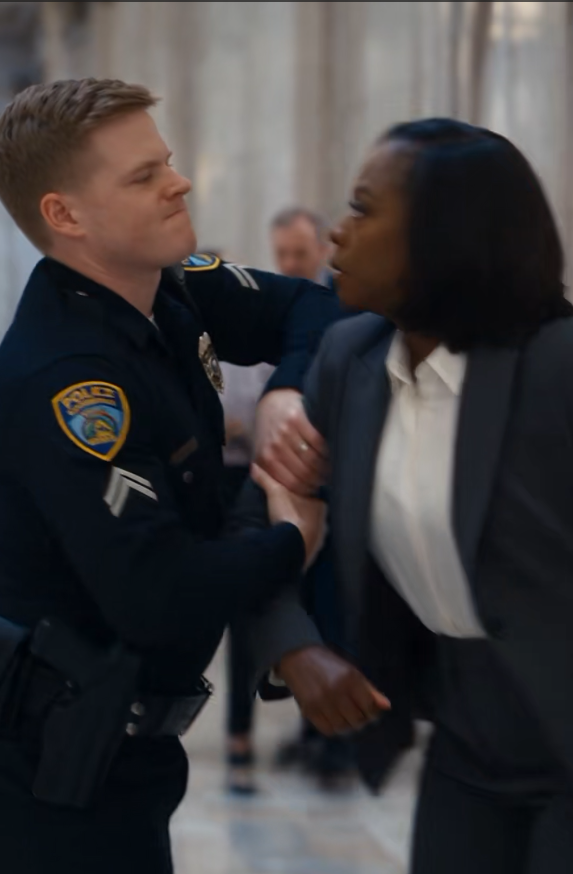
“Yes.”
“That doesn’t change what he did.”
“No.”
“But it changes the department.”
“Yes.”
I closed my eyes.
The stakes shifted again.
If Miller could show supervisors encouraged aggressive enforcement, the case would no longer be about one officer’s judgment.
It would implicate policy.
Training.
Command.
Maybe more.
“What does he have?”
“Text messages.”
I was at the hearing by eight-thirty.
Chief Reeves was there.
So was Lieutenant Cole.
Cole had not attended earlier sessions.
He sat behind department counsel with a rigid expression.
Miller entered with Sloan.
He did not look at me.
Park called the hearing to order.
Sloan moved to reopen testimony.
Benton did not oppose.
That told me enough.
Miller returned to the stand.
Sloan asked whether he had received direction regarding missed appearances.
“Yes.”
“From whom?”
“Lieutenant Cole.”
“What direction?”
“To stop letting people walk around without being challenged.”
Cole stared at him.
“Anything else?”
“He said the courthouse was getting too loose.”
“Did he discuss identity checks?”
“Yes.”
“What did he say?”
Miller swallowed.
“That we should ID anyone who looked out of place around holding areas.”
Benton stood.
“Objection. Vague.”
Park overruled.
Sloan produced screenshots.
Text messages.
Cole to officers.
Court admin complaining again. Tighten it up.
Another.
If they don’t belong, move them.
Another.
No more excuses about people getting lost.
Then one from the week before the incident.
Take control early or they control you.
I looked at Thomas.
He was seated two rows ahead.
His face was unreadable.
Sloan sat.
Benton stood for cross-examination.
“Officer Miller, did Lieutenant Cole tell you to strike Judge Caldwell?”
“No.”
“Did he tell you to ignore dispatch descriptions?”
“No.”
“Did he tell you to lie during Internal Affairs?”
Miller looked down.
“No.”
“Did he tell you to call Judge Caldwell ‘you people’?”
“No.”
Sloan objected.
“Sustained.”
Benton nodded.
“Did any supervisor require you to detain someone before verifying identity?”
“No.”
“Did anyone forbid you from radioing dispatch?”
“No.”
“Calling the courtroom?”
“No.”
“Asking a bailiff?”
“No.”
“So whatever pressure you felt, the decisions in that hallway were yours.”
Miller’s face tightened.
“Yes.”
There was the harder truth.
Systems matter.
Culture matters.
Pressure matters.
And none of those things erase personal choice.
Benton sat down.
Park looked toward the parties.
“I will accept the messages into evidence. Lieutenant Cole will testify.”
Cole did.
He denied encouraging unlawful stops.
He said “tighten it up” meant improve coordination.
He said “move them” meant direct lost visitors.
He said “take control early” was standard leadership language.
Some of that might even have been true.
Then Benton showed him Thomas’s email from three months earlier.
Subject line: Concern regarding Officer Miller interactions.
Cole admitted receiving it.
“What did you do?”
“I spoke to him.”
“Documented?”
“No.”
“Follow-up?”
“No.”
“Observation?”
“No.”
“Referral?”
“No.”
“Why?”
Cole shifted.
“I didn’t think it rose to formal discipline.”
“What would have?”
“A sustained complaint.”
“How does a complaint become sustained?”
“Investigation.”
“And did you initiate one?”
“No.”
Benton let the answer sit.
Then she produced another document.
A supervisor log.
Three entries.
Miller advised about unnecessary physical contact.
Miller reminded to de-escalate.
Miller cautioned regarding tone with civilians.
All within seven weeks.
Cole stared at the pages.
Benton asked, “How many warnings were necessary before you considered this a pattern?”
Sloan objected.
Park sustained.
Benton rephrased.
“At what point does repeated behavior become a supervisory concern?”
Cole looked toward Reeves.
Then back.
“It already was.”
The admission was quiet.
That made it worse.
The hearing recessed.
In the hallway, Chief Reeves approached me.
“We need to talk.”
I looked at him.
“Here?”
“Private room.”
Thomas was nearby.
I asked him to come.
Reeves frowned but agreed.
Inside the small conference room, Reeves closed the door.
He looked older than he had in November.
“I’m going to recommend broader review.”
“Of what?”
“Courthouse policing.”
“Good.”
“Stops. Identification practices. Use of physical control. Supervisor reporting.”
Thomas leaned against the wall.
Reeves continued.
“I should have done it earlier.”
I watched him.
That was not a sentence chiefs said easily.
“Why didn’t you?”
He looked at the table.
“Because each complaint looked small alone.”
Thomas said, “That’s how they stay small.”
Reeves glanced at him.
Thomas did not look away.
I asked, “What happens now?”
“Miller’s termination recommendation remains.”
“And Cole?”
“Separate discipline.”
“Administrative only?”
“For now.”
I folded my arms.
“Why are you telling me?”
Reeves took a breath.
“Because I want you to support the review publicly.”
There it was.
Not corruption.
Not exactly.
Institutional instinct.
Use the harmed person to validate the repair.
“What kind of review?”
“Joint committee. Judges, police, defense, prosecutors, courthouse staff.”
“Community?”
“We hadn’t discussed—”
“Then discuss it.”
He frowned.
“Maya Reynolds?”
I had not said her name.
But he had understood.
“Yes.”
“She has an open matter.”
“That doesn’t make her incapable of describing a courthouse.”
Reeves looked at me carefully.
“You want her on the committee.”
“I want people who are usually managed by the system to have a voice in how it manages them.”
Thomas gave the smallest nod.
Reeves rubbed his jaw.
“That will be controversial.”
“Then it may be useful.”
He almost smiled.
Almost.
“I’ll consider it.”
“No.”
His expression changed.
“No?”
“If you want my public support, that is the condition.”
The room went quiet.
This was the choice.
I could have accepted the review as offered.
It would have looked constructive.
Safe.
Professional.
I could have given the department a statement about lessons learned and rebuilding trust.
No one would have blamed me.
But the entire case had begun because one title had changed my value in a hallway.
If reform centered only people with titles, then we would be rebuilding the same hierarchy with better language.
Reeves studied me.
“You know they’ll say you’re politicizing this.”
“They’ve said worse.”
“This could complicate everything.”
“It should.”
He looked toward Thomas.
Thomas shrugged.
“She’s the judge.”
I said, “Not in here.”
Reeves finally nodded.
“All right.”
That afternoon, Evelyn Park issued her decision.
Bradley Miller’s termination was upheld.
Her written findings were precise.
He had initiated detention without adequate verification.
He had used unauthorized force.
His explanation was inconsistent with witness testimony and objective evidence.
His later administrative statement contained material inaccuracies.
Supervisory pressure provided context but not justification.
Then came the sentence quoted everywhere the next morning:
“Authority does not become lawful merely because it is exercised with confidence.”
Miller sat motionless while Park read the order.
When she finished, he did something I had not expected.
He asked to speak.
Sloan leaned toward him.
Miller shook his head.
Park allowed it.
He stood.
For several seconds, he said nothing.
Then he looked toward me.
“I was wrong.”
No one moved.
His voice was low.
“I thought she was lying because I had already decided what was happening.”
Sloan stared at the table.
Miller continued.
“I kept waiting for something in the evidence to prove I was right.”
He swallowed.
“It didn’t.”
I listened.
There are apologies that ask to be forgiven.
There are apologies that ask to be admired.
This one sounded like neither.