I looked through the conference-room glass.
Investigators moved between rooms carrying laptops and sealed evidence bags.
"The company has eighty-six complaints," I said. "We finally have a live incident where the contemporaneous evidence contradicts the crew report."
"Which means you've become part of the evidence."
"I was already part of the evidence."
"Not like this."
He was right.
I didn't like that.
I had spent six weeks trying to remain invisible inside the case.
Now my name sat in the center of it.
"We can separate my investigative role from my witness role."
"We'll have to."
"Then do that."
He studied me.
"You planning to prove something?"
"No."
"Good."
I knew him well enough to understand the question behind the question.
Had the incident become personal?
Of course it had.
The trick was not pretending otherwise.
Professionalism didn't require having no reaction.
It required recognizing the reaction before it started making decisions for you.
"I want the records preserved before Meridian decides this was one rogue flight attendant."
My supervisor nodded.
"So do I."
That was the real danger.
Brittany Miller had lied.
The recorder established that.
Daniel Price contradicted her.
Ashley contradicted her.
Captain Lawson's initial conversation with me contradicted parts of her account.
But one lying employee did not prove an institutional practice.
The case we had built over six weeks suggested more.
We still needed the bridge between individual conduct and management knowledge.
That bridge arrived forty-eight hours later.
It came from Ashley.
She requested another interview.
No airline counsel present.
She walked into the room carrying a manila envelope.
She looked as if she hadn't slept.
I was not allowed to conduct the interview because I was now a witness in her portion of the case.
I watched through one-way glass.
Ashley sat across from two investigators.
One of them said, "You asked to speak with us again."
"Yes."
"Is your attorney aware?"
"I have my own attorney now."
"All right."
She placed the envelope on the table.
"There are emails."
The investigator didn't touch the envelope yet.
"What emails?"
Ashley stared at it.
"About incident reports."
"Explain."
She folded her hands.
"When something happens with a passenger, we write a cabin report. If security gets involved, there's another form. Certain reports get reviewed by base management."
"Certain reports?"
"Anything involving discrimination complaints. Removal. Law enforcement. Social media."
"Who reviews them?"
Ashley hesitated.
"I don't know everyone."
"Who do you know?"
She named two managers.
Neither name surprised us.
Both had appeared repeatedly in our complaint files.
"What happens during the review?"
Ashley looked toward the dark glass.
For a moment, I wondered whether she knew I was there.
"They send edits."
"What kind of edits?"
"Language."
"Give me an example."
She swallowed.
"If you write that a passenger questioned a seat reassignment, they'll ask whether the passenger was disruptive."
"Was the passenger disruptive?"
"Sometimes. Sometimes not."
"And if not?"
"They'll ask whether the questioning affected boarding."
The investigator waited.
Ashley continued.
"If you say no, they ask whether the passenger raised their voice."
"And if they didn't?"
"They'll say, 'Was their tone confrontational?'"
The investigator said nothing.
Ashley gave a tired laugh with no humor in it.
"There's always another word."
"Until what?"
"Until the report sounds like the crew had a safety reason."
Behind the glass, I stopped breathing for a second.
Not because it surprised me.
Because it fit too well.
The investigator asked, "Why?"
Ashley stared at her hands.
"Because safety decisions are protected."
"Protected from what?"
"Complaints. Refund claims. Discrimination allegations. If it's framed as safety, management backs the crew."
"Did anyone ever tell you to falsify a report?"
"No."
The investigator let the silence sit.
Ashley looked up.
"Not like that."
"Then how?"
"They teach you how to write one."
"Who is 'they'?"
"Managers. Senior crew. People like Brittany."
She rubbed her thumb across one fingernail.
"You learn which words survive review."
The investigator finally opened the envelope.
Inside were printed emails.
Ashley spoke before he read them.
"Those are mine from last year. I had written that a passenger complained after she was moved from first class because of a seat issue. My manager sent it back three times."
"What changed?"
"The final version said she became confrontational during a safety-related reseating."
"Was there a safety reason?"
"No."
"Why did you submit it?"
Ashley's face tightened.
"Because I wanted to keep my job."
That sentence became the center of the case.
Not because it excused her.
Because it explained the mechanism.
Nobody needed to issue a written order saying discriminate.
Nobody needed to write falsify evidence.
A system could teach people what outcomes were rewarded and what versions of events were accepted.
By Friday, subpoenas went out.
Internal emails came back.
Training documents.
Complaint-resolution templates.
Crew incident reports.
Draft versions of reports.
Revision histories.
And buried in those records was the thing we had been missing.
A management presentation from nine months earlier.
The title was harmless.
CUSTOMER INCIDENT RISK REDUCTION.
One slide contained a list of terms.
Preferred terminology for operational defensibility.
Disruptive.
Noncompliant.
Escalating.
Interference.
Safety-based reseating.
Crew concern.
The same words we had seen repeated across passenger complaints.
At the bottom of the slide, in smaller text:
Avoid subjective descriptors that may create discrimination exposure. Anchor decisions to safety and compliance.
The language was careful.
Legally polished.
Possibly defensible in isolation.
Then we compared it against report histories.
In case after case, employees had originally described routine disagreements.
A customer questioned a downgrade.
A traveler objected to being skipped during service.
A passenger asked why another person had been allowed a larger bag.
After management review, the final reports changed.
Questioned became challenged.
Objected became disruptive.
Asked repeatedly became refused instruction.
And in several files, racial discrimination complaints disappeared from the final narrative entirely.
Then we found Kevin Johnson's report.
His original case had said:
Passenger requested explanation for involuntary seat reassignment.
The final version said:
Passenger became increasingly confrontational during boarding and challenged agent authority regarding an operational seating decision.
There had been no operational seating decision.
The seat had never needed to be reassigned.
A supervisor had attempted to move Johnson after assuming his first-class boarding pass was incorrect.
That detail was visible in internal system notes.
Then removed from the customer complaint summary.
I read the file twice.
The second time, I noticed something else.
The supervisor who approved the final language had also reviewed three cases involving Brittany Miller.
Including two previous accusations that Black passengers had become aggressive after service disputes.
Both complaints had been closed.
Insufficient evidence.
I leaned back in my chair.
Across the table, my supervisor looked at me.
"You see it."
"Yeah."
"It's bigger than Brittany."
"It always was."
He tapped the page.
"But Brittany may have known that."
I thought about the flight.
Her confidence.
How quickly she had used the word aggressive.
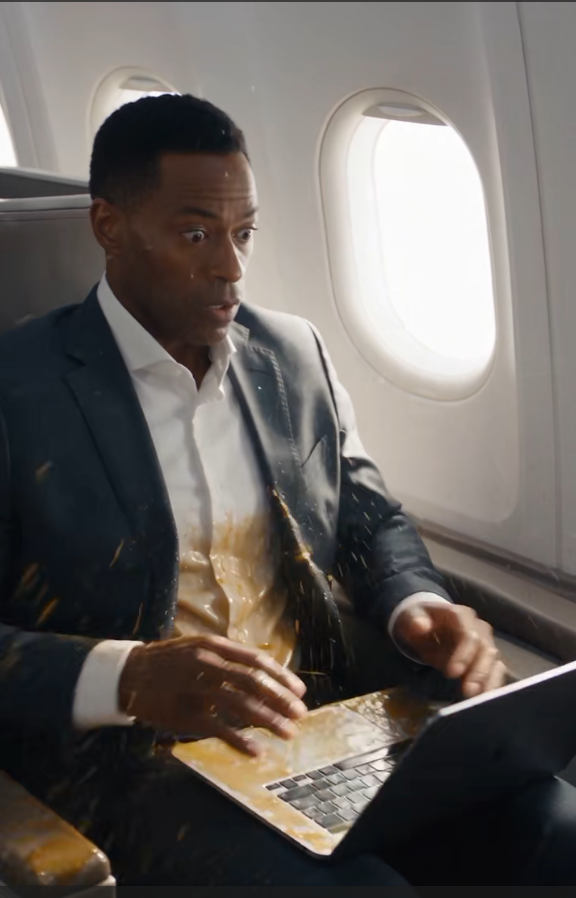
How easily she had converted a spill into interference.
How she had told Ashley what she had seen before Ashley ever wrote a report.
Maybe Brittany wasn't improvising.
Maybe she was following a script so familiar that she no longer experienced it as lying.
That possibility disturbed me more than deliberate cruelty.