People who knew they were doing wrong could sometimes be deterred.
People who believed the system had made them right were harder.
Part IV — The Cost of Telling the Truth
Meridian suspended Brittany with pay.
They also suspended Ashley.
That told us almost as much as the emails.
The stated reason was neutral: both employees were involved in a disputed safety incident under investigation.
But Ashley had become a cooperating witness.
Her attorney called ours within hours.
"It looks retaliatory."
It did.
We couldn't simply declare it illegal retaliation without examining Meridian's disciplinary policies.
So we did.
The company argued that suspension was standard for employees involved in serious onboard incidents.
Records showed otherwise.
In the previous two years, flight attendants accused of excessive alcohol service, passenger mistreatment, and multiple procedural violations had remained on active duty while cases were reviewed.
Ashley had been removed from schedule less than a day after management learned she contradicted Brittany.
Another pattern.
Another thread.
But the human cost was becoming visible.
Ashley stopped receiving pay differentials she depended on.
Her coworkers stopped texting.
Someone leaked her name to an airline employee forum.
Posts called her a traitor.
A liar.
A federal plant.
One message said:
Never fly with somebody who won't back crew.
That phrase stayed with me.
Back crew.
Not tell the truth.
Not protect safety.
Back crew.
Daniel Price had his own consequences.
Meridian's lawyers interviewed him for nearly three hours.
Afterward he called our office.
"They kept asking if maybe you moved your arm toward the cart."
"What did you tell them?"
"The same thing I've told everybody. You didn't touch it."
"What else?"
"They asked if you seemed irritated."
I almost laughed.
"Did I?"
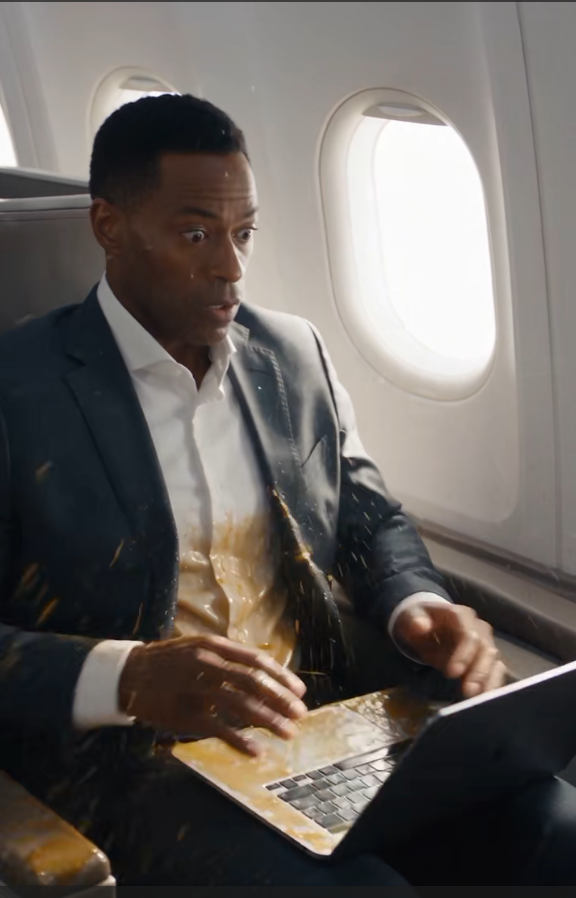
"You seemed like somebody had spilled coffee on a laptop."
"Fair."
"They want gray."
"Most lawyers do."
"No. They want enough gray to say Brittany wasn't lying."
He paused.
"There's a difference."
He was right.
The investigation accelerated.
So did Meridian's response.
The company hired outside counsel and announced an independent review.
It also circulated an internal memo reminding employees not to discuss active investigations with unauthorized parties.
Legally routine.
Practically chilling.
Complaints slowed.
Then stopped.
For nine days, not a single current Meridian employee contacted us.
My supervisor called it the freeze.
"They're scared."
I looked at a chart on the wall containing eighty-six complaint numbers.
"Or we've got everything we're going to get."
"No."
"Why?"
"Because systems like this always create someone who kept records."
He was right.
On the tenth day, a package arrived.
No return address.
Inside was a flash drive.
No note.
We treated it as unverified evidence until forensic review established its origin and integrity.
The drive contained years of internal quality-assurance data.
Complaint classifications.
Crew identifiers.
Resolution codes.
Demographic information that Meridian publicly claimed it did not use in operational complaint review.
That changed everything.
The airline had tracked race.
Not always directly. Sometimes through passenger-provided discrimination claims. Sometimes through internal notes. Sometimes through customer-service coding.
And when analysts compared outcomes, one result stood out.
Black passengers who complained about premium-cabin treatment were significantly more likely to have their cases reclassified as safety or conduct disputes than white passengers raising comparable service complaints.
That alone didn't prove intent.
But another document came with the data.
A draft presentation.
Never publicly released.
One chart showed discrimination complaints increasing.
Beside it was a note:
Operational classification reduces liability exposure when conduct basis documented.
My supervisor read it quietly.
Then he said, "There it is."
I wasn't convinced.
"Maybe."
He looked at me.
"You don't think so?"
"I think it's ugly. I don't know whether it's enough."
"Anthony."
"We need context."
He stared at me for a second.
Then nodded.
"Good."
That was the danger of finding the sentence you had spent months looking for.
You wanted it to mean everything.
Sometimes it did.
Sometimes context destroyed it.
We subpoenaed the presentation's authors, revision history, meeting notes, and distribution list.
Context did not destroy it.
It made it worse.
The presentation had been created for senior operations managers after the airline faced a series of discrimination complaints.
One meeting summary included the phrase:
Strengthen frontline documentation to ensure service disagreements do not mature into unsupported bias claims.
Again, careful wording.
Again, defensible if separated from practice.
But witnesses described what happened afterward.
Managers began holding workshops.
Crew members were taught to document tone, body language, compliance, and perceived escalation.
Nothing inherently improper about that.
The problem was asymmetry.
They weren't trained to document evidence that contradicted escalation.
If a passenger spoke calmly, it rarely appeared.
If another passenger supported the accused customer, it often disappeared.
If a crew member made a mistake first, the mistake became context rather than cause.
The resulting reports looked complete.
They weren't.
They were curated.
And curated records had been used to close complaints.
My flight became a demonstration of the process in real time.
The original onboard message transmitted to operations said:
Passenger in 4B physically interfered with beverage cart and became verbally aggressive when corrected.
Brittany's preliminary report said:
Passenger grabbed service equipment, raised voice, repeatedly challenged crew authority, and refused de-escalation instructions.
The cabin audio captured by my recorder showed none of it.
Daniel Price contradicted it.
Ashley contradicted it.
Even Captain Lawson's notes recorded that I had been calm when he approached.
Then investigators recovered something we hadn't known existed.
A draft report saved automatically on Brittany's company tablet during the flight.
It had been created before landing.
Before police boarded.
Before she knew who I was.
The first version contained a sentence that did not appear in the final report:
Passenger denied touching cart. Seatmate stated passenger did not make contact.
Twenty-two minutes later, that sentence was gone.
In its place:
Nearby passenger attempted to insert himself into crew interaction and may not have observed initiating conduct.
I stared at the screen.
The deletion was the case.
Not all of it.
But enough to show choice.
Brittany hadn't simply remembered the event differently.
She had recorded contradictory evidence and then removed it.
My supervisor stood behind me.
"Still need context?"
"Always."
"You're impossible."
"That's why you hired me."
He almost smiled.
Then his expression changed.
"She's asked for an interview."
"Brittany?"
"Through counsel."
"With us?"
"Yes."
"Why?"
"She says management trained her to write reports that way."
That was the reversal.
Until that moment, Brittany Miller had been the clearest example of what Meridian was accused of doing.
Now she wanted to become a witness against the system that had taught her.
And because I had been the person in 4B, I had to decide whether I could hear her without wanting punishment more than truth.
I told my supervisor I shouldn't conduct the interview.
He nodded.
"I agree."
I watched from behind the glass again.
Brittany entered wearing a navy suit.
No uniform.
No scarf.
No authority of the cabin around her.
She sat across from investigators with an attorney beside her.
For several minutes, she said nothing meaningful.
Policy.
Training.
Judgment.
Stress.
Then one investigator placed the two versions of her report in front of her.
"Why did you remove Mr. Price's statement?"
Brittany looked at the pages.
"My understanding was that it wasn't reliable."