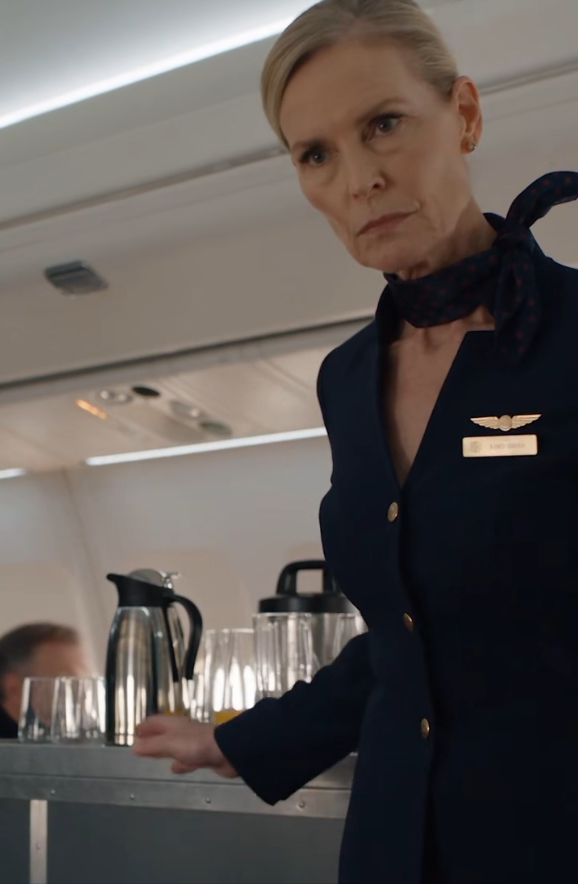
Meridian had just shown us it was deeper.
The closure email had been approved by Corporate Customer Integrity and Safety.
The audit history identified three reviewers.
The final approval came from a director-level account.
That same account had approved forty-one of the eighty-six complaints.
Thirty-six of the forty-one involved Black passengers.
Thirty-two ended with the same six words.
The deeper we went, the less Brittany looked like the whole problem.
She was a problem.
But she existed inside a structure that rewarded a particular kind of certainty.
Crew account first.
Passenger credibility second.
Conflicting employee statements corrected for consistency.
Security language generated from selected behavior boxes.
Complaints closed from summaries written by the same people whose conduct was being challenged.
The process had been designed to protect operational authority.
In practice, it had become a machine that could turn assumption into record.
And once the record existed, every later reviewer treated it as fact.
That was how an accidental coffee spill became an aggressive passenger.
Not in one lie.
In stages.
Brittany's assumption.
Ashley's silence.
A checked box.
Generated language.
A crew-consistency edit.
A corporate summary.
A closure finding.
No single step had to look outrageous.
Together they created a false history.
We interviewed Brittany two weeks later.
She arrived with company counsel.
Her hair was down instead of in the tight bun I remembered.
She wore a gray jacket and carried a leather folder.
She recognized me immediately.
Unlike Ashley, she did not look surprised for long.
“So this was a setup.”
“No.”
“You were investigating us before you boarded.”
“Yes.”
“So you were looking for something.”
“I was observing.”
“That's the same thing.”
“It isn't.”
Her attorney touched her arm.
“Brittany.”
She sat.
I began with routine questions.
Employment history.
Training.
Role on Flight 2208.
Seat assignments.
Service sequence.
Then the spill.
“What caused the beverage cart to move?”
“You did.”
“How?”
“You reached toward it.”
“Did you see my hand touch it?”
“I saw movement.”
“That wasn't my question.”
Her mouth tightened.
“No. I didn't see actual contact.”
“Then why did you report physical interference?”
“Because that's what happened.”
“What happened?”
“You were upset. The cart moved. There was a disturbance.”
“Those are three different facts.”
“They were part of the same incident.”
“Was the passenger in 4A involved?”
“He may have moved.”
“He told police his arm hit the cart.”
Brittany glanced at her attorney.
“I wasn't focused on him.”
“Why not?”
“Because he wasn't the issue.”
“Why was I?”
“You were the passenger escalating the situation.”
“What did I do to escalate it?”
“You challenged me.”
“What did I say?”
“You were argumentative.”
“What words?”
“I don't remember exact words.”
I slid the transcript from my wrist recording across the table.
Her eyes stopped on it.
Company counsel leaned forward.
“What is this?”
“A contemporaneous recording.”
His gaze moved to me.
“Audio?”
“Yes.”
He looked at the attorneys on our side.
There was a short legal discussion about authorization and evidentiary handling.
Brittany said nothing.
When they finished, I turned one page toward her.
“This is the first exchange after the spill.”
She read.
You grabbed the cart?
No, ma'am.
Lower your voice.
Her jaw shifted.
I turned another page.
“He's getting aggressive.”
Another.
“Captain, we have a situation in 4B.”
Another.
“You told Ashley to write what she observed.”
“I did.”
“Did you then edit her report?”
“She was inexperienced.”
“That isn't what I asked.”
“Yes.”
“Why?”
“To make it accurate.”
I placed Ashley's original draft beside the final version.
“Which one is accurate?”
“The final one.”
“You just told me you did not see my hand touch the cart.”
She looked at the page.
“You were involved in the disturbance.”
“So you changed ‘passenger did not make contact with cart’ to ‘physically interfered with cabin equipment.’”
“I corrected a junior employee's incomplete report.”
“By adding something you did not see.”
“I added context.”
“False context?”
Her attorney said, “Don't characterize.”
I looked at Brittany.
She looked back.
That was the first moment I saw uncertainty.
Not remorse.
Not yet.
Just the realization that the clean language in the report could no longer protect the messy sequence that produced it.
I asked, “Why did you tell Ashley to watch me before I sat down?”
Her expression changed.
“I don't remember that.”
I played the recording from before takeoff.
The sound was faint because the device had been in passive buffer mode, but the words were clear enough.
Watch 4B.
He's going to ask for an upgrade.
Brittany stared at the speaker.
Then she looked at me.
“You were recording before the incident?”
“Operational buffer.”
“That is unbelievable.”
“Why did you think I would ask for an upgrade?”
“I don't remember.”
“You saw my boarding pass.”
“I see hundreds.”
“Mine said 4B.”
No answer.
“First class.”
No answer.
“Why would I ask for an upgrade?”
She looked at her attorney.
He said nothing.
Finally she said, “People try things.”
“What people?”
Her face hardened again.
“I am not racist.”
I had not used the word.
Nobody in the room had.
I let the silence stay.
She leaned forward.
“I have served thousands of passengers. Every race. Every background. I have never had a complaint like this.”
That was not true.
We had found three prior complaints naming her.
Two had been closed as misunderstandings.
One had been reclassified as a service-style concern.
I didn't show those yet.
Instead I asked, “Do you believe you treated me differently because I am Black?”
“No.”
“Then explain the upgrade comment.”
“I can't.”
“Explain skipping my predeparture service.”
“I was busy.”
“You served 4A.”
“That happens.”
“Explain why the cart moved and you looked at me instead of the person who actually bumped it.”
“I was responding quickly.”
“Explain why ‘aggressive’ was the first behavior label you used.”
“You were challenging my authority.”
“I said, ‘No, ma'am.’”
She looked down.
There it was.
Not a confession.
Something more useful.
No answer.
We ended after three hours.
As company counsel gathered his papers, Brittany stood.
For a moment, she remained beside the chair.
Then she looked at me.
“You could have told me who you were.”
It was the first thing she had said that sounded personal.
I closed the folder in front of me.
“Would it have changed how you treated me?”
She opened her mouth.
Nothing came out.
I didn't need an answer.
Part V — What the Company Knew
The investigation might have ended with employee discipline if the evidence had stopped there.
It didn't.
The preservation orders produced internal training slides, complaint-review manuals, supervisor messages, and years of version histories.
Most were mundane.
A few were not.
One training document instructed frontline employees to “protect crew authority through unified incident reporting.”
Another warned that “contradictory employee narratives create unnecessary exposure.”
A supervisor's message to a group of lead attendants said:
When reporting difficult passenger interactions, avoid uncertain phrasing. If safety concerns are present, use approved behavioral descriptors.
The approved descriptors included aggressive, confrontational, noncompliant, intimidating, disruptive.
Nothing about those words was improper by itself.
Sometimes passengers were aggressive.
Sometimes they were dangerous.
Flight crews needed authority and clear reporting tools.
The problem was how the tools were being used.