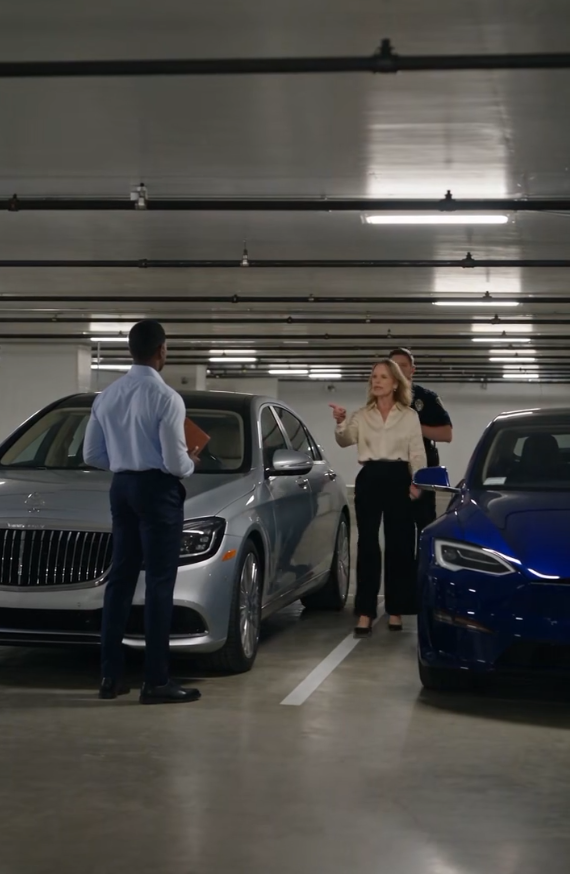
Part I — The Two Clicks
The handcuffs closed around Marcus Reed’s wrists before Officer Daniel Hayes knew enough to explain why he was putting them there.
Two metallic clicks echoed through the underground garage.
Marcus felt the pressure first against the bone of his left wrist, then his right. The cuffs were not painfully tight, but they were real in a way arguments were not. Real enough to alter posture. Real enough to turn a disagreement into a detention. Real enough that whatever happened next would be interpreted through the fact that one man had authority and another had his hands behind his back.
Ten feet away, Diane Mercer smiled.
It lasted less than a second.
Marcus saw it anyway.
“There,” she said. “Was that so difficult?”
Officer Hayes glanced at her but did not answer.
The garage beneath the apartment building smelled faintly of concrete dust, engine oil, and the damp September air that followed cars down the ramp. Fluorescent strips buzzed overhead. Marcus’s dark blue sedan sat in the nearest visitor space, his suit jacket folded across the passenger seat exactly where he had left it twenty minutes earlier.
He lowered his eyes toward the floor.
Not because Diane had won anything.
Because he needed one second.
One second to make sure irritation did not become anger, that anger did not become movement, and that movement did not give Hayes a new problem to solve.
Marcus had spent most of his adult life watching people make irreversible decisions during reversible moments.
He had learned to recognize one when it arrived.
He lifted his head.
The red indicator on Hayes’s body camera was still glowing.
“Officer Hayes?”
Hayes looked at him. “What?”
Marcus turned only as far as the cuffs allowed and looked directly into the lens mounted on Hayes’s chest.
“Please make sure that camera keeps recording.”
Hayes paused.
Something in Marcus’s tone seemed to bother him more than anger would have. Anger he understood. Fear he understood. He had been trained to hear escalation in a voice, to see it in shoulders and hands.
Calm required interpretation.
Diane stepped closer to the front of her silver Mercedes.
“He’s trying to intimidate you now,” she said.
Marcus ignored her.
“And before you transport me anywhere,” he continued, “I’d like you to make one telephone call.”
Hayes’s brow tightened. “To your attorney?”
“No.”
Marcus gave him the number slowly.
Hayes repeated the final four digits and looked at the screen of his department phone.
Diane made an impatient sound.
“This is ridiculous. You caught him where he shouldn’t be. Why are we standing here entertaining this?”
Marcus kept his eyes on Hayes.
“When they answer, tell them you need to verify the identity of Marcus Reed.”
Hayes looked at the number again.
“What is this?”
“The clerk’s office at the federal courthouse.”
The officer stopped moving.
Diane’s expression changed by degrees, satisfaction draining into uncertainty.
Marcus continued.
“Ask them exactly who you just put in handcuffs.”
The silence that followed was brief, but it had weight.
Hayes studied him.
Until that moment, he had been looking at Marcus as a subject: middle-aged man, no visible weapon, calm demeanor, no confirmed resident status, conflicting story. Now he looked at him as if details were rearranging themselves.
Charcoal slacks.
Pale blue shirt.
Leather document folder.
The deliberate vocabulary.
The absence of pleading.
Hayes’s shoulder radio crackled.
“Unit twelve, status?”
Hayes touched it.
“Unit twelve. I’m okay. One detained. Stand by.”
Marcus watched the officer’s face as his dispatcher said something else too low for him to make out.
Hayes’s eyes moved to Marcus again.
Diane folded her arms.
“Officer, I live here. He doesn’t. I don’t understand what else you need.”
Hayes no longer looked at her.
He entered the number Marcus had given him.
The call rang twice.
“Federal courthouse, clerk’s office.”
Hayes turned slightly away, though the garage carried every word.
“This is Officer Daniel Hayes with Metro Police. I’m attempting to verify an individual named Marcus Reed.”
A pause.
Hayes glanced toward Marcus.
“Yes. Marcus. Reed. Date of birth—”
Marcus supplied it.
Hayes repeated it.
The pause on the other end lasted longer this time.
Then the officer straightened.
“I’m sorry?”
Diane’s arms loosened.
Marcus said nothing.
Hayes listened.
His face did not collapse into astonishment. He was too disciplined for that. But something closed behind his eyes.
“Yes,” he said. “I understand.”
Another pause.
“No, ma’am. He is not at the courthouse.”
He turned enough that Marcus could see his jaw tighten.
“He is currently detained at a private residential building.”
The clerk apparently asked another question.
Hayes looked directly at Marcus’s cuffed hands.
“Yes.”
The word came out flatter than the others.
“Yes, he is.”
He listened again.
Then: “Understood.”
Hayes ended the call.
For several seconds no one spoke.
A car entered from the street level and rolled slowly down the ramp. Its headlights washed over them, turning all four concrete pillars into long shadows. The driver looked once, quickly, then kept going.
Diane broke first.
“Well?”
Hayes slid the phone into his pocket.
He stepped behind Marcus.
The key entered the first cuff.
“Mr. Reed—”
Marcus corrected him without turning.
“Judge Reed is accurate at work. Marcus is fine here.”
The cuff opened.
Hayes removed the second.
Diane stared.
“What does that mean?”
Marcus brought his arms forward and rubbed one wrist lightly.
Hayes did not answer Diane.
He looked at Marcus.
“I spoke to the clerk’s office. They confirmed you’re United States District Judge Marcus Reed.”
Diane’s mouth parted.
The moment could have satisfied Marcus.
It did not.
He had seen versions of it before—the sudden recalibration when someone discovered the person in front of them possessed a title, access, authority, money, influence, or a number that could be called.
It was rarely justice.
Usually it was merely hierarchy correcting itself.
Diane recovered quickly.
“I had no way of knowing that.”
Marcus looked at her for the first time since the cuffs had gone on.
“No,” he said. “You didn’t.”
There was no triumph in it.
That unsettled her more.
Hayes cleared his throat.
“Judge Reed, I apologize for the—”
Marcus turned toward him.
“Why?”
The officer blinked. “Excuse me?”
“Why are you apologizing?”
Hayes hesitated.
“For the detention.”
“You believed you had grounds for it five minutes ago.”
“Yes, but—”
“What changed?”
Hayes glanced briefly at Diane, then toward Marcus’s car.
“We verified your identity.”
“No. You verified my occupation.”
Hayes went quiet.
Marcus nodded toward the camera.
“My identity was the same before the call.”
Diane stepped forward.
“Oh, come on. This is becoming absurd. He admitted he doesn’t live here.”
Marcus looked at her.
“So do the plumber, the mail carrier, a visiting daughter, a caregiver, and every guest in this building.”
“I saw you trying the security door.”
“Yes.”
“With something that didn’t work.”
“Yes.”
“And when I asked what unit you lived in, you refused to answer.”
“I told you I was visiting a resident and that building management could verify it.”