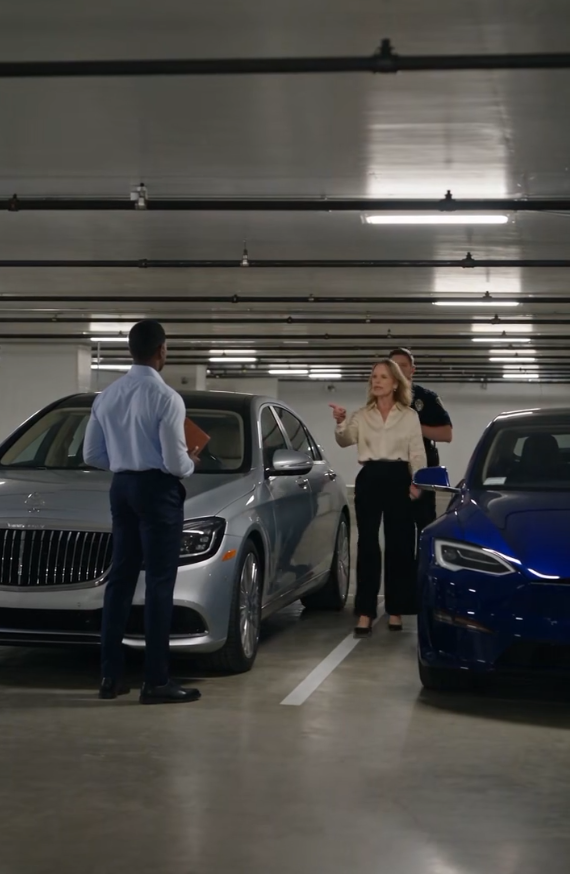
“You were evasive.”
Marcus’s voice stayed level.
“You demanded identification before you told me who you were.”
“I’m a resident.”
“So is my mother.”
“You said that after the officer arrived.”
“No. I said it before you called him.”
Diane looked toward Hayes as though he might arbitrate her memory.
His body camera already had.
Marcus glanced at the small envelope lying on the hood of his sedan where Hayes had asked him to place it. Two electronic parking passes were visible through the clear plastic window.
“My mother moved into 7C twelve days ago,” Marcus said. “The property manager issued those passes this morning. One of the building credentials appears not to have been activated correctly. I tried it once at the security door. You approached me and asked what I was doing. I told you. You asked for my driver’s license. I declined and said I would speak to management.”
“You refused to cooperate.”
“With you.”
Diane drew back slightly.
Marcus looked at Hayes.
“I cooperated with the police.”
Hayes’s expression tightened because the distinction was accurate.
Marcus had stepped away from the vehicle when ordered. He had answered whether he lived there. He had explained the access problem. He had requested verification through management.
And Hayes had cuffed him without making that verification.
The garage suddenly felt less like a scene in progress and more like evidence.
Hayes knew it too.
“Sir—Judge Reed—I’d like to get the property manager down here.”
“That’s what I asked you to do before you detained me.”
“I understand.”
“Do you?”
Hayes met his eyes.
Marcus let the question sit.
Then he stepped toward the hood of his car and picked up the envelope.
Diane shook her head.
“So that’s it? Because he’s a judge, suddenly I’m the criminal?”
“No one called you a criminal,” Marcus said.
“You’re making this sound like I did something terrible.”
“I’m describing what happened.”
“You were somewhere you didn’t belong.”
Marcus looked at her.
“My mother lives upstairs.”
Diane crossed her arms again, but there was less certainty in it now.
Hayes used his radio to request that building management come to the garage.
Marcus went to his passenger door, opened it, and removed his suit jacket.
He slipped it on carefully.
The transformation was small and immediate. The pale blue shirt, charcoal slacks, and leather folder had already suggested professional purpose. The jacket completed the image Diane would later insist she could not have been expected to recognize.
But Marcus knew clothing was not the point either.
He buttoned one button and closed the door.
His wrists still carried faint red impressions from the cuffs.
Hayes noticed.
“Are you injured?”
“No.”
“Do you require medical attention?”
“No.”
The procedural questions sounded strange after everything else.
Footsteps echoed near the elevator lobby.
A woman wearing a building-management badge hurried into the garage carrying a tablet.
She saw Marcus first.
“Mr. Reed. I’m so sorry. I just saw your message about the pass.”
Then she noticed Hayes.
Then Diane.
Then Marcus’s wrists.
Her face changed.
“What happened?”
Diane spoke immediately.
“I found him trying to access the resident entrance.”
The manager looked at her.
“Mrs. Mercer, Mr. Reed is an authorized family visitor for 7C.”
Diane’s shoulders went rigid.
The manager turned to Marcus.
“I entered both passes myself this morning. The parking credentials are active. The door credential may have been assigned incorrectly.”
Marcus nodded. “That appears to be the issue.”
Hayes asked, “Can you confirm his mother resides here?”
“Yes. Evelyn Reed. Unit 7C.”
Diane stared at the manager.
“She just moved in?”
“Twelve days ago.”
“I wasn’t told.”
The manager looked confused.
“There’s no reason you would be.”
Diane’s lips pressed together.
Marcus watched Hayes.
The officer took out a small notebook, though the camera was still recording.
“When did you arrive, Judge Reed?”
“Approximately twenty-five minutes ago.”
“And Mrs. Mercer approached you—”
Marcus lifted a hand.
“You have the recording.”
Hayes stopped.
Marcus nodded toward the camera.
“I’d rather not improve anyone’s version by repetition.”
Diane’s face flushed.
“That sounds like a threat.”
“It’s not.”
“It certainly sounds like one.”
Marcus looked at her.
“No, Mrs. Mercer. It sounds like preservation.”
For the first time, she had nothing ready to say.
The property manager shifted her weight.
“Should I call Ms. Reed and tell her—”
“No,” Marcus said.
It was the first answer he gave quickly.
The manager paused.
Marcus looked toward the elevator.
His mother was seventy-two and proud of the independence represented by the apartment upstairs. She had resisted the move for months, not because she disliked the building, but because she disliked the idea that her son had helped arrange anything for her.
He did not want her first month there defined by seeing him in handcuffs beneath it.
“I’ll speak with her myself.”
The manager nodded.
Hayes closed his notebook.
“Judge Reed, I need to document the detention.”
“You should.”
“I also want to be clear that I—”
Marcus met his eyes.
“Keep the video.”
Hayes stopped.
Marcus’s voice softened but not enough to become comforting.
“Whatever you think happened here, do not let that recording disappear into a routine report.”
Hayes looked at the red light on his camera.
“It won’t.”
Marcus held his gaze for another second.
Then he turned toward the elevator.
Behind him, Diane said, “He’s going to make this into something.”
Marcus stopped.
He did not turn around.
“No,” he said. “The recording will tell us what it already is.”
The elevator doors opened.
He stepped inside.
As they closed, he saw the three of them framed in the narrowing gap: the officer standing beside his cruiser, the property manager holding a tablet, and Diane next to her Mercedes with the satisfied smile gone from her face.
Marcus rode alone to the seventh floor.
Only when the elevator began moving did he look down at the marks around his wrists.
Then he flexed his hands once, picked up the leather folder, and prepared to tell his mother why he was late.
Part II — What the Camera Saw
Evelyn Reed opened her apartment door before Marcus knocked twice.
“You’re thirty-seven minutes late.”
Marcus held up the envelope.
“Technical difficulties.”
His mother looked past him toward the hallway.
“At your age?”
“With the building.”
“That I believe.”
She stepped aside.
Evelyn’s apartment still looked recently occupied. Two framed photographs leaned against the wall instead of hanging from it. A stack of flattened boxes sat near the kitchen. One lamp stood where it belonged; another remained wrapped in brown paper beside a bookcase.
Marcus put the envelope on the counter.
His mother looked at his wrists.
She said nothing.
Marcus removed his jacket.
That made it worse.
The red marks were more visible against the cuffs of his shirt.
Evelyn pointed to a kitchen chair.
“Sit.”
“Mom.”
“Marcus.”
He sat.
She took his left hand and turned it palm-up as if he were still eight years old and had come home from school with a scraped elbow.