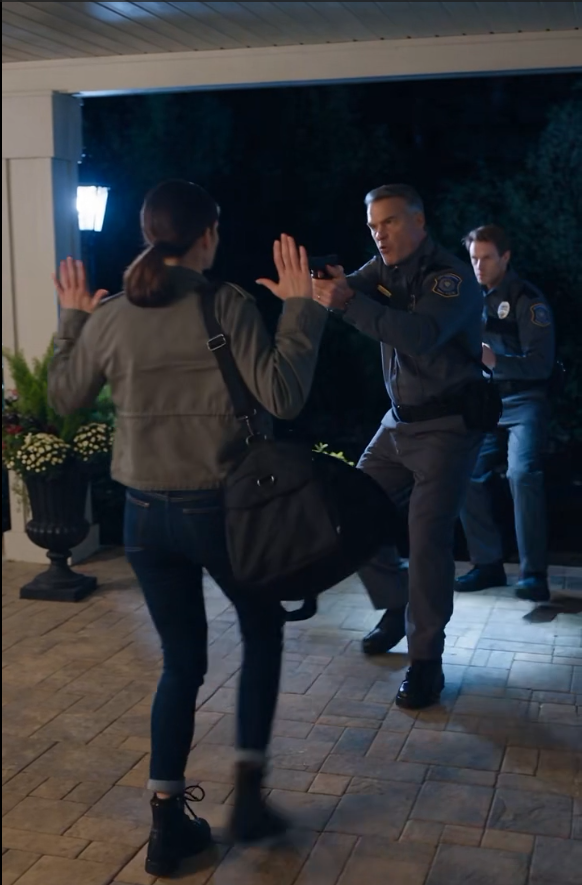
I almost laughed.
“I haven’t made any public statements.”
“We appreciate that.”
“You’re afraid I will.”
He didn’t answer.
Amy appeared behind me.
She had heard enough.
“Why does the board want a private meeting?”
The man straightened.
“Ms. Johnson.”
“Why?”
“We want to understand what happened.”
“The police are investigating what happened.”
“This is also an HOA employment issue.”
“Then interview your employee.”
“We intend to.”
Amy folded her arms.
“Did Marcus Hale disclose the circumstances under which he left his police department when Willow Ridge hired him?”
The board member’s face changed.
Only for a second.
It was enough.
“I don’t handle personnel matters.”
“You’re on the board.”
“Not that committee.”
“Did he disclose it?”
“I don’t know.”
Amy nodded.
“Then you should find out.”
He left three minutes later.
I closed the door.
“You saw that.”
“Yes.”
“He knows something.”
“He knows enough to be uncomfortable.”
“What do you think happened?”
Amy shook her head.
“Don’t fill gaps with guesses.”
That became harder the next morning.
A neighbor brought over an old newspaper clipping.
Not because she had been investigating.
Because she remembered.
The paper was seven years old.
The headline was small.
OFFICER PLACED ON LEAVE AFTER TRAFFIC STOP REVIEW.
Marcus Hale was named in the third paragraph.
The article said an officer had displayed his weapon during the stop of an unarmed motorist after incorrectly entering the plate number into a database. The driver had been ordered out of the vehicle and detained for twenty-three minutes before the mistake was discovered.
No shots fired.
No injuries.
The article ended by saying the department had opened an internal review.
There was no follow-up attached.
Amy read it at the kitchen table.
“Does this matter?” I asked.
“Yes.”
“You sound unsurprised.”
“I’m not surprised by a prior complaint. I’m interested in the pattern.”
“Gun on an innocent person.”
“Possibly. We don’t know the findings.”
“What else could the findings say?”
“A lot of things.”
I paced.
Amy watched me.
“You want him to be a monster.”
I stopped.
“What?”
“You want this to be simple.”
“He pointed a gun at you.”
“Yes.”
“And apparently did it before.”
“Maybe.”
“Why are you defending him?”
“I’m not.”
“It sounds like you are.”
Amy’s voice cooled.
“I’m defending facts.”
The words landed harder than I expected.
She looked at the clipping.
“If Marcus was investigated and cleared, that matters. If he was disciplined, that matters. If he resigned before discipline, that matters. What I want doesn’t change any of those possibilities.”
I sat.
“Fine.”
Amy’s expression softened.
“Dad.”
“I said fine.”
“You taught me this.”
I looked at her.
“No, I didn’t.”
“Yes, you did.”
“When?”
“Every time I came home from school furious at somebody and you made me tell you what they actually said instead of what I thought they meant.”
I remembered.
Amy at twelve, arms folded, insisting a teacher hated her.
Amy at fifteen, furious that a soccer coach was “trying to ruin her.”
Me asking, What exactly happened?
She gave me a small smile.
“You created a monster.”
“Apparently.”
The detective called an hour later.
The HOA’s camera system had not been under maintenance.
Not until after the incident.
A technician’s service log showed the recording server had been shut down at 11:48 p.m.
Ninety-one minutes after Marcus drew his weapon.
My mouth went dry.
“Who shut it down?”
The detective wouldn’t say.
But he asked whether Marcus had access to the security office.
Of course he did.
He was the security chief.
The missing video changed everything.
The investigation was no longer only about what happened on my porch.
It was about what happened afterward.
By Monday, Willow Ridge had stopped sending community-wide emails.
Rumors filled the silence.
Some residents believed Marcus had been protecting us from an unknown intruder.
Others knew Amy was FBI and decided that must mean she had done something secretive or suspicious.
One online neighborhood comment said federal agents “don’t carry normal identification.”
Another person claimed Amy had refused to identify herself.
Someone else wrote that Marcus had “nearly been asNextlted.”
I showed Amy.
She took my phone and locked the screen.
“Stop reading it.”
“They’re lying.”
“Some are.”
“You don’t care?”
“Of course I care.”
“You don’t act like it.”
She set the phone on the table.
“Dad, I work in a profession where the difference between what happened and what people say happened can be enormous. If you chase every bad version, you’ll lose your mind.”
“So we do nothing?”
“No. We do the thing that matters.”
“What’s that?”
“Tell the truth where it counts.”
The next day, the detective found the footage.
Not on the main server.
On an automated backup.
Marcus had apparently known about the primary recorder.
He had either forgotten or never known that the HOA’s gate contractor maintained a secondary rolling archive for system diagnostics.
The detective would not show us the full video because it was evidence.
But he described it.
Amy entered the camera frame carrying her bag.
The security vehicle approached from behind.
Amy turned toward our property.
Marcus exited.
Amy stopped.
Marcus drew his firearm.
Only then did Amy turn around.
No sudden reach.
No advance.
No visible threat.
Exactly as Nolan had said.
I sat in silence after the call.
Amy stood at the sink looking into the backyard.
“You knew,” I said.
“I remembered.”
“That’s different.”
“No.”
She turned.
“That’s exactly why evidence matters.”
The police executed a search warrant at the Willow Ridge security office that afternoon.
By evening, Marcus’s employment was terminated.
The HOA announcement was four sentences long.
No praise.
No defense.
No mention of administrative leave.
Just a statement that Marcus Hale was no longer associated with Willow Ridge security operations and residents should direct questions to management.
I thought I would feel satisfaction.
I didn’t.
Amy didn’t either.
Because Marcus had still not been arrested.
And because Nolan called just after six with information that made the missing arrest seem suddenly unimportant.
The police had obtained Marcus’s old personnel records.
The seven-year-old traffic stop had not been his final problem.
There had been two later complaints.
The last one involved a teenager outside a closed convenience store.
No crime.
No weapon.
Marcus had drawn his sidearm during questioning.
Internal investigators concluded his report contained statements contradicted by surveillance footage.
He had been facing termination.
He resigned before the final disciplinary hearing.
Then, three years later, Willow Ridge hired him as chief of security.
The HOA application asked whether he had ever been terminated from law enforcement.
Marcus answered no.
Technically true.
It did not ask whether he had resigned while facing termination.
The background check noted his service dates.
No one requested the disciplinary file.
No one asked why he left.
No one wanted to know badly enough.
I sat at the table with the newspaper clipping in front of me.
Seven years earlier, a gun.
Then another.
Then another.
And now Amy.
“You were right,” I said.