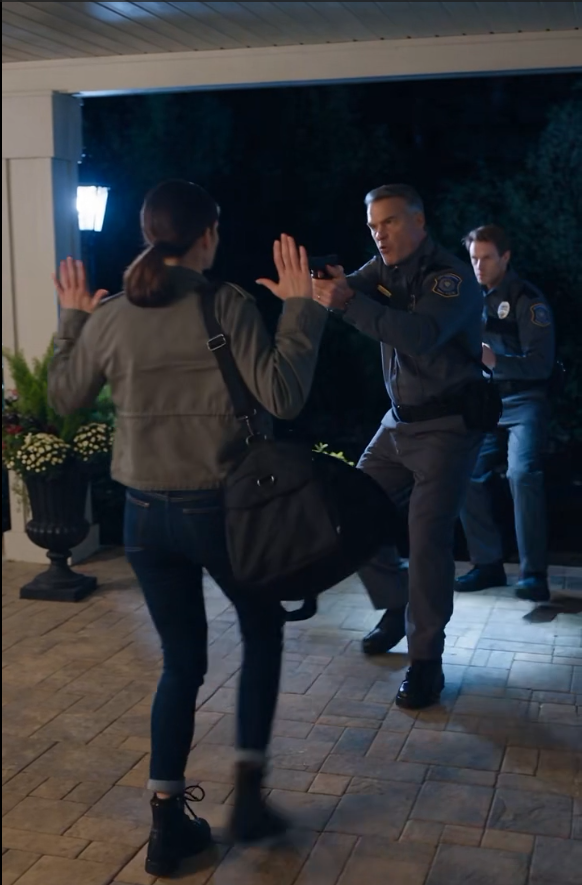
She looked up.
“About what?”
“I wanted a monster.”
Amy waited.
“It would be easier if he were one.”
She understood.
A monster would have let everyone else off the hook.
But Marcus had not walked into Willow Ridge and seized power.
He had been hired.
Renewed.
Praised.
Defended.
Given keys, a vehicle, authority, a uniform, and a title.
Residents had laughed about him.
Complained about him.
Then accepted him.
Including me.
The central question was no longer why Marcus believed he could point a gun at my daughter.
The answer was becoming obvious.
For years, enough people had taught him he could.
Part IV — Reckoning
The arrest came on Wednesday morning.
Marcus was charged with offenses related to the armed encounter and the subsequent handling of security evidence. The exact legal language mattered less to me than the fact that he was no longer free to reduce the night to a disagreement over procedures.
His lawyer issued a statement before lunch.
Marcus had acted “in good faith while responding to suspicious behavior.”
The statement accused Amy of refusing lawful commands and suggested her federal status was being used to “intimidate a private security professional after the fact.”
I read it twice.
Then a third time.
Amy took the paper from my hand.
“You’re doing that thing again.”
“What thing?”
“Trying to get angrier by rereading it.”
“It’s working.”
She threw it into the recycling bin.
“Then stop.”
The criminal case moved slowly.
The HOA crisis moved faster.
Residents demanded a meeting.
The board scheduled one for Friday evening in the community clubhouse.
Amy had planned to fly home that afternoon.
I assumed she would postpone.
She didn’t.
“My leave ends Monday.”
“So?”
“So I have a job.”
“You’re leaving before the meeting?”
“Yes.”
I stared at her.
“Amy.”
“What?”
“You can’t.”
“Why?”
“Because this is about you.”
“No. The criminal case is about what Marcus did to me. The meeting is about what this neighborhood allowed.”
“And you’re part of that.”
“I don’t own property here.”
“You grew up here.”
“Not in Willow Ridge.”
That was true.
I had moved here after Amy was already in college.
She had visited only occasionally.
“That’s not the point.”
“Then what is?”
I struggled to answer.
Finally I said, “I don’t want to stand in that room alone.”
Amy’s expression changed.
There it was.
The thing beneath all my anger.
She came around the kitchen island.
“You should’ve said that first.”
“I just did.”
She leaned against the counter.
“I can change my flight to Saturday.”
“Thank you.”
“But I’m not speaking for you.”
“I didn’t ask you to.”
“You were going to.”
I sighed.
“Maybe.”
“This is your community.”
“It doesn’t feel like it.”
“Then decide what you want it to be.”
Friday night, the clubhouse parking lot was full twenty minutes before the meeting.
The board had placed rows of folding chairs in the main room.
Every one of them was occupied.
People stood along the walls.
Marcus was not there.
His attorney had advised him against attending.
The absence felt strange.
He had dominated Willow Ridge for years, and now everyone had gathered because of him while the chair he usually occupied near the back wall remained empty.
Nolan stood near the side entrance.
He looked more nervous than he had on my porch.
I approached him.
“You all right?”
“No.”
“Good answer.”
He smiled briefly.
Amy came in behind me.
Conversations softened.
Heads turned.
I hated it immediately.
Amy seemed not to notice.
She chose two chairs halfway back instead of sitting near the front.
The board president opened with a prepared statement.
He expressed concern.
He described a review.
He promised reforms.
No one believed him.
Questions began.
Why had Marcus been allowed to carry a gun?
What training had he received?
Had the board known he had not retired honorably?
Why hadn’t complaints been investigated?
Who shut down the camera server?
Why did the first community email describe Amy as a nonresident?
The board president tried to answer.
Then tried not to answer.
Then lost control of the room.
A man near the aisle stood.
“My wife has called Marcus three times in the last year because people were cutting through our yard. We wanted security. Now everybody’s acting like the board hired some lunatic out of nowhere.”
Someone shouted from the back, “He pulled guns on people before!”
“We didn’t know that.”
“You didn’t ask.”
“I’m talking to the board.”
Another resident stood.
“This is turning into a witch hunt.”
Amy remained still beside me.
I leaned toward her.
“How are you not saying anything?”
“Because they’re finally talking about the right thing.”
“What?”
“Themselves.”
The meeting grew uglier.
People who had praised strict security blamed the board.
Board members blamed incomplete background information.
Residents who had complained about Marcus claimed they had always known he was dangerous.
Others insisted nobody could have predicted the porch incident.
Then Nolan walked to the microphone.
The room quieted.
He didn’t look at Amy.
He looked at the board.
“My name is Nolan Pierce. I worked under Marcus Hale for eighteen months.”
Someone near the front muttered something.
Nolan continued.
“I saw him draw his firearm on people before Ms. Johnson.”
Silence.
The board president leaned toward his microphone.
“Mr. Pierce, because there is an active criminal investigation—”
“I already gave this information to police.”
The president stopped.
Nolan gripped the podium.
“I saw it twice. I knew of at least one other time. I didn’t report him outside the security chain.”
His voice shook.
“I told myself that if nobody got hurt, then maybe I was overreacting. I told myself he had more experience than me. I told myself I needed my job.”
He swallowed.
“Those were excuses.”
No one interrupted.
“The night at this house, Ms. Johnson did not threaten him. She didn’t reach for anything. Marcus drew before she even turned around.”
A woman near the wall whispered, “Jesus.”
Nolan looked toward me then.
“I should have said something sooner.”
I didn’t know what to say.
Amy did.
“Say the rest.”
Everyone turned toward her.
Nolan looked confused.
Amy nodded toward the microphone.
“Tell them what happened after.”
Nolan understood.
“He called me the next morning and told me to change my statement.”
The room erupted.
The board president struck the table with his palm.
“Order.”
Nobody cared.
Nolan spoke over the noise.
“He wanted me to say Ms. Johnson reached inside her jacket before he drew.”
“Did she?” someone shouted.
“No.”
The answer rang through the clubhouse.
“No,” Nolan repeated. “She didn’t.”
The board president finally restored enough quiet to continue.
Then he did something I didn’t expect.
He apologized.
Not the polished kind.
Not the language from the emails.
He looked old under the fluorescent lights.
“We failed.”
Nobody moved.
He removed his glasses.
“We treated complaints as personality disputes. We accepted a background check that satisfied the minimum requirement and never asked why a former officer with seventeen years of service had left before retirement eligibility. We allowed the security department to review its own complaints. We gave one individual too much operational authority without independent oversight.”