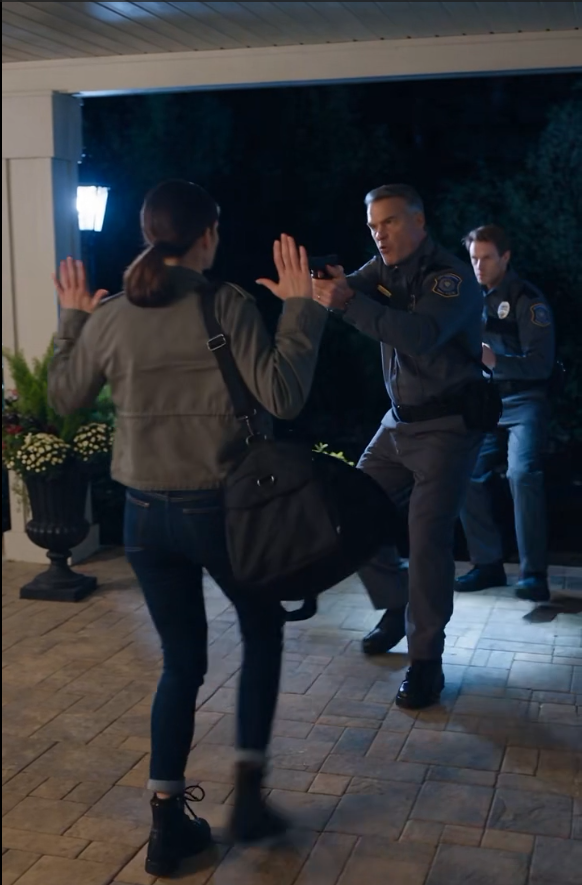
Stopped.
Amy turned toward my house.
Marcus got out.
Even without audio, I could see when he called to her.
She stopped.
Then Marcus’s arm moved.
The pistol appeared.
Amy had not even turned around yet.
A sound traveled through the courtroom.
Not a gasp.
Just the collective adjustment of people seeing something that had previously existed only in words.
The video continued.
Amy turned slowly.
Raised one hand.
Marcus advanced.
She remained almost perfectly still.
Watching it was worse than living it.
The night itself had been chaos.
The video was calm.
Objective.
Merciless.
Marcus’s attorney tried to argue the angle didn’t show Amy’s right hand clearly during one moment.
The prosecutor played a second camera.
A wider view from the opposite entrance.
Both hands visible.
No reach.
No threat.
Then came the security-office footage.
That was new.
A camera inside the operations room showed Marcus entering after police released him from the scene.
11:43 p.m.
He sat at a terminal.
11:46.
He made a phone call.
11:48.
The monitor went dark.
The prosecution had recovered logs showing his credentials were used to shut down the primary recording server at that exact time.
Marcus stared at the table.
His lawyer requested a break.
The judge denied it.
Then Nolan testified.
He told the same story he had told police.
Marcus drew first.
Amy did nothing threatening.
Marcus asked Nolan the next morning to change his statement.
Under cross-examination, Marcus’s attorney attacked Nolan’s credibility.
“You were afraid you’d lose your job?”
“Yes.”
“You disliked Mr. Hale?”
“Sometimes.”
“You disagreed with his management style?”
“Yes.”
“You wanted to protect yourself after a controversial incident?”
“Yes.”
The attorney seemed pleased.
“So your testimony serves your own interest.”
Nolan thought about it.
“Some of it probably does.”
The lawyer blinked.
Nolan continued.
“But the video shows what I’m saying.”
That ended the exchange.
The prosecution then introduced Marcus’s employment history.
Not as evidence that he was automatically guilty because of prior conduct.
The judge was explicit about that.
The relevant issue was the HOA hiring file and Marcus’s statements about his law-enforcement departure, because those statements connected to his authority, training claims, and the board’s reliance on his representations.
The old records showed a pattern of disciplinary findings.
Weapon drawn during low-risk encounters.
Escalation after verbal noncompliance.
Inaccurate reporting.
And, in the final internal case, security video contradicting Marcus’s written account.
I stared at that line.
Security video contradicting written account.
Seven years later, he had done it again.
Only this time, he had known what a camera could do to his story.
That was why he shut down the server.
The clue had been sitting in his past all along.
Marcus knew exactly how dangerous video could be.
Because video had ended his police career.
During a recess, I found Amy alone near a courthouse window.
“You knew this was where it was going.”
“No.”
“But you suspected.”
“I suspected the server wasn’t random.”
“Because of his history?”
“I didn’t know the full history until discovery.”
She looked out at the parking lot.
“But people repeat solutions that worked before.”
“What worked before?”
“Leaving before the process finished. Controlling the report. Making the event harder to reconstruct.”
I thought about the first HOA email.
A nonresident individual.
Suspicious behavior.
Internal review.
A version created before facts.
Marcus had not invented that instinct on my porch.
He had lived by it.
“He almost got away with it before,” I said.
Amy nodded.
“And he thought he could again.”
After the recess, something unexpected happened.
Marcus’s attorney announced that Marcus wanted to testify.
Even his own lawyer looked unhappy.
The judge warned him about self-incrimination.
Marcus insisted.
He took the stand.
For the first several minutes, he sounded reasonable.
That was almost worse than the shouting on the porch.
He spoke about seventeen years in law enforcement.
About responsibility.
About how communities depended on people willing to confront suspicious behavior rather than ignore it.
He described Amy as “unknown at the time.”
He described the neighborhood as private property.
He said recent concerns about trespassing had heightened security awareness.
The prosecutor stood.
“When Ms. Johnson displayed FBI credentials, why didn’t you lower your weapon?”
“Credentials can be falsified.”
“Did you attempt to verify them?”
“No.”
“Why?”
“The situation was active.”
“What was active about it?”
“She was refusing commands.”
“What crime did you believe she had committed?”
“Possibly trespass.”
“At her father’s home?”
“I didn’t know he was her father initially.”
“When did you learn?”
“When he opened the door.”
“Did you lower the weapon then?”
Marcus hesitated.
“No.”
“Why not?”
“She remained noncompliant.”
The prosecutor let the answer sit.
Then asked, “At that point, what exactly was Ms. Johnson required to comply with?”
Marcus looked toward Amy.
For the first time all day, she met his eyes.
He looked away.
“My instructions.”
“Under what authority?”
“I was responsible for security.”
“That was not my question.”
Marcus’s face began changing.
I recognized it.
The same tightening around the mouth.
The same flush near the collar.
Embarrassment turning into defiance.
The prosecutor asked, “Did you have arrest authority?”
“No.”
“Probable cause to believe she had committed a felony?”
“No.”
“Did you see a weapon?”
“No.”
“Did she threaten you?”
“Not verbally.”
“Did she threaten you physically?”
“She refused orders.”
“That is not what I asked.”
Marcus leaned toward the microphone.
“She challenged me from the moment I approached her.”
Amy did not move.
The prosecutor paused.
“What do you mean by challenged you?”
“She kept telling me what I could and couldn’t do.”
“You mean she told you to lower your gun?”
“Yes.”
“And you considered that a challenge?”
Marcus realized too late where the question had taken him.
His attorney objected.
The judge overruled.
The prosecutor stepped closer.
“Mr. Hale, you testified that your actions were based on safety. The video shows you drawing your weapon before Ms. Johnson turned to face you.”
“I didn’t know what she had.”
“You didn’t know she had a weapon.”
“I didn’t know that she didn’t.”
The prosecutor waited.
Then said, “You understand those are not the same thing?”
Marcus stared at him.
The prosecutor returned to the table.
One last question.
“Why did you shut down the recording server at 11:48 p.m.?”
Marcus’s attorney stood.
“Objection.”
Overruled.
Marcus looked toward the judge.
Then the prosecutor.
“I was securing the system.”
“From what?”
“Unauthorized access.”
“Whose?”
“I had concerns.”
“What concerns?”
Marcus said nothing.
The prosecutor held up a printed service report.
“The contractor found no external access attempt. No malware. No outage. No system fault.”
Marcus’s face was damp now.
“Why did you shut it down?”
“I already answered.”
“No. You didn’t.”
Marcus’s attorney objected again.
The judge instructed the prosecutor to move on.
But the answer was already there.
In the silence.
The court later ruled that the case would proceed.
There would be no quiet dismissal.
No administrative misunderstanding.
No return to Willow Ridge with everyone pretending the night had been complicated.
Outside the courthouse, reporters waited.
Not many.