Just enough.
Amy stopped when she saw them.
“You knew?”
“No.”
“You want to go out another door?”
She considered it.
Then shook her head.
“No.”
We walked through the main entrance.
Questions came immediately.
“Agent Johnson, do you believe Mr. Hale targeted you because you’re federal law enforcement?”
No response.
“Do you think the HOA is responsible?”
No response.
“Will you file a civil suit?”
Amy kept walking.
Then one reporter called, “What would you say to private security officers watching this case?”
Amy stopped.
I nearly walked into her.
She turned.
Cameras lifted.
For several seconds she said nothing.
Then:
“Authority isn’t measured by how quickly someone obeys you. It’s measured by what you do when they don’t.”
That was all.
She turned and walked away.
By the time we reached the parking lot, the sentence was already being uploaded somewhere.
I shook my head.
“What?”
“You know that’s going to follow you around.”
“I know.”
“You could’ve kept walking.”
“I know.”
“Why didn’t you?”
Amy unlocked the car.
“Because Nolan should’ve heard someone say it years ago.”
That was the closest she ever came to explaining.
Part VI — Aftermath
Marcus never returned to Willow Ridge.
Months later, the criminal case ended with a negotiated disposition that permanently barred him from armed private-security work and carried legal consequences for the incident and the attempted destruction of evidence.
Some residents thought the result was too harsh.
Others thought it was too lenient.
For once, I stopped reading what they thought.
The HOA settled separately with Amy.
She refused to discuss the amount with me.
“Confidential.”
“You’re my daughter.”
“Still confidential.”
“What are you doing with it?”
“That’s also none of your business.”
Two weeks later, Willow Ridge announced a new training fund.
Every security contractor working on the property would receive de-escalation training, use-of-force instruction, legal-authority review, and independent complaint monitoring.
The program was funded for five years.
I called Amy.
“You did this.”
“I don’t know what you’re talking about.”
“Of course you do.”
“Sounds like the HOA made a good decision.”
“Amy.”
“I have to go, Dad.”
She hung up.
I laughed alone in my kitchen.
Nolan came by the following spring.
The porch looked different.
I had replaced the light fixture.
Not because anything was wrong with the old one.
I simply got tired of seeing the exact same pool of yellow light in which Marcus had stood.
Nolan noticed.
“Looks brighter.”
“It is.”
He had put on some weight.
He looked healthier.
He told me he was working security for a medical office complex.
Unarmed.
“I like it better.”
“Less exciting?”
“Much.”
We sat on the porch.
He looked at the steps.
“You ever think about that night?”
“Yes.”
“Me too.”
He rubbed his palms together.
“I still hear myself not saying anything.”
“You eventually did.”
“Eventually.”
I let that sit.
Nolan looked toward the street.
“I keep wondering what would’ve happened if she hadn’t been FBI.”
I turned to him.
He continued.
“If it had been somebody who didn’t know how to stand, where to put their hands, what to say.”
I had wondered the same thing.
Often.
“What do you think?”
Nolan shook his head.
“I don’t know.”
Neither did I.
That uncertainty became the part I could never shake.
Amy’s credentials had not saved her at first.
Marcus saw them and ignored them.
Her training had not magically controlled him.
It had only helped her avoid making a dangerous situation worse.
The truth was more uncomfortable.
Another person might have panicked.
Reached for a phone.
Turned too quickly.
Argued.
Tried to walk away.
Done something completely innocent that Marcus interpreted as defiance.
And then the story might have ended on my porch instead of in a courtroom.
That realization changed how I thought about the entire incident.
For months, I had treated Amy’s profession as the twist.
Marcus thought he was threatening an ordinary woman and discovered she was an FBI tactical commander.
That was the version neighbors repeated.
It was dramatic.
Satisfying.
Almost funny once everyone knew she survived.
But it was wrong.
Amy’s position should never have mattered.
A person should not need federal credentials to make an armed man respect the limits of his authority.
A daughter walking to her father’s front door should have been enough.
A resident saying, She belongs here, should have been enough.
An empty hand should have been enough.
Nothing suspicious found should have been enough.
At some point, enough had to mean enough.
Willow Ridge changed slowly.
The gate remained.
The HOA remained.
People still argued over lawns and parking.
But the security culture changed.
The new guards were less visible.
They asked more questions and gave fewer commands.
Complaints went to an outside company.
Every use-of-force report triggered automatic video preservation.
The security chief no longer controlled access to recordings.
People grumbled that the new system was bureaucratic.
I found I liked bureaucracy more than I used to.
Bureaucracy, when designed correctly, made it harder for one angry man to become the entire system.
Amy visited again eleven months after the incident.
This time her flight arrived in the afternoon.
I offered to pick her up.
She refused.
“I know where the house is.”
“Your last driver didn’t.”
“I’ll survive.”
At 4:12, I heard a car outside.
I went to the window.
Amy stepped onto the sidewalk.
Dark jeans.
Gray jacket.
Boots.
For a second, the sight knocked the air out of me.
Same clothes.
Maybe not exactly.
Close enough.
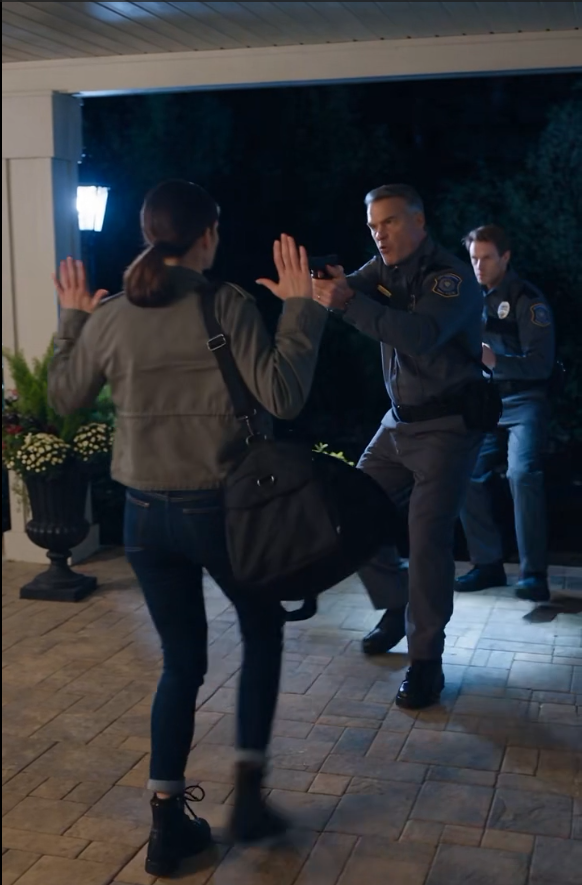
A black duffel bag hung from her shoulder.
She paid the driver, turned, and started walking toward the porch.
No security SUV.
No flashlight.
No voice shouting freeze.
Just Amy.
She saw me through the window.
I opened the door.
“You planning to make me stand out here?”
“You have a key.”
“I did last time too.”
I smiled despite myself.
She reached the porch.
Before stepping inside, she glanced toward the bottom step.
I knew exactly what she was looking at.
“So,” I said, “you staying more than two days this time?”
“Four.”
“Four whole days?”
“Try not to make it weird.”
“No promises.”
She stepped inside and dropped her duffel bag.
Then she looked down at her boots.
I watched her.
Amy looked back at me.
“What?”
“Nothing.”
She kicked one boot off.
Then the other.
Exactly as she had when she was sixteen.
Exactly as she had before jobs became classified and visits became rare and the world taught both of us how much could happen between one open door and the next.
She walked toward the kitchen.
“I’m starving.”
“There’s food.”
“Actual food?”
“I cooked.”
“That wasn’t my question.”
I followed her, offended on principle.
Behind us, evening light stretched across the empty porch.
There was no uniform at the bottom of the steps.
No gun.
No trembling flashlight.
No one demanding proof that she belonged.
Only her boots by the door and the small scratches her duffel had left on the floor.
For almost a year, I had imagined that the most important moment of that night was Marcus finally learning who Amy was.
An FBI tactical operations commander.
A woman trained to make decisions under pressure.
Someone far more capable than the frightened intruder he had invented in his head.
I had been wrong.
The important thing was not who she was.
It was where she had been going.
Home.
And as Amy opened my refrigerator and complained that I still bought the wrong kind of milk, I finally understood the simplest truth Marcus had missed when he raised that gun.
She should never have needed to be anyone special to make it safely to my front door.