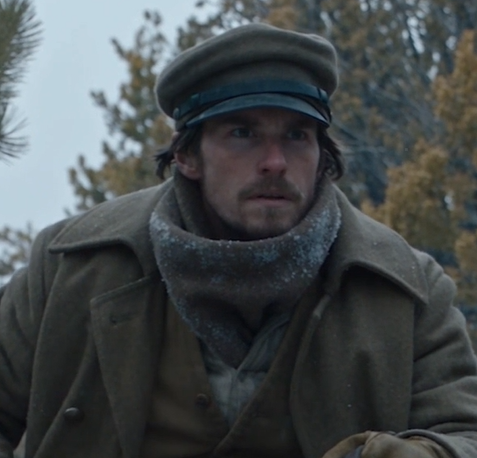
“Stand, Rust.
Damn you, stand.”
Caleb grabbed the warrior by his buckskin belt and the collar of the shearling coat.
He hauled him upward, his boots slipping on the frozen stones, his bad knee buckling twice until he screamed through his clenched teeth.
With a final, lung-bursting heave that left the taste of copper in his throat, he rolled the warrior belly-down across the saddle.
The Apache groaned, his head lolling against the dun’s off-flank.
Caleb took the rawhide latigo and lashed the man’s wrists to the cinch rings, then tied his good leg under the horse’s belly to keep him from sliding off into the drifts when the trail turned vertical.
He picked up his gunbelt, buckled it around his waist with numb, clumsy fingers, and slid the Winchester back into its scabbard.
He had no coat.
He had no gloves other than his thin buckskin mittens, now stiff with frozen blood.
He had twenty miles of wilderness between himself and any white settlement, and he was heading in the opposite direction.
He knew where the Apache winter rancherias were.
Every scout who had ever ridden with Woolsey knew: they were tucked into the high, secret amphitheaters of the Black River canyons, behind walls of columnar basalt where no cavalry patrol could ride without losing three horses to the scree.
To go there was madness.
It was walking into the mouth of a kiln with a bundle of dry straw on your back.
“Tonto Basin,” Caleb whispered to the falling snow, his lips numb and clumsy.
“You didn’t die there, Caleb.
Maybe you’re supposed to die here.”
He took Rust’s lead rope in his bare right hand and began to walk.
The world ceased to have depth.
It became a white, whirling cylinder of wind and pine needles.
For the first two hours, Caleb could feel his toes.
They throbbed with a rhythmic, pulsing fire that matched his heartbeat.
By the third hour, the fire went out, replaced by a strange, wooden lightness, as though he were walking on two cedar stumps strapped to his shins.
His hands were past feeling.
He kept the lead rope wrapped twice around his forearm so that when his fingers finally failed entirely, the horse would still drag him forward.
Every twenty paces, his mind would drift.
He saw the smoke again.
But it was not the smoke of the Tonto villages; it was the chimney smoke of his father’s farm in the Shenandoah Valley, smelling of hickory chips and dried apples.
He saw his sister Sarah standing by the well-sweep, her apron blowing in the spring breeze, holding a tin dipper of cold, sweet spring water.
Just sit down, Caleb, the wind seemed to say in Sarah’s voice. The grass is soft under the fence. You’ve been walking since sixty-one. Just sit down and take your boots off.
He stumbled.
His bad knee struck a buried limestone boulder, and he went down into the drift on his face.
The snow was warm.
That was the terrible lie of it.
It felt like a down quilt plucked from his grandmother’s cedar chest.
It invited his cheek to rest, invited his eyelids to settle over his stinging pupils.
He could just lie here.
Rust would stay by him until the wolves came; the Indian on the saddle would slip into the great dark without ever knowing who had freed his foot from the iron.
A hand moved on the saddle above him.
A groaning voice—weak, raspy, but thick with authority—spoke a single word in the Athabaskan tongue.
“Doo-dah.”
Caleb forced his head up.
The warrior was conscious.
He had lifted his head from Rust’s shoulder, his black eyes bloodshot and swollen, staring down through the curtain of snow at the white man lying in the drift.
He looked at Caleb’s bare shoulders, clad only in the thin vest and the frozen cotton tunic.
He looked at the shearling coat wrapped around his own broken chest.
Their eyes met through the white gale.
There was no hatred in the warrior’s face now.
There was only a terrible, solemn wonder—the look of a man who has crossed the river of death, looked back, and seen his enemy building a bridge for him out of his own bones.
“Doo-dah,” the warrior repeated, his voice cracked like dry leather.
He made a faint, upward jerk of his chin. Get up.
Caleb dragged himself up Rust’s front leg, using the horse’s shoulder as a ladder, until he was on his feet again.
His teeth were locked together so tightly his jaw ached down into his collarbones.
“I’m…
I’m up,” Caleb croaked.
“Don’t… don’t you worry, chief.
I’m up.”
They climbed through a notch in the rimrock where the wind screamed like a banshee, cutting through the gap with such force that Rust had to lean thirty degrees into the blow to keep his footing.
On the other side, the land fell away into a deep, sheltered box canyon, timbered with heavy fir and giant blue spruce that broke the fury of the northern storm.
Caleb did not see them until they were six feet away.
They materialized out of the grey timber like spirits formed from the falling snow: six men on short, shaggy mountain ponies, their faces blackened with charcoal and grease for war, their hands holding short-barreled carbines and iron-tipped lances wrapped in otter fur.
Rust stopped.
Caleb did not reach for his rifle.
He could not have lifted his arm if an emperor had offered him a crown for the motion.
He simply stood there, swaying on his dead feet, his hands hanging by his sides, his breath coming in faint, grey wisps that barely disturbed the snow on his beard.
One of the horsemen—a lean, scarred warrior with a Mexican bridle on his pony—leveled a flintlock trade gun at Caleb’s chest.
The hammer was drawn back to full cock; the pan was protected from the snow by a greasy square of flannel.
Caleb looked at the black hole of the muzzle.
Let it come, he thought. At least it’s quick. At least it’s warm.
A sudden, sharp bark came from the saddle of the dun gelding.
The wounded warrior on Rust’s back lifted his head.
He spoke in a voice that was hoarse and broken, yet filled with a sudden, imperious thunder that brought every horse in the draw to a dead halt.
The riders froze.
The man with the flintlock lowered his gun an inch, his eyes darting from the white man to the figure lashed across the saddle.
“Nalche!” the rider cried out.
A chorus of guttural, astonished shouts erupted from the timber.
Two more horsemen rode forward, their ponies stepping gingerly through the drifts.
They looked at the swollen, bandaged leg; they looked at the splints of scrub oak tied with grey flannel; they looked at the heavy sheepskin shearling coat of a white soldier buttoned around the son of their clan.
The scarred rider swung down from his pony.
He did not look at Caleb.