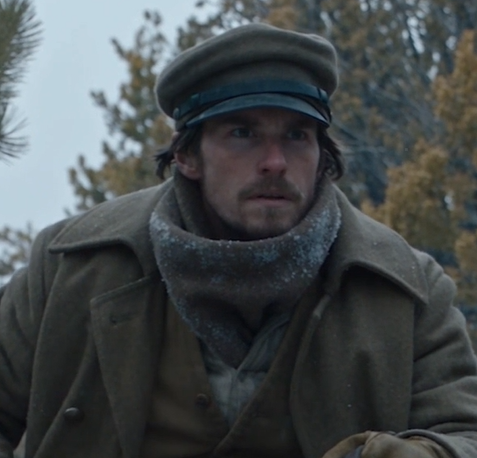
He drew a knife, sliced the rawhide lashings that held the wounded man to the saddle, and caught him as he fell forward, two other warriors leaping down to help lower him into the snow.
Nalche lay in their arms, speaking rapidly in short, breathless bursts, his fingers pointing back at the trail, then down at the blood-stained flannel on his leg, and finally at Caleb’s bare, shivering chest.
The warriors turned their heads.
Six pairs of black, unreadable eyes looked at Caleb Morrison.
Caleb tried to speak.
He wanted to tell them that the dun horse was a good horse, that they should take care of him and not eat him if they could help it, because Rust had never failed a man on a mountain trail.
He opened his mouth, but his tongue was like a stone in his cheek.
The world tilted thirty degrees to the left.
The grey spruce trees rushed up to meet him, and Caleb Morrison fell into the white drift, his face hitting the snow without him ever feeling the cold of it.
He woke to the smell of burning piñon wood and grease.
It was the smoke that brought him back, but this smoke did not have the sour, oily stench of burning corn and burning flesh that had haunted his dreams since the Tonto Basin.
It was clean.
It smelled of pitch, dried sage, and the sweet, musky steam of boiling venison.
Caleb opened his eyes.
He was lying on a thick bed of dried grass covered with three layers of mountain lion and buffalo robes.
Above him, the smoke-hole of a conical wickiup opened toward a circle of grey winter sky, where the flakes of snow sizzled as they fell into the low, glowing coals of a central hearth.
He tried to lift his hands.
They were wrapped in clean, pounded buckskin, smelling heavily of some bitter, yellow herbal mash that pulled the throbbing ache from his skin.
His feet, too, were bundled in hot stones wrapped in wool, the heat radiating up into his calves with a sharp, prickling needle-pain that told him the flesh was alive, even if it was angry.
Beside the fire sat an old woman, her face wrinkled like a dried persimmon, stirring a clay pot with a peeled willow stick.
When she saw his eyes open, she did not move, did not speak; she simply looked at him with the cool, incurious gaze of a hawk on a fence post, then dipped a horn spoon into the broth and set it on a flat stone near his shoulder.
A shadow crossed the low entrance of the wickiup.
The hide door was pushed aside, admitting a blast of cold mountain air, and a man stepped inside, stooping low beneath the willow poles.
He was an old man, past sixty winters, but he carried himself with the heavy, unbending dignity of a pine that has survived three forest fires.
His hair was iron-grey, parted in the center and braided with strips of red wool.
Across his cheek ran a long, pale scar where a Mexican saber had laid the bone bare thirty years ago.
He wore a simple buckskin shirt, unadorned except for a necklace of bear claws and silver buttons hammered from Spanish coins.
It was Chief Takakota.
Caleb had never seen him in the flesh, but every scout in the territory knew the profile.
He was the war chief who had driven the California Column out of the Chiricahua foothills in ’62, the man who had out-thought three cavalry colonels and kept his band free while the rest were being herded like cattle onto the malaria-choked flats of the Bosque Redondo.
Behind the chief stood Nalche.
The younger warrior was leaning heavily on a crutch fashioned from a forked juniper branch, his left leg wrapped in fresh white doe-skin, his face still pale from the blood-loss, but his eyes clear and steady.
Over his shoulders, he still wore Caleb’s sheepskin shearling coat.
Takakota stood over the fire, looking down at the white man lying in the robes.
He looked for a long time, his gaze traveling from Caleb’s bandaged hands to his hollow, bearded cheeks, and finally to his eyes.
“You speak the Mexican tongue?”
Takakota asked.
The words were Spanish, spoken with the clipped, harsh accent of the mountain Ndé, but they were clear.
Caleb swallowed, his throat raw. “Un poco,” he whispered in the same tongue. A little.
Takakota nodded.
He sat down cross-legged on the dirt opposite the fire, his hands resting on his knees.
The firelight flickered across the saber scar on his cheek, casting deep, shelf-like shadows under his brow.
“My son told me of the iron,” Takakota said, his voice low, vibrating in the small space of the lodge like the rumble of distant thunder.
“He told me of the two springs that three men cannot bend.
He told me that a white soldier came through the timber with a rifle that shoots twelve times.”
The old chief leaned forward, his black eyes fixing Caleb with a weight that made the breath catch in the soldier’s throat.
“He told me the white soldier put his rifle in the snow.
He told me the white soldier stepped upon the iron with his own feet.
And when the iron was open, the soldier took the skin from his own back and put it upon a dying Apache.”
Takakota looked back at Nalche, who stood silent in the shadows of the lodge, his hand resting on the wool collar of the coat.
“Three years ago,” Takakota continued, his voice dropping an octave, each word falling like a lead ball into a deep well, “men who wear coats like that came to the Tonto.
They came to the camp of my brother, Delshay.
They came with sacks of pinole.
They said: Eat with us. Let us make a treaty so the wagons may pass.“
Caleb felt his heart stop.
A cold sweat, colder than the blizzard on the rim, broke out across his temples.
“My brother sat with them,” the chief whispered.
“The children sat with them.
And while their mouths were full of corn meal, the soldiers pulled pistols from their coats and shot twenty-eight men, women, and babies.
They took their scalps for the governor in Tucson.
They burned the winter squash.”
Takakota reached down to his belt.
His hand came away with a knife—not an iron butcher knife, but an old Spanish dagger with a cross-guard of rusted brass and an eight-inch blade ground down to a razor’s edge.
He did not raise it to strike.
He laid it flat across his palms, holding it out over the coals between them.
“When my riders brought you into the canyon,” Takakota said, “the young men said: Cut his throat. Let his blood run into the snow to feed the spirits of the children who died in the Tonto. They said: He is one of them. He wears their boots. He carries their lead.“
Caleb closed his eyes.
The memory of the dust-filmed eyes of the old man in the squash patch came back to him with an agonizing, crystalline brightness.