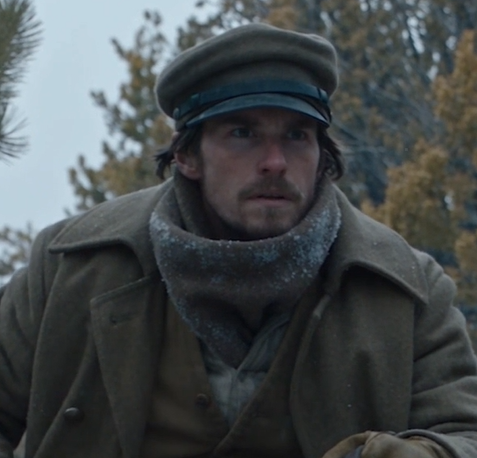
“They were right,” Caleb whispered in Spanish, his voice shaking.
“I was there.”
The lodge went so quiet that the sizzle of the fat in the pot sounded like a rifle shot.
Nalche shifted his weight on the juniper crutch, his fingers tightening on the sheepskin coat.
Takakota did not move.
His face was an immovable mask of red granite.
“You were there?”
“I was there,” Caleb said.
He opened his eyes and looked directly into the old chief’s face.
He was tired of running.
He was tired of the silence, tired of the empty cabin on the Verde, tired of carrying the dead across three hundred miles of mountains.
“I didn’t shoot the children.
I shot the ground.
But I stood in the line.
I took their pay.
I watched the smoke go up, and I did not stop it.”
Caleb pulled his hands from the buffalo robe, holding up the bandaged, useless bundles before the chief.
“Take the hair,” Caleb said, his voice flat, clean, and emptied of fear.
“You have the right of it.
I’ve been dead since sixty-four anyway.”
Takakota looked at Caleb’s open, unguarded face.
He looked at the white man’s hands—the hands that had torn their own flesh against the Swedish iron, the hands that had bound his son’s splintered leg with the cloth from his own back.
Slowly, the old chief turned the dagger in his hands.
He did not raise the point.
He reversed the weapon, took the cold steel blade in his own fingers, and extended the brass hilt across the fire, offering it to Caleb.
“Your blood,” Takakota said, his voice rising, filling the wickiup with a strange, fierce music that was older than the soldiers, older than the missions, older than the iron traps of the white skinners, “your blood was dirty when you walked into that draw.”
He pointed the hilt directly at Caleb’s breastbone.
“The blood you spilled in the Tonto—the blood of your silence—that blood died in the snow when you gave your skin to my son.
You left it on the iron jaws.
You left it on the stones.”
The chief leaned closer, until Caleb could smell the sage and the old mountain smoke on the elder’s breath.
“A man who kills for his tribe is only a dog following the pack,” Takakota said.
“A man who gives his own life to an enemy who holds a knife at his throat… that man has no tribe.
The Great Spirit has stripped him bare so that he may be born again.”
The old woman by the hearth set the clay bowl down with a soft click.
Nalche stepped forward from the shadow of the door.
With his right hand, the young warrior reached out and touched Caleb’s shoulder—not with the tentative curiosity of a stranger, but with the heavy, firm grip of a brother who has shared a canteen on the edge of the grave.
“You have no people now, white soldier,” Takakota said, and for the first time, the corner of the old chief’s mouth softened into something that resembled mercy.
“The blue-coats will call you a traitor.
The towns will call you an Indian lover.
But here, in the shadow of the rim, while the snow covers the world…”
Takakota laid the brass dagger across Caleb’s bandaged chest, right over his beating heart.
“Here, your blood is ours.”
The storm blew itself out on the fourth day.
When Caleb Morrison finally limped out of the wickiup on two swollen, throbbing feet, the sun was bursting over the Mogollon Rim like an explosion of liquid gold against the snow.
The air was clean and sharp, tasting of frozen pine and ozone, so bright that it hurt a man’s eyes to look at the cliffs.
Down in the draw, the children of the rancheria were sliding on sleds made of buffalo ribs, their high, clear laughter echoing off the four-hundred-foot walls of red basalt.
Near the horse corral, Rust stood with his head over the willow rail, his dun coat thick with winter grease, munching contentedly on a bundle of dry grama grass that two young girls had carried to him in a willow basket.
Caleb stood in the sunlight, wearing a pair of soft, smoked buckskin trousers and a new shirt of deer hide, embroidered across the shoulders with black and white porcupine quills in the pattern of the hawk’s wing.
Over his shoulders, warm and familiar, hung his sheepskin shearling coat.
Nalche had returned it that morning, pressing the bone toggles into Caleb’s bandaged fingers with a quiet nod that required no words in any tongue.
Caleb looked south, toward the jagged blue haze where the Tonto Basin lay fifty miles away, buried under the winter clouds.
For the first time in three years, the smell of the smoke did not come to him.
The wailing of the women was gone, silenced by the steady, rhythmic beat of a water drum somewhere across the camp and the laughter of the children on the hill.
The guilt was not gone.
A man does not bury twenty-eight dead souls with a single act of iron.
But the weight was different now.
It was no longer an anchor dragging him down into the grey shale; it was a debt, being paid one day at a time, one breath at a time, among the people he had once watched burn.
He reached into his pocket, pulled out a small piece of dried venison, and began to limp slowly down the hill toward his horse, his boots leaving two deep, steady tracks in the clean, unbroken white of the Arizona snow.