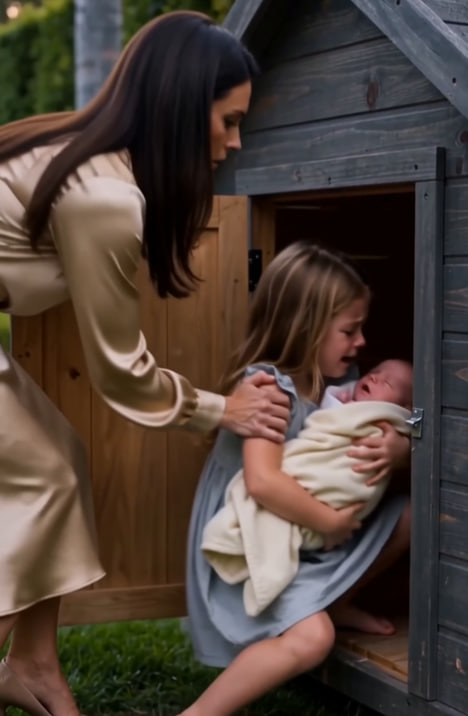
Vale Estate had never really been Adrian’s.
That fact once embarrassed him.
Caroline never cared.
Her grandmother, Elizabeth Rowan, had purchased the property decades earlier.
When Caroline inherited, she modernized the mansion but preserved the gardens.
After Caroline died from leukemia when Maisie was three, most of her interest went into trust for their daughter.
Adrian received thirty percent outright and lifetime conditional occupancy while raising Maisie.
He had called the structure “overprotective.”
Caroline replied from her hospital bed:
“That’s what trusts are for.”
Now Adrian sat across from Evelyn Hart while she explained why.
The estate was worth approximately $8.6 million.
Debt:
None.
Maisie’s trust held seventy percent.
Adrian thirty.
No refinance without trustee approval.
No sale unless Evelyn, as independent trustee, concluded it served Maisie’s interests.
Seraphine entered Adrian’s life a year after Caroline died.
They married eighteen months later.
Clara was born five weeks ago.
Seraphine had no ownership interest in Vale Estate.
She knew.
At first, she said she did not care.
Then she began renovating.
New garden furniture.
Pool deck.
Interior art.
Nursery.
Some paid from joint funds.
Some from Seraphine’s personal money.
Adrian let her.
Maybe that helped her begin thinking of the estate as hers.
Evelyn handed him the loan application.
Applicant:
Adrian Vale and Seraphine Vale.
Requested:
$4.2 million.
Purpose:
Debt consolidation, home renovation, family investment.
Adrian stared at his signature.
It looked real.
Electronic.
“Where did they get this?”
Evelyn asked:
“Have you signed documents through DocuSure recently?”
“Yes.”
“For company contracts.”
“Could Seraphine access your account?”
Adrian wanted to say no.
Then remembered.
Seraphine handled travel forms while Clara was due.
She knew his passwords to several household systems.
Not company credentials, supposedly.
But DocuSure used his personal email authentication.
The lender had not funded anything because title review revealed the trust.
Then Seraphine shifted strategy.
If Maisie no longer lived there—
perhaps she thought the trustee would allow sale or restructuring.
Evelyn said:
“She asked whether you could buy the trust’s interest.”
“With what money?”
“That is what I wondered.”
Adrian looked at the loan application again.
Four-point-two million was not enough to buy seventy percent.
Unless Seraphine expected a discounted internal transaction.
Or had another source.
Evelyn opened a second file.
Seraphine owned a company Adrian barely understood.
Serein House Wellness LLC.
Luxury postpartum products.
Online memberships.
Boutique retreats.
Adrian believed it had shut down.
It had not.
Debt filings showed secured obligations exceeding $1.1 million.
Personal guarantees:
Seraphine Vale.
Another private note:
$620,000.
Total known exposure:
Approximately $1.72 million.
Adrian stared.
“She told me she owed forty thousand.”
Evelyn shook her head.
“Not according to these records.”
Seraphine had not needed $4.2 million only for debt.
The remaining amount might fund a new venture.
Or purchase Adrian’s thirty percent if the estate were sold.
Adrian suddenly remembered something.
Two months earlier, Seraphine suggested moving to Palm Beach.
Vale Estate carries too much grief. Maisie might heal better somewhere new.
At the time it sounded compassionate.
Now it sounded transactional.
Evelyn said:
“There’s something else about Caroline’s trust.”
Adrian looked up.
“If Maisie is permanently removed from your care because of documented danger to another child, the trust appoints a professional guardian for her property interests.”
Adrian went still.
“Why?”
“Caroline wanted the trust protected if you ever became unable to prioritize Maisie.”
That sentence hurt.
“Does that mean I lose my occupancy rights?”
“Possibly. Depending on circumstances.”
Adrian understood.
If Seraphine could establish that Maisie was dangerous around Clara and Adrian sided with Seraphine—
Maisie might be placed elsewhere.
A professional guardian might eventually decide Vale Estate was unnecessary.
Adrian’s occupancy could end.
The trust’s share could be sold.
Adrian would receive his thirty percent of sale proceeds.
Roughly $2.5 million before costs.
Enough to combine with financing.
Enough for Seraphine’s plan.
He looked sick.
Evelyn said quietly:
“Caroline did not write this because she expected betrayal.”
“Then why?”
“She expected incentives.”
Adrian looked toward the old photograph on Evelyn’s desk.
Caroline holding three-year-old Maisie.
He whispered:
“I brought the incentive into the house.”
Evelyn answered:
“You brought a wife into the house.”
She paused.
“What she did afterward belongs to her.”
Adrian appreciated the distinction.
But it did not erase his blindness.
---