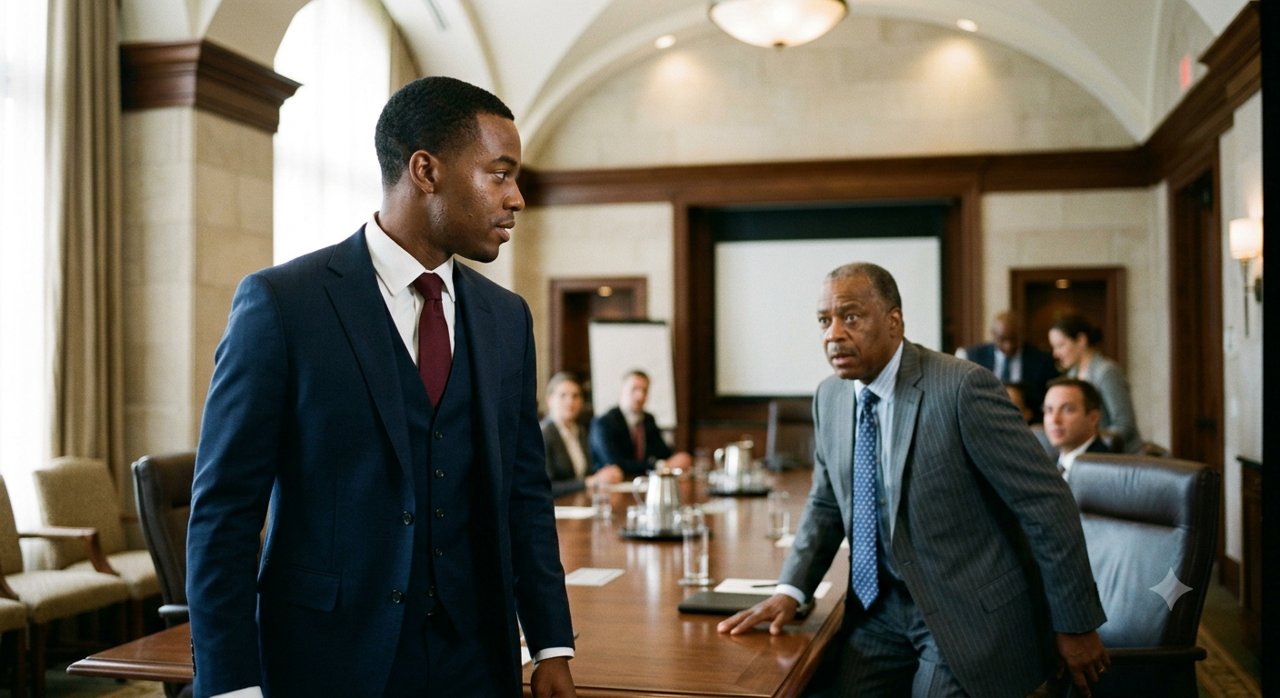
Grace Holloway arrived at seven-oh-two with a leather satchel under one arm and two coffees in the other.
She was fifty-three, precise, and had been Lucienne's attorney for eleven years.
She set the coffees on the conference table without being asked, opened the satchel, and began laying out documents in a row she had clearly already decided on.
"Marcus Delaney," she said, without looking up.
"Hired through a third-party staffing agency.
The agency has one corporate client on record.
A shell company registered in Delaware.
The shell traces back — through two layers — to a private equity fund managed by Harlan Voss."
Lucienne sat down.
"He planted him."
"Three years ago.
Right after you began the preliminary investigation into Voss's current fund." Grace looked up.
"He knew you were looking at him.
He put someone in your car."
"For three years."
"Yes."
Daniel was seated at the far end of the table.
He had slept in the guest room and eaten breakfast and looked, if not well, then at least present.
Solid.
He had borrowed a dark sweater and sat with both hands flat on the table, listening.
"What does the current case look like?" Lucienne asked.
Grace pulled a document to the center of the table.
"Strong, but not complete.
We have wire transfer records showing funds moved from three client accounts into a holding vehicle Voss controls personally.
We have two former employees willing to testify about pressure to falsify quarterly reports.
We have email correspondence that is — suggestive." She paused.
"What we don't have is a clear pattern of intent.
His defense will argue accounting error.
Mismanagement.
Not fraud."
"And if we can show he has done this before," Lucienne said.
"Deliberately.
Calculatedly.
With forged documents."
Grace looked at the worn letter in the center of the table.
She had read it when she arrived.
She had not said anything about it yet.
"That letter," she said carefully, "is twenty-five years old."
"It establishes a pattern."
"It establishes that he forged a personal letter to manipulate two young people.
A judge may not connect that to securities fraud."
"A jury will." Lucienne met her eyes.
"A jury of people who have children.
Who have been lied to.
Who understand what it means when a powerful man fabricates evidence to protect his financial interests." She let that sit.
"We don't need the letter to be the case.
We need it to be the story.
The story that makes everything else make sense."
Grace picked up her coffee.
Drank.
Set it down.
"You're going to meet him today," she said.
It wasn't a question.
"Noon.
The Aldrich Club."
"He'll have a lawyer present."
"He'll try not to.
He wants this to feel like a conversation between old friends." Lucienne straightened the folder in front of her.
"He's going to tell me my father ordered him to separate us.
He's going to present it as an act of loyalty."
"And if he has documentation supporting that?"
"Then we find out what that documentation actually says — and whether it's real." She looked at Daniel.
"You met with him alone.
In your apartment.
No witnesses."
"No," Daniel said.
"That's not entirely true."
Both women looked at him.
He had been quiet through most of Grace's summary.
Now he leaned forward slightly.
"My neighbor," he said.
"Mrs.
Calloway.
She was seventy at the time, lived directly across the hall.
She used to keep her door open in the evenings.
She saw Harlan come in.
She heard part of the conversation — enough to know it wasn't friendly.
She came to check on me afterward." He paused.
"She asked me if I was in trouble.
I told her no."
"Is she still alive?" Grace asked.
"I don't know.
I haven't been back to that building in twenty years."
Grace was already writing.
"Address," she said.
Daniel gave it.
"I'll have someone there by ten," Grace said.
Lucienne looked at the window.
The morning light was flat and gray — the kind of light that made everything look exactly as it was, without softening.
"There's something else," Daniel said.
They both looked at him again.
He reached into the pocket of the borrowed sweater and produced a small object — a USB drive, old and scratched, the kind that had been handled many times.
"After Harlan came to see me," he said, "I was frightened.
I didn't know who to trust.
So before I left — before I disappeared — I recorded everything I could remember him saying.
On a voice recorder I had from university.
I wrote it all down.
And I scanned every document he had shown me." He set the drive on the table.
"I've carried this for twenty-five years.
I didn't know what I was going to do with it.
I just knew I couldn't throw it away."
Grace stared at the drive.
"The documents he showed you," she said slowly.
"The ones he used to convince you that Lucienne's family was in danger."
"All of them.
Scanned.
Dated.
With his handwriting on the margins."
"If those documents are fabricated—"
"They are," Daniel said.
"I had them looked at.
Eight years ago, when I was trying to understand what had happened to my life.
A forensic document examiner.
I paid him with money I didn't really have." He looked at Lucienne.
"He confirmed it.
All of it was fabricated.
Created specifically to frighten me into leaving."
The conference room was very quiet.
Lucienne looked at the USB drive on the table.
Then she looked at Daniel.
"You've had this for eight years," she said.
"Why didn't you come to me?"
He held her gaze.
"Because by then I had nothing.
No home.
No work.
No way to reach you that didn't feel like I was asking you to save me." His voice was even.
Careful.
"I wasn't going to come back into your life as a burden.
I wasn't going to do that to you."
She wanted to say something.
Several things.
None of them came out right in her mind.
So she said: "You came back as a witness.
That's different."
He nodded once.
Grace picked up the USB drive and held it carefully, the way you hold something that has been waiting a long time to matter.
"I need to verify the contents before noon," she said.
"And I need to make three calls." She was already standing.
"Don't go to that meeting without me."
She left the room.
Lucienne and Daniel sat across the table from each other in the gray morning light.
"My father," she said finally.
"Do you think he knew what Harlan did?"
Daniel was quiet for a long time.
"I think," he said carefully, "that your father wanted us apart.
I think Harlan knew that.
And I think Harlan did what your father wanted — but went much further than your father ever asked.
Because it also served Harlan." He paused.
"I don't think your father forged a letter.
I don't think he would have done that.
But I think he looked the other way when you stopped looking for me.
And I think part of him was relieved."
It landed the way true things land — not like a blow, but like a door opening onto a room you had always suspected was there.
"He never liked you," she said.
"No."
"He was wrong."
Daniel looked at his hands.
At the bracelet.
"He was wrong about a lot of things," he said quietly.
"So was I."
Her phone buzzed on the table.
Grace.
A text: *Drive is clean.
Contents confirmed.
Call me.*
She reached for the phone.
Outside the conference room window, Cresthaven was fully awake — traffic moving, people walking, the city doing what cities do, indifferent and relentless.
Noon was four hours away.