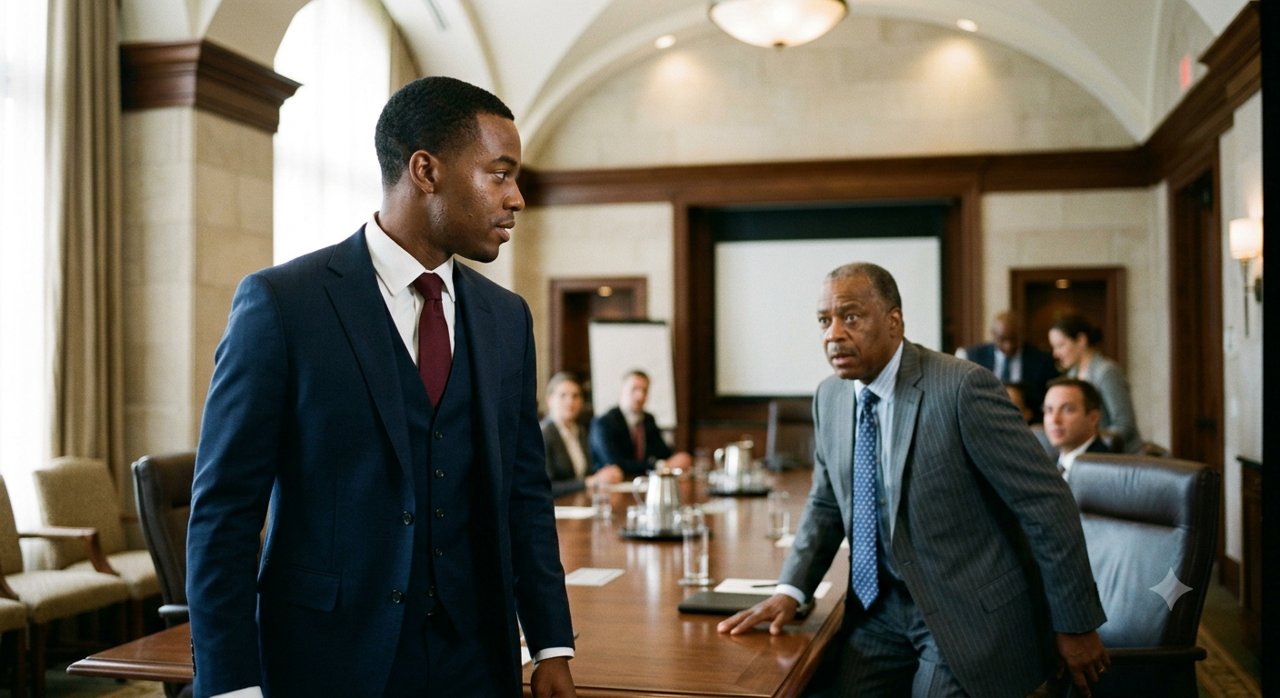
The Aldrich Club occupied a four-story brownstone on the quieter end of Meridian Street — the kind of building that had no sign outside because the people who needed to know where it was already knew.
Lucienne arrived at eleven fifty-eight.
Grace was beside her.
Daniel was not.
They had agreed on that.
His moment would come, but not here.
Not yet.
The maître d' showed them to a private dining room on the second floor.
Dark wood paneling.
Two place settings.
A third chair had been added, which told her Harlan had brought someone after all.
He was already seated.
Harlan Voss at sixty-one looked exactly like what he was — a man who had spent four decades being right about everything and expected to continue.
Silver-haired.
Well-tailored.
The kind of tan you get from a second home somewhere warm.
He stood when she entered, which was the correct thing to do, and smiled, which was the wrong thing to do.
"Lucienne." He extended his hand.
"You look wonderful."
She shook it.
"Harlan."
His eyes moved to Grace.
A small adjustment in his expression — not quite displeasure.
Recalculation.
"I wasn't aware you were bringing counsel."
"This is Grace Holloway.
She's here as a courtesy." Lucienne sat down.
"Who did you bring?"
The man in the third chair was younger.
Mid-forties.
The kind of lawyer who charged by the quarter-hour and billed for the drive over.
"Thomas Reeve," Harlan said.
"An associate.
I thought it might be useful to have someone taking notes."
"Of course." She unfolded her napkin.
"Shall we order first, or would you prefer to get to it?"
Harlan smiled again.
"You were always direct.
I always admired that." He settled back in his chair.
"Let's talk."
"All right." She looked at him.
"Tell me about the night you went to Daniel Ashworth's apartment."
Something moved behind his eyes.
Gone in an instant.
"That was a very long time ago," he said.
"Twenty-five years.
Yes.
Tell me about it."
He picked up his water glass.
Set it down.
"Your father was concerned about your relationship.
He felt that Daniel was — not the right match for you.
Not at that stage of your life.
He asked me, as a family friend, to have a conversation."
"A conversation."
"A private conversation.
Man to man." His voice was measured.
Reasonable.
"I explained to Daniel that your family was going through a sensitive period.
That the timing was difficult.
I suggested — gently — that some distance might be appropriate."
"And the documents you brought with you?"
A pause.
Fractional.
"I'm not sure what documents you mean."
"The fabricated financial records.
The photographs.
The names of dangerous people who didn't exist." She kept her voice pleasant.
"Those documents."
Harlan looked at Thomas Reeve.
Reeve's pen had stopped moving.
"Lucienne." Harlan's voice shifted — still warm, but with something underneath it now.
A current.
"I understand you've spent time with Daniel.
I understand he's told you a version of events.
But you have to understand that a man who has lived the life he's lived — the failures, the hardships — that kind of life shapes memory in particular ways."
"It does," she agreed.
"Which is why we don't have to rely on his memory."
She opened the folder in front of her and placed the forged letter on the table between them.
Harlan looked at it.
His face did not change.
But his right hand, resting on the tablecloth, went very still.
"That is a letter I wrote," she said.
"Except that I didn't write it.
You did.
Or you had it done." She turned it to face him.
"The handwriting analysis was completed this morning.
The paper stock dates to a specific commercial supplier.
That supplier's records — still archived — show a bulk purchase by your personal assistant in the autumn twenty-five years ago."
Reeve put his pen down entirely.
"Harlan." His voice was low.
A warning.
Harlan ignored him.
His eyes were on Lucienne.
"You've been busy," he said quietly.
"I have." She placed the USB drive on the table beside the letter.
"Daniel kept scans of every document you showed him that night.
All fabricated.
Confirmed by forensic analysis eight years ago." She let him look at it.
"I also have a witness.
Your former neighbor, Mrs.
Calloway — still very much alive, still very sharp — who heard enough of your conversation with Daniel to confirm its nature and tone."
The room was very quiet.
Harlan sat back slowly.
Something had left his face — the ease, the warmth, the practiced comfort of a man who had never been caught.
"What do you want?" he said.
"I want you to understand what is happening." She kept her voice level.
"I have been investigating your current fund for fourteen months.
I have wire transfer records, falsified reports, and two former employees.
What I needed was evidence of intent.
Of pattern." She looked at him directly.
"You gave me that twenty-five years ago.
You just didn't know I'd ever find it."
Harlan leaned forward.
The warmth was gone entirely now.
"You think a forged letter from twenty-five years ago is going to hold up in a securities case?" His voice was low and precise.
"My lawyers will bury that.
It's ancient, it's personal, and it's the word of a homeless man against mine."
"He's not homeless anymore," Grace said.
It was the first thing she had said since sitting down.
Harlan looked at her.
"And it's not just his word," Grace continued.
"It's his word, supported by forensic document analysis, supplier records, a contemporaneous witness, and twenty-five years of consistent account." She closed her own folder.
"But you're right that the letter alone isn't the case.
It's the foundation.
The case is what you've been doing to your current investors.
The letter simply explains why you thought you could keep doing it."
Harlan was quiet for a long moment.
Then he looked back at Lucienne.
"Your father," he said, "asked me to handle it."
"I know you're going to say that."
"It's the truth."
"Perhaps part of it is." She didn't look away.
"But my father did not ask you to fabricate documents.
He did not ask you to forge my handwriting.
He did not ask you to destroy a man's life and then spend twenty-five years paying people to watch for him." She picked up the USB drive and placed it back in the folder.
"Whatever my father asked you to do, you chose to go much further.
Because it served you.
Because Daniel disappearing gave you the leverage you needed to renegotiate your partnership position."
Harlan said nothing.
"Eight months," she said.
"That's how long the deal stalled.
That's how long it took you to get what you wanted.
And all it cost you was two people's lives."
The silence stretched.
Then Harlan pushed back his chair and stood.
"I'll need to speak with my legal team," he said.
"Of course." She didn't stand.
"Grace will be in touch about the formal process.
I'd suggest you make yourself available."
He looked at her one more time.
The look of a man who had spent his whole life being the one who ended conversations.
"You should know," he said quietly, "that your father never forgave himself.
For any of it."
She held his gaze.
"That's between him and whatever comes after," she said.
"It has nothing to do with you."
He left.
Reeve gathered his papers and followed without a word.
Grace let out a slow breath.
"That went better than I expected," she said.
"He'll fight it."
"Yes.
But he knows we have him." Grace looked at the folder.
"He'll try to negotiate.
Minimize.
Shift blame to your father's estate."
"Let him try." Lucienne looked at the empty doorway.
"Set up the meeting with the SEC contact for tomorrow.
And call the two former employees.
I want their statements locked in before his lawyers start making calls."
Grace nodded and reached for her phone.
Lucienne sat alone at the table for a moment.
The dining room was quiet.
The untouched water glasses.
The unused silverware.
The chair where Harlan Voss had been sitting, pushed back at an angle, as if he had left in a hurry.
She thought about her father.
About the complicated, difficult, sometimes cruel love of a man who had wanted the best for her and had a very narrow idea of what the best looked like.
She thought about Daniel, sitting in her conference room with a USB drive he had carried for twenty-five years.
She stood up.
There was still a great deal to do.