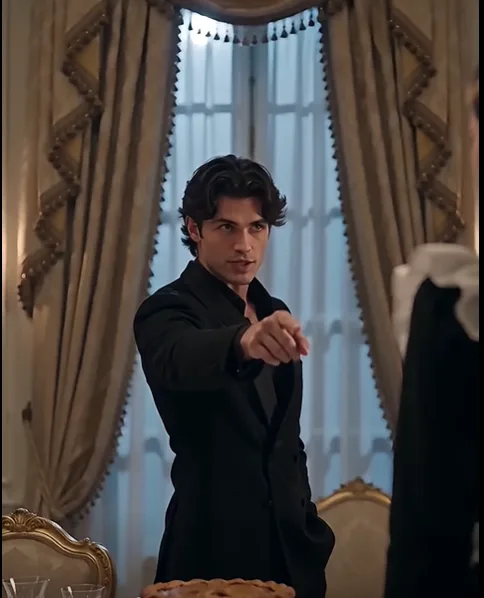
Then the foyer lights went out.
The mansion fell into darkness.
Someone shouted.
A gunshot cracked outside.
Nell ducked instinctively.
Benny pulled Carmine behind a stone column.
Emergency lights flickered on.
One of the strangers was gone.
The other lay unconscious on the marble floor.
Carmine looked toward Nell.
She was standing perfectly still.
Too still.
“Nell.”
She looked at him.
“I'm fine.”
“You're shaking.”
“I know.”
Another shot sounded outside.
Carmine crossed the foyer.
“Nobody leaves this house.”
Nell followed him.
“You can't stop them.”
“I don't have to.”
He opened the front doors.
Two security men were already moving across the drive.
The black sedan disappeared beyond the iron gates.
Carmine watched it go.
Then he looked down.
Something had been left on the steps.
A small metal key.
Nell recognized it immediately.
Her father's bakery key.
She had kept a duplicate for years.
This one had a thin strip of blue paint near the bow.
Her father had marked his keys that way.
Her fingers trembled as she picked it up.
“There was a basement,” she whispered.
Carmine turned.
“Under the bakery?”
“No. Under the building next door.”
“What was in it?”
“I don't know.”
“Then we're going.”
She looked at him sharply.
“You're not going anywhere near that place.”
“Why?”
“Because this started before you knew about it.”
“And now?”
“Now you're involved.”
Carmine's gaze settled on her.
“Nell, I was involved long before you walked into my dining room with a tray.”
She looked away.
For the first time, the anger in her face broke.
Beneath it was something more fragile.
A woman who had spent three years carrying a question so heavy she had stopped expecting anyone to help her lift it.
That night, they drove to Magazine Street.
The city was wet from rain.
Neon reflected in puddles. Streetcars groaned in the distance. The old buildings seemed to lean toward one another as if whispering.
The bakery was gone.
A brick shell remained behind temporary fencing, its windows boarded.
Nell stood before it.
She didn't cry.
Carmine thought that was worse.
She reached through a gap in the fence and touched the brick.
“My father used to stand right there.”
Carmine said nothing.
“He'd come outside at five in the morning and breathe the air before opening the doors.”
She smiled faintly.
“He said you could tell what kind of day it would be by the smell of the river.”
“What does it smell like tonight?”
“Rain.”
She looked at him.
“And old ashes.”
They found the basement entrance beneath the neighboring building.
The key worked.
Inside, the air smelled of dust, rust, and damp concrete.
Carmine switched on his flashlight.
There were boxes.
Ledger books.
Photographs.
Bank statements.
And one locked metal cabinet.
Nell stared.
“My father knew.”
Carmine opened the cabinet.
Inside was a folder.
The first page contained a list of property transactions.
The second contained names.
The third contained payments.
And the fourth contained one name that made Carmine go completely still.
His father's.
Beneath it was a payment made eighteen months before the bakery burned.
Nell saw his face.
“What is it?”
He closed the folder.
“Nothing.”
“Don't lie to me.”
“I said it's nothing.”
“You're doing the same thing everyone else did.”
Carmine looked at her.
“What?”
“Deciding what I can survive knowing.”
Silence.
Then he handed her the folder.
She read.
Her breathing became shallow.
“My father was going to expose your family.”
“Yes.”
“And you knew?”
“No.”
“You're sure?”
Carmine's voice was quiet.
“I spent four years trying to understand what my father built. Every time I thought I had found the bottom, there was another floor.”
Nell closed her eyes.
A sound came from the hallway.
Footsteps.
Carmine extinguished the flashlight.
They stood in darkness.
The footsteps stopped.
A door creaked.
Then came a man's voice.
“Miss Fontaine.”
Nell's entire body stiffened.
Victor Hale.
“You should have stayed a maid.”
Carmine's expression went cold.
Hale continued.
“Three years was a long time to hide. You almost made it.”
Carmine whispered, “Stay behind me.”
Nell shook her head.
“No.”
“Nell.”
“I've been behind people for three years.”
She stepped forward.
Her voice trembled, but it did not break.
“You burned my father's bakery.”
Hale laughed softly.
“You're still thinking too small.”
“What do you mean?”
“The bakery was never the target.”
Carmine understood.
“The records.”
Hale said nothing.
Nell looked at the folder in her hands.
“All of this.”
“Exactly.”
The silence that followed seemed to swallow the room.
Hale had not burned the bakery to remove Nell's father.
He had burned it to destroy evidence.
But he had failed.
Because Emmett Fontaine had hidden copies beneath the neighboring building.
Carmine took a slow breath.
“Benny.”
A crash came from upstairs.
Then shouting.
Security had arrived.
Hale ran.
Carmine moved after him.
Nell grabbed his arm.
“Let him go.”
Carmine stopped.
“He'll disappear.”
“No.”
She held up the folder.
“He won't.”
The police arrived twenty minutes later.
This time, Nell had evidence.
Names.
Accounts.
Photographs.
Dates.
Enough to reopen the case.
Enough to expose the men who had manipulated the insurance investigation and the property deals.
Enough to tear open a portion of Carmine's father's empire that Carmine himself had never known existed.
Months later, the Fontaine Bakery reopened.
It was smaller.
Brighter.
The front windows were new.
The old brick remained.
Nell stood behind the counter one rainy morning while her father sat near the window, watching the street.
He did not remember everything.
But when Nell placed a slice of pecan pie in front of him, he smiled.
“Seven minutes,” he murmured.
She froze.
Then she laughed through tears.
“Seven minutes.”
Outside, a black car stopped briefly across the street.
Carmine stepped out.
He did not enter immediately.
He stood beneath the awning, looking through the glass.
Nell saw him.
For a moment, neither moved.
Then she opened the door.
“You're early.”
“I had business nearby.”
“You always have business nearby.”
“I've been accused of that.”
She smiled.
Carmine glanced at the pie cooling on the counter.
“Is that mine?”
“No.”
He looked wounded.
“After everything I've done for this bakery?”
“You've done plenty.”
“That's not an answer.”
Nell cut him a slice.
“Too sweet.”
He took a bite.
Stopped.
She watched him carefully.
“Well?”
Carmine looked at her.
“Still the best pie in New Orleans.”
She shook her head.
“You're getting sentimental.”
“Don't tell anyone.”
He set down his fork.
The bakery was warm.
The rain tapped softly against the windows.
For three years, Nell had believed being unnoticed was the same thing as being safe.
She finally understood the difference.
Being unseen had protected her from questions.
It had also left her alone with them.
Carmine had not saved her.
He had simply been the first person willing to look closely enough to see what everyone else had ignored.
And sometimes that was where justice began—not with a gun, not with a threat, not with revenge, but with one person finally asking a woman standing three feet away the question nobody had bothered to ask in three years.
Who made the pie?
Nell looked at the man across the counter.
“Carmine?”
“Yes?”
“You never thanked me.”
He smiled.
“I thought you'd prefer the truth.”
“What truth?”
“I've been coming here every morning for six months because I like the coffee.”
Nell laughed.
“And the pie?”
His expression softened.
“The pie got me through the door.”
She looked toward the rain.
For once, the silence did not feel like loneliness.
It felt like peace.