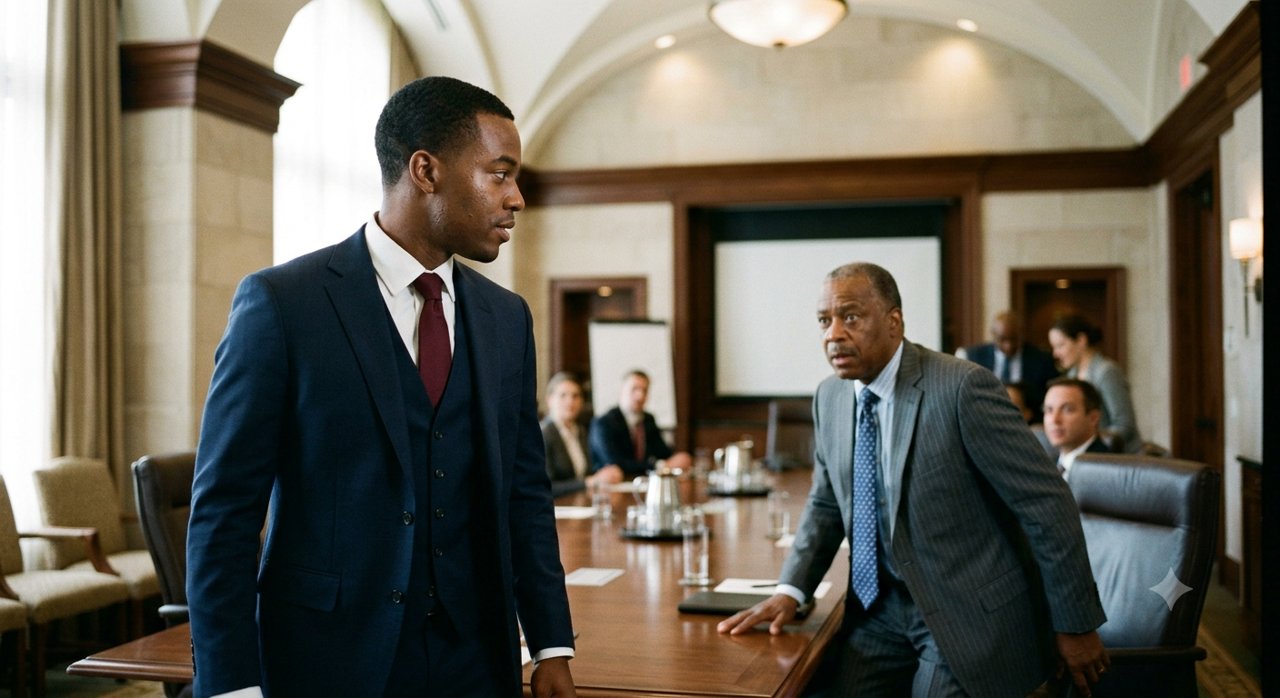
Warren Gould met me in a conference room on the fourth floor of the Southern District courthouse the following afternoon.
He was in his mid-fifties, broad-shouldered, with the particular stillness of someone who had spent decades listening to people try to convince him of things.
He shook my hand, gestured to a chair, and sat across from me without preamble.
"Daniel Hartley called me this morning," he said.
"He told me you were the most rigorous legal historian he had supervised in thirty years.
He also told me you were in danger.
I want to hear from you directly."
Reeves and Cho were in the room as well, which told me the FBI and the prosecutor's office had already spoken.
I laid out everything — the restaurant, the document, the circled word, the anonymous envelope, the marginal note from the German attaché.
I set the photocopy on the table in front of Gould.
He read it carefully.
He read it again.
"This note," he said.
"If authenticated, this is the drafter's own stated intent."
"Yes," I said.
"Combined with my dissertation's analysis of the annex, you have both academic interpretation and primary-source confirmation.
The mistranslation isn't arguable.
It's documented."
Gould looked at Reeves.
"How long until the filing window closes?"
"Five days," Reeves said.
"Then we move now." Gould closed the folder.
"Miss Miller, I want a signed declaration from you by tomorrow morning.
I want your dissertation chapter on the annex submitted as a supporting exhibit.
And I want Professor Hartley available as a secondary academic witness if needed."
"He'll cooperate," I said.
"Good." Gould leaned forward.
"I also want to be direct with you about something.
Dominic Russo will know we are moving.
He has contacts in this building — not in my office, but in this building.
When he finds out, he will apply pressure.
He will do it through his lawyers first.
If that doesn't work, he will do it through other means." He paused.
"Are you prepared for that?"
"I've been preparing for it since the night at the restaurant," I said.
"There's one more thing." Gould slid a photograph across the table.
"Do you recognize this man?"
The photograph showed a man in his seventies.
White-haired, slight, photographed getting into a car outside what appeared to be a Naples hotel.
"No," I said.
"His name is Enzo Caruso.
He was the junior Italian legal attaché at the 1947 Trieste negotiations.
He is ninety-one years old and he has been living in Naples for the last sixty years." Gould tapped the photograph.
"We believe he is the one who sent the envelope to Professor Hartley."
I stared at the photograph.
"He's been alive this whole time," I said.
"Yes.
And we believe he has been waiting for someone to find the correct reading of that annex for a very long time." Gould sat back.
"His brother was one of the original signatories of the agreement.
The assets that were surrendered under Article Nine — the ones Russo's organization has been claiming for thirty years — they originally belonged to the Caruso family."
The room was very quiet.
"He sent me the proof," I said slowly, "because the assets were stolen from his family."
"We believe so."
I thought about a ninety-one-year-old man in Naples, holding onto a photocopy of a marginal note for decades, waiting for the right person to understand what it meant.
"Is he safe?" I asked.
"We have people watching him," Cho said.
"That's not what I asked."
Cho looked at me.
"We're doing everything we can."
That afternoon, I signed the declaration.
Every word of it was precise, sourced, and unambiguous.
I cited twelve primary documents, four secondary analyses, and the marginal note from the Caruso envelope.
I attached the relevant chapter of my dissertation.
I signed my name at the bottom with the same fountain pen I had used at Maison Étoile.
The next morning, Dominic Russo's lead attorney filed an emergency injunction to block the federal investigation.
The morning after that, Gould's office filed to have the injunction dismissed.
On the fourth day, Dominic Russo called me directly.
I was in the university library when my phone rang.
Unknown number.
I answered it anyway.
"Miss Miller." His voice was exactly as I remembered it.
Calm.
Controlled.
The voice of a man who had never needed to shout.
"I think it's time we spoke properly."
"We're speaking now," I said.
"In person," he said.
"Tonight.
Alone.
I'm prepared to make this very worth your while."
"How worth my while?"
"Your mother's medical bills," he said.
"All of them.
Past and future.
Paid in full.
A private care arrangement.
The best specialists in the country." A pause.
"All I need is for you to withdraw the declaration."
My hand tightened on the phone.
"That's a generous offer," I said.
"I'm a generous man," Russo said.
"When I choose to be."
"And when you choose not to be?"
Silence.
"I'll think about it," I said.
"I'll call you back."
I ended the call.
I sat for a moment in the quiet of the library, surrounded by books, the late afternoon light coming through the tall windows.
Then I called Reeves.
"He just offered to pay my mother's medical bills," I said.
"In exchange for withdrawing the declaration."
"We know," Reeves said.
"We were on the call.
Did you think we weren't monitoring your phone?"
"I was hoping you were," I said.
"Is that enough?"
"Attempted witness tampering on a federal case?" Reeves said.
"Yes, Miss Miller.
That's enough."
The filing window closed the next morning.
Dominic Russo's refinancing agreement never went through.