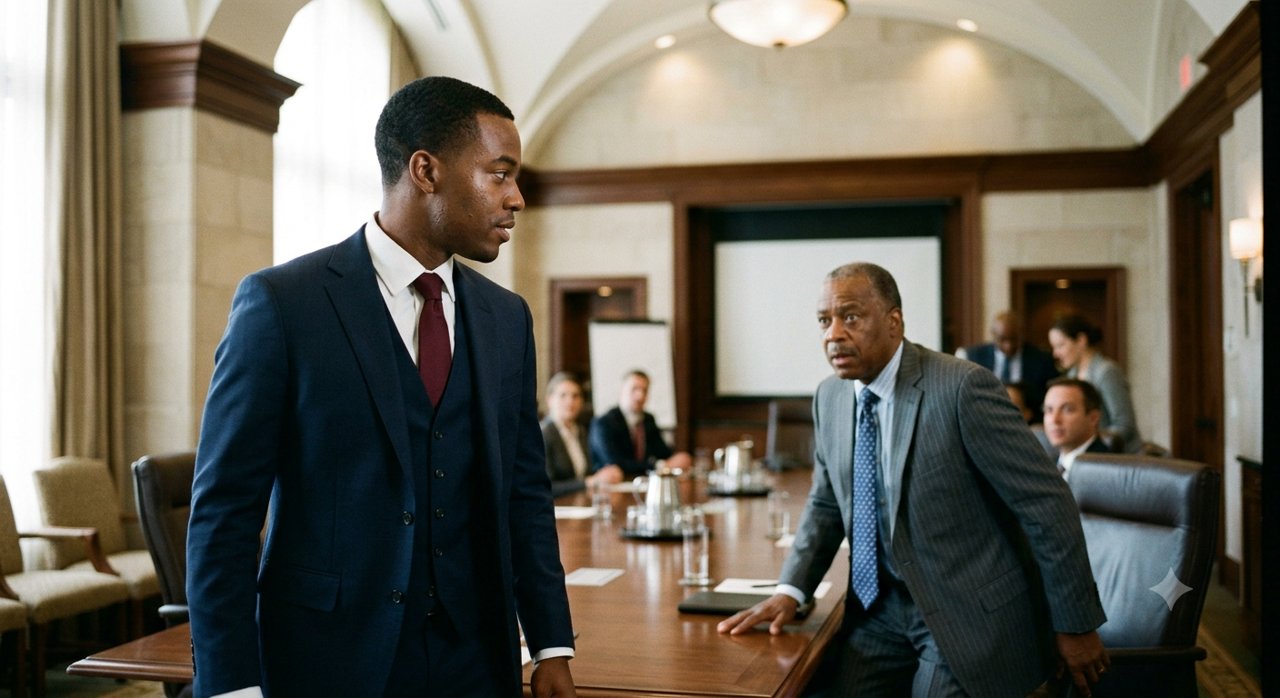
They executed the warrant on a Tuesday.
I was not supposed to be there.
Gould had been clear about that — witness safety, procedural integrity, half a dozen reasons that all made sense and none of which I fully accepted.
I had made my case to Reeves the night before, sitting in the dry-cleaning back room with cold coffee and the corkboard full of photographs.
"You said we'd see," I reminded him.
He looked at me for a long moment.
"You stay behind the observation glass.
You don't enter the room.
You don't speak.
If I say leave, you leave immediately."
"Agreed."
Dominic Russo was brought into the federal building at nine-fifteen in the morning.
He was not handcuffed in the lobby — that had been arranged deliberately, a small courtesy that Gould said was strategic.
They wanted him calm.
They wanted him talking.
He was placed in Interview Room B.
His attorney, a sharp-faced woman named Claire Ashworth, arrived twelve minutes later and spent eight minutes alone with him before the agents entered.
I watched through the observation glass.
Gould sat across from Russo.
Reeves stood near the door.
Cho had a folder open on the table.
Russo looked composed.
He sat with his hands folded, his jacket still on, the expression of a man who had been in difficult rooms before and had always walked out of them.
"Mr.
Russo," Gould said.
"I want to give you the opportunity to speak before we go further."
"My client has nothing to say," Ashworth said.
"Your client attempted to tamper with a federal witness four days ago," Gould said.
"We have the call recorded.
We have the offer documented.
That's a separate charge from the asset fraud case, and it carries its own sentencing weight." He opened his own folder.
"The asset fraud case rests on a thirty-year misapplication of the 1947 Trieste Protocol.
We have a declaration from a Columbia University doctoral candidate who is the leading academic authority on the relevant annex.
We have a primary-source document — a handwritten marginal note from the German legal attaché who drafted the annex — confirming the correct interpretation.
And we have thirty years of financial records showing how your organization built its asset structure on the wrong reading."
Russo's composure held.
But his hands — still folded on the table — pressed slightly harder against each other.
"We also have Enzo Caruso," Gould said.
The hands stopped moving.
"Mr.
Caruso is ninety-one years old," Gould continued.
"He has agreed to provide a sworn statement regarding the original intent of Article Nine and the assets his family surrendered under it.
He has been waiting a long time to give that statement."
Ashworth leaned toward Russo and spoke quietly in his ear.
Russo didn't move.
"Mr.
Russo," Gould said.
"The refinancing window is closed.
The asset structure cannot be moved.
The case is built.
What I'm offering you now is the opportunity to cooperate, which will be noted in sentencing." He paused.
"Or you can say nothing, and we proceed to trial, and everything comes out in open court."
Russo looked up.
For the first time since he had entered the room, he looked directly at the observation glass.
He couldn't see me.
The glass was one-way.
But he looked at it as if he knew I was there.
"The waitress," he said quietly.
Ashworth put her hand on his arm.
"Dominic—"
"She circled one word," he said.
Not to Gould.
Not to Ashworth.
To the glass.
"One word in a document I've had for thirty years.
Every lawyer I've ever employed looked at that document.
Every accountant.
Every advisor." He paused.
"And a waitress circled the word that destroyed everything."
The room was very quiet.
"She's not a waitress," Gould said.
Russo looked back at the table.
Something in his face had changed — not broken, not defeated, but different.
The composure was still there, but underneath it, something had gone out.
"No," he said.
"I suppose she isn't."
He looked at Ashworth.
"Tell them what they need," he said.
Ashworth's eyes widened slightly.
"Dominic, I strongly advise—"
"Tell them what they need," he said again.
Quietly.
Finally.
He was charged that afternoon.
Wire fraud, racketeering, asset fraud, and attempted witness tampering.
Carlo Mancini was arrested at a hotel in Midtown two hours later.
Alderman Ferretti resigned from his city council seat before the close of business.
I was in the hallway outside the interview room when Reeves found me.
"You weren't supposed to still be here," he said.
"I know," I said.
He looked at me for a moment.
Then he held out his hand.
I shook it.
"The witness assistance paperwork for your mother goes through tomorrow," he said.
"The medical arrangement is confirmed.
She won't have to worry about the bills."
I nodded.
I didn't trust my voice quite enough to speak.
"You did good work," Reeves said.
"Real work.
The kind that matters."
He walked back down the corridor toward the interview room, and I stood alone in the hallway for a moment, the fluorescent lights humming above me, the building going about its business all around me.
Then I took out my phone and called Ohio.