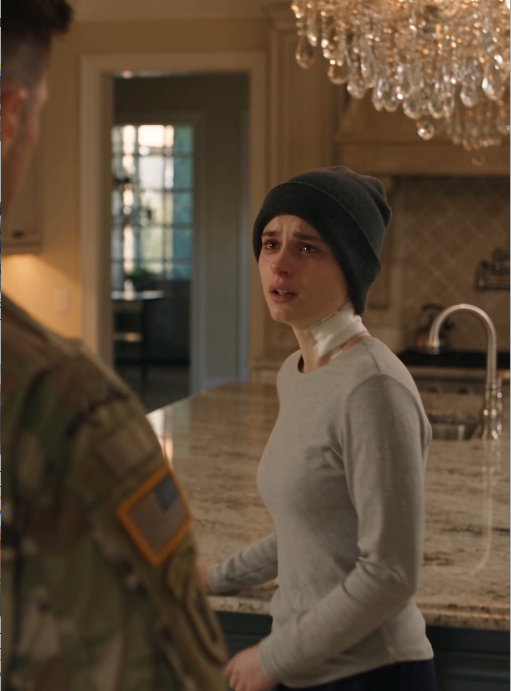
CHAPTER 2 — The Mystery Revealed
Claire received her diagnosis on a Tuesday.
She had been feeling tired.
Then a swollen lymph node in her neck.
Then blood work.
Biopsy.
She wasn't expecting the word cancer.
No one ever is.
The hematologist spoke slowly.
Treatment.
Reasonably favorable prognosis.
Tests.
Claire heard only half of it.
She walked out.
Called David.
No answer.
Normal.
Time difference.
She sent:
I need to talk to you when you can. It's important. I'm okay right now.
Two hours later, Margaret called.
— What's wrong?
Claire was surprised.
— Did David tell you?
— No.
— I saw your car at the hospital this morning.
Coincidence.
Margaret had a cardiac check-up appointment in the same complex.
Claire cried.
Told her.
Margaret came over that night.
Cooked.
Stayed.
— We have to tell him, — Claire said.
— Of course.
David called the next day.
Claire was getting a scan.
Margaret answered.
— She's undergoing some tests.
— What tests?
Margaret looked at Claire, who was far away.
— Nothing urgent.
— She's exhausted.
David:
— Tell her I love her.
— Of course.
Margaret didn't tell him.
Later, she justified it:
— I didn't want to tell him without you.
That seemed reasonable.
Two days later, Claire sent an email.
Got no response.
Margaret:
— David is in a complicated phase right now.
— I've explained it to him.
Claire:
— You told him?
— Yes.
— What did he say?
Margaret took a breath.
— That he trusts the doctors.
— That he wants you to focus on your treatment.
Claire cried with relief.
Then came the first fake email.
Not warm.
Not completely cruel.
Distant.
That was what made it believable.
David had been colder in his messages for weeks.
Exhaustion.
Schedules.
Claire read:
I don't want this to interfere with what I'm doing here. Focus on recovering.
It hurt.
But she rationalized it.
Soldiers.
Work.
Pressure.
Margaret:
— The Carter men are like that when they're scared.
Claire:
— Not David.
— Everyone has their limits.
Then came the treatment.
Margaret accompanied her.
She didn't fake her care.
The care was real.
Brought a blanket.
Learned the names of the medications.
Bought beanies.
Made soup.
One night Claire threw up, and Margaret held the hair she still had left.
— Thank you.
— You are family.
That was also true.
People can care for you and manipulate you at the same time.
Perhaps that was what confused Claire the most later on.
She couldn't turn those seven months into a complete lie.
Margaret had been there.
When Claire woke up with a fever, she was there.
When she lost her hair, she helped her cut it.
When she cried in the car, Margaret waited.
And meanwhile, every few days, she placed a new wedge between husband and wife.
To David:
Claire doesn't want you to see her like this.
To Claire:
David needs distance.
To David:
The results are good. She doesn't want to worry you.
To Claire:
He's focused on work. Don't take his silence as rejection.
Then:
David is thinking about what to do when he gets back.
Claire:
— What does that mean?
Margaret:
— He's scared.
— Of me?
— Of the life that awaits you both.
— I'm not trying to defend him.
— I'm just saying some people can't handle illness.
Claire couldn't sleep.
Days later, the second fake email arrived:
Mom explained to me that recovery will be long. Maybe it's best that when I get back, we give each other some space and don't make any emotional decisions.
Claire cried for six hours.
Didn't call.
Why?
Because Margaret had already planted another idea:
— If you pressure him, he might make up his mind for good.
Claire wanted to keep the possibility alive.
She became obedient to the silence.
Not out of fear of Margaret.
Out of fear of losing David.
That was the mechanism.
Not force.
Information.
Here is the English translation of Chapters 3 and 4:
---
THE PAPERS
Three weeks after the first cycle of treatment, Margaret spoke about the trust.
The Carter family had money.
Not a billionaire fantasy.
David’s father, Henry, had built a regional engineering and infrastructure company.
Later, he sold the majority stake.
He retained investments, properties, and a seventeen percent share in Carter Infrastructure Holdings.
When he died six years earlier, he created a trust.
Margaret was the primary trustee until David turned thirty-six.
At thirty-six, David acquired the right to assume control.
Not an obligation.
He could postpone for five years by means of a written declaration.
David turned thirty-six during the deployment.
Claire remembered because they had a video call.
A ridiculous cake on the screen.
David:
— When I get back, I’ll have to review the entire trust.
Claire:
— Do you want to?
— Not particularly.
— Mom has been managing it for years.
— But Dad wanted me to decide at this age.
That was January.
In April, while Claire was sick, a letter arrived from the fiduciary law firm.
Confirmation of election for administrative continuity.
Claire didn’t understand.
Margaret:
— David has decided that I should continue for five years.
— Did he tell you?
— Yes.
— It makes sense while he’s away.
— I suppose.
There was a document for Claire to sign.
Not because her signature was required for continuity.
But because of the residence.
The mansion was held within the trust.
Claire had a contractual right of marital occupancy as long as she was married to David and it remained her primary residence.
Margaret wanted to refinance a line of credit partially secured by other properties.
The bank required an acknowledgment from adult occupants regarding certain notices.
A technical document.
Boring.
Margaret:
— David already approved it.
Claire:
— Why do I have to sign?
— Because you live here.
— You aren’t giving up the house.
Claire was tired.
She had received medication that morning.
Not sedated.
Competent.
Just exhausted.
She read it.
A clause stated:
*The undersigned acknowledges that they hold no independent financial interest in the trust assets and agrees that residential occupancy may be modified pursuant to instructions from the trustee.*
Claire:
— This says you can change my right to live here.
Margaret:
— Only if David decides to as well.
— He requested it.
Claire:
— I want to ask him.
Margaret:
— Of course.
That night, a fake message arrived from David’s account:
**Mom told me about the documents. Sign whatever is necessary so everything remains stable until I get back. I trust her.**
Claire signed the next day.
She didn’t know that David had never chosen continuity.
Margaret had used a digitized signature from a previous document to file the declaration.
Not perfect.
Enough to pass initial review.
Why?
Because Margaret needed to remain trustee until December.
She had authorized an eight-million-dollar investment deal six months earlier.
Not illegal by definition.
But outside the risk mandate Henry had established.
A private real estate development in Charleston.
A luxury project.
Delays.
Costs.
An insolvent partner.
Margaret had used trust funds to cover successive capital calls.
If David assumed control on his birthday, he would see it.
He could unwind the investment and demand an audit.
Margaret believed that if the project had until December, it would be refinanced and no one would lose anything.
She needed time.
Five years on the document.
In reality, she needed eight months.