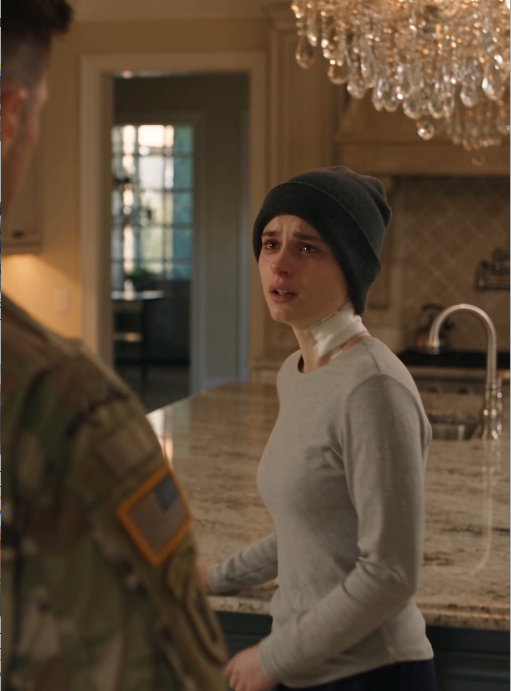
She told herself:
*When everything turns out well, I’ll tell him.*
Then Claire fell ill.
And she discovered the letter.
Because the mail arrived at the house.
Margaret understood that the illness could serve as the perfect reason to control communications.
She didn't create the cancer.
She didn't wish for the illness.
But she saw an opportunity.
That was the moral line she crossed.
First, she thought:
*I’m not going to worry David until we know the prognosis.*
Then:
*I don’t need him coming back and reviewing the trust now.*
Then:
*Just a few weeks.*
Then:
*If Claire thinks he wants distance, she won’t ask him questions.*
Each step was small compared to the previous one.
Until seven months had passed.
---
THE MESSAGES THAT NEVER ARRIVED
David spent his first night back in the guest room.
Not because of a separation.
Claire asked for it.
— I need space.
He wanted to stay by her side.
He didn't insist.
Margaret locked herself in her wing.
No lawyers yet.
No police either.
First, they wanted to understand.
David sat with two phones.
His own.
Claire’s.
They compared.
February:
normal.
March:
normal.
April:
rupture.
Claire had sent:
*I need to talk.*
David never received it.
It wasn't on his phone.
Claire showed the sent log.
David searched the trash bin, archives.
Nothing.
Then an email from David that he didn't write.
Then another.
Then five.
David:
— Mom had the tablet.
Claire:
— Could she delete what I sent?
— If the account was synced and she accessed it before I saw it, yes.
— But how did she know when?
David thought.
His personal account wasn't the only form of communication.
He used encrypted civil messaging on his phone.
Margaret didn't have access to that.
Claire:
— I wrote to you through there twice.
David:
— I didn't receive it.
Claire checked.
The messages were marked as delivered.
David opened his blocked list.
Claire appeared blocked during the period from May to September.
He had never blocked her.
— How?
Then he remembered.
In June, his phone glitched.
Margaret had helped from the United States to restore a backup because the family device account was still linked to her from years back.
David:
— It can't be.
Claire:
— What?
— She had access to the family account.
— She could manage devices.
— She blocked me?
— She might have.
David felt shame.
— I should have separated that years ago.
Claire:
— Don't do this.
— What?
— Turning this into:
«I should have known.»
— I could say that too.
— No.
— Yes.
— We trusted.
— That isn't a crime.
— Using it against us is.
David looked at her.
Claire had changed.
Physically weaker.
Emotionally clearer.
— What exactly did she tell you about me?
She hesitated.
— That you were considering a divorce.
David closed his eyes.
— Never.
— That the illness reminded you of your father.
Henry had died of pancreatic cancer.
David had spent his final months caring for him.
Claire:
— She said you couldn't go through that again.
David wept.
— God.
— I believed it because…
— Because of Dad.
— Yes.
— You once said you didn't know if you could go through a hospital experience again.
David remembered.
After his father's death.
— I said it scared me.
— Not that I would abandon my wife.
Claire:
— I know that now.
Silence.
David:
— What did she tell you about me?
Claire:
— That you asked about me but didn't want to talk directly.
— That you were worried about the treatment.
— That maybe it was better if I looked for an apartment as your return got closer.
— Did you look?
— Yes.
That hurt.
— Where?
— A small apartment near the hospital.
— I was going to move next week.
Forty-eight days before.
If he had returned according to schedule, Claire would have disappeared from the house.
David would have found an empty room.
Margaret would probably have said:
*Claire decided to leave.*
Claire would have thought:
*David asked her to leave.*
The marriage could have ended without a single direct conversation.
— Why were you washing dishes?
he asked.
Claire almost laughed.
— Because I used a cup.
— I thought…
He felt stupid.
A tragedy setup.
A sick woman working.
But no.
— Margaret didn't force me to work.
— I want to be clear about that.
— She took care of me.
— A lot.
David:
— I know.
— That makes it worse.
— Yes.
Claire:
— I don't want you turning everything she did into a complete lie.
— She accompanied me.
— She was scared with me.
— Once, she slept in a chair at the hospital.
— And then she came home and wrote to you as if she were you.
— Yes.
Both truths.
David stood up.
— I have to talk to her.
Claire:
— Not today.
— Claire.
— No.
— You just got back.
— I just discovered that the last seven months didn't exist the way I thought they did.
— I don't want an explosion.
David took a breath.
— Okay.
— Tomorrow.
— With someone else.
— A lawyer.
— Yes.
Claire:
— And David.
— What?
— Don't rescue me by making decisions for me.
He paused.
— What do you want?
— To sleep.
— Then talk to the doctor.
— Then a lawyer.
— Then decide where I want to live.
David felt an urge:
*Here.*
*With me.*
He didn't say it.
— Okay.
Claire nodded.
That was the first real act of reconstruction.
Not a hug.
Not a promise.
A question.
And an «okay».