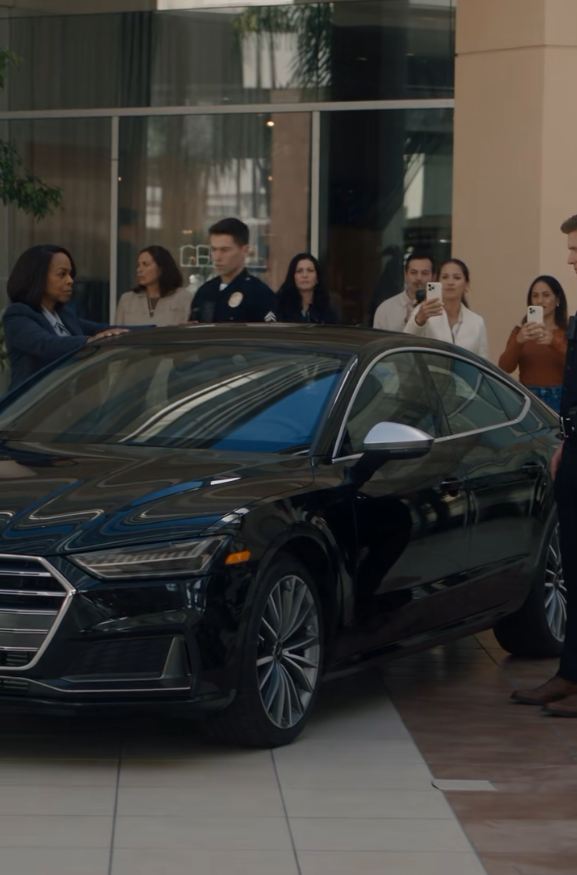
Part I — The Parking Lot
Officer Derek Mitchell’s hand was already moving toward Valerie Henderson’s wrist when she took one measured step backward and said, “Do not touch me unless you can explain what I am being detained for.”
The sentence was not loud.
It did not need to be.
Around them, the Saturday morning traffic of Willowbrook Heights had slowed into a strange half-circle of spectators. Shopping bags hung forgotten from wrists. A young employee stood motionless behind a crooked train of carts. Two women near the entrance of a department store had their phones raised. A man beside a silver SUV was openly recording.
Valerie noticed all of it without turning her head.
She kept her attention on Mitchell.
He stood less than three feet away in full uniform, shoulders squared, one hand hovering near his duty belt. He had approached her black Mercedes less than five minutes earlier with the absolute confidence of someone who believed the facts would eventually arrange themselves around his certainty.
So far, they had refused.
“You don’t tell me how to do my job,” Mitchell said.
Valerie held his gaze.
“No,” she replied. “But I understand procedure extremely well.”
For the first time, the second officer looked at her differently.
Officer Daniel Reeves had arrived from the far side of the parking lot less than a minute earlier. He was younger than Mitchell by several years, leaner, quieter, with the watchful manner of someone accustomed to letting a situation reveal itself before committing to it.
His first act upon approaching had been to glance at the Mercedes’ license plate.
Mitchell had not done that.
Reeves shifted his eyes from Valerie to his partner.
“Derek,” he said, lower now. “Did dispatch confirm the vehicle?”
Mitchell’s jaw tightened.
“No.”
“Then why are we calling it stolen?”
“I said possible stolen vehicle.”
“You said that after you had her out of the car.”
Mitchell’s attention snapped toward him. “You want to do this here?”
Reeves did not answer.
Valerie did.
“I would prefer that both of you do it here,” she said. “Because this is where you stopped me.”
A few feet away, someone murmured, “She’s got a point.”
Mitchell heard it.
That seemed to make things worse.
Valerie had seen men like him in court before—not necessarily cruel men, not necessarily corrupt ones, but men who interpreted uncertainty as disrespect. The more a situation slipped beyond their control, the harder they tried to tighten their grip around it.
She had spent more than twenty years in courtrooms watching small decisions become large consequences.
That experience was the only reason she had not raised her voice.
That morning had begun without the slightest suggestion that she would need any of those instincts.
Sunlight had filled the tall windows of her home as she stood in the kitchen with a cup of coffee, enjoying the unfamiliar luxury of nowhere urgent to be. She had left her judicial robe hanging where it belonged. The week’s files remained closed on the table beside rows of law books and framed photographs from a career she rarely discussed outside the courthouse.
Near the entrance sat the small engraved key holder her father had given her when she became an attorney.
For my daughter, who will change the world.
The words had embarrassed her when she was twenty-six.
Now they comforted her.
Her father had believed in change as if it were practical work: something accomplished one document, one argument, one decent decision at a time. He had never been impressed by titles. When Valerie became a judge, he had congratulated her, hugged her, and then reminded her that a robe did not make a person wise.
“You still have to listen,” he had told her.
Years after his death, she still heard that sentence whenever she entered a courtroom.
That Saturday, she had wanted no courtroom at all.
No attorneys.
No petitions.
No cameras waiting outside the courthouse.
Just errands.
On the way to Willowbrook Heights, she had seen her elderly neighbor, Mrs. Patterson, wrestling grocery bags toward her car outside a small market. Valerie had pulled over without thinking.
“Let me help you with those.”
Mrs. Patterson had surrendered the heaviest bags with a grateful laugh.
“You judges ever take a day off?”
“Occasionally, under supervision.”
Mrs. Patterson had smiled. “Saw you on the news last week.”
Valerie had groaned theatrically. “Then I apologize.”
The older woman laughed.
They had parted with a wave.
Less than an hour later, Valerie was standing beside her Mercedes with both hands visible while a police officer suggested she might have stolen it.
The absurdity of that would have been easier to tolerate if Mitchell had shown any interest in confirming his suspicion.
He had not.
When Valerie first lowered the window and asked whether something was wrong, he had ordered her out.
When she asked why, he had looked at the black Mercedes, then at her, as though that comparison answered the question.
“Whose car is this?”
“Mine.”
“Of course it is.”
The skepticism in those four words had transformed confusion into something colder.
Still, Valerie had complied.
She stepped out.
She kept her hands visible.
She answered his questions.
Then he demanded registration and identification.
She said both were inside her handbag.
When she moved toward it, he snapped, “Don’t start reaching around.”
Valerie had frozen instantly.
“You asked me for my documents.”
His response stayed with her.
“People pull this kind of thing all the time. Expensive vehicle, convenient explanation, and suddenly everything supposedly belongs to them.”
Not one fact.
Only assumption.
Valerie had asked whether he had checked the plate.
He had not.
Whether he had run the registration.
He had not.
“What suspicious behavior?” she asked when he claimed he knew suspicious conduct when he saw it.
He never answered.
Instead, he ordered her to place her hands on the car.
By then, phones were recording.
And now, with Reeves watching, Valerie understood that the encounter had reached the moment when it could either become a procedural mistake or something far worse.
Reeves gave her a small nod.
“You can get your identification.”
Valerie opened her handbag slowly.
Mitchell exhaled through his nose. “We’re not doing a courtroom routine here.”
That made Reeves look at him again.
Valerie said nothing.
Her fingers moved past her driver’s license.
For one second she considered handing it over.
The car was registered to her. The matter could have ended there.
But it would not really end there.
Not anymore.
Mitchell had already turned a baseless suspicion into a public detention. The phones around them had recorded his words. More importantly, he had demonstrated that he was willing to proceed without information while treating requests for basic procedure as defiance.
Monday morning, Valerie was scheduled to preside over a police misconduct hearing involving members of Mitchell’s unit.
She had known the unit name.
She had reviewed preliminary filings.
She had not memorized every officer associated with it.
Until now.
Valerie removed the other card.
Mitchell gave her a dismissive half-smile.
“What is that supposed to be? Another excuse?”
She turned it toward him.