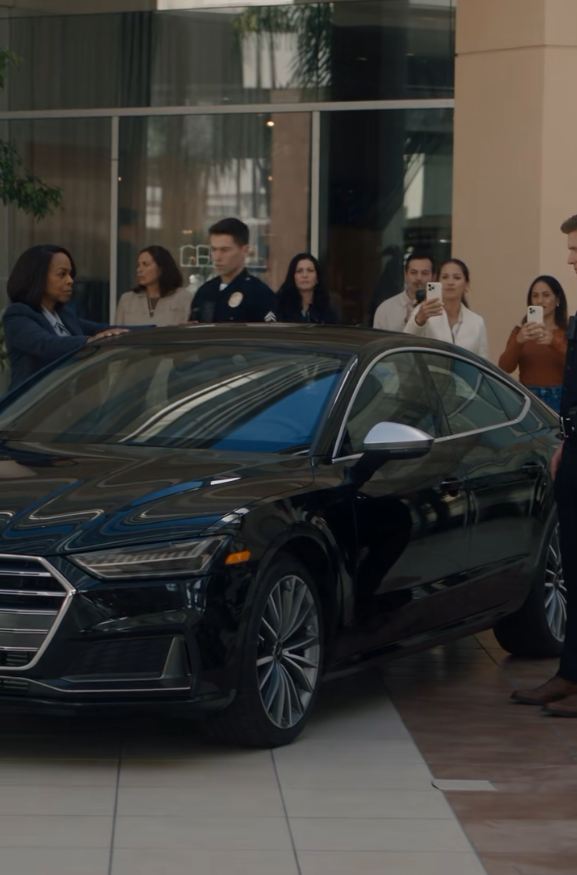
Reeves saw it first.
His face changed.
Not dramatically. He simply stopped moving.
His eyes went to the card, then to Valerie, then back to Mitchell.
“Derek.”
Mitchell frowned. “What?”
Reeves pointed.
Mitchell looked at the identification.
The confidence left his face in stages.
First irritation.
Then uncertainty.
Then recognition.
Finally, calculation.
The card identified Valerie Henderson by title.
The Honorable Valerie Henderson.
Superior Court Judge.
Mitchell looked up.
Valerie did not smile.
She did not need to.
“You’re—”
“Yes.”
He glanced toward the Mercedes.
Then toward the crowd.
Then at the phones.
Reeves said nothing.
Mitchell’s posture altered almost imperceptibly. His shoulders lowered. The hand near his belt moved away.
“Judge Henderson, I—”
Valerie returned the card to her wallet.
“Before you say anything else,” she said, “run the registration.”
Mitchell stared at her.
Reeves reached for his radio.
Within seconds, dispatch confirmed what should have been checked at the beginning.
The black Mercedes was registered to Valerie Henderson.
No stolen vehicle report.
No warrant associated with the plate.
No alert.
Nothing.
Reeves ended the transmission.
For a moment, the only sound was the distant scrape of shopping carts.
Mitchell cleared his throat.
“There may have been a misunderstanding.”
Valerie looked at him.
“No.”
The single word landed harder than if she had raised her voice.
“A misunderstanding requires two people to misunderstand the same thing. I told you this was my vehicle. You refused to verify it.”
Mitchell glanced at the crowd.
“That’s not exactly—”
“It is exactly what happened.”
His eyes hardened briefly, then softened again as he remembered the phones.
“Judge, I had information that—”
“What information?”
He stopped.
Valerie waited.
Reeves looked at him too.
Mitchell’s mouth opened, but whatever explanation he had expected to produce did not arrive.
Valerie adjusted the strap of her handbag.
“You asked me to get out. I complied. You asked for identification. When I attempted to retrieve it, you ordered me not to move. You accused me of behavior you could not identify, suggested I had stolen a vehicle you had not checked, and then attempted to place your hand on me after your partner questioned the basis for the detention.”
She paused.
“I would be very careful about inventing information now.”
Mitchell’s face went flat.
The warning had landed.
A younger woman in the crowd whispered, “Wow.”
Valerie ignored it.
She looked at Reeves.
“Officer Reeves, I assume this encounter will be documented.”
“Yes, ma’am.”
“Completely?”
Reeves met her eyes.
“Yes.”
Mitchell shifted.
“Judge Henderson—”
She turned back to him.
“Officer Mitchell, I believe you and I will be having a much longer conversation very soon.”
Then she opened the Mercedes door.
Nobody tried to stop her.
As Valerie got inside, she noticed her shopping bags still sitting neatly on the passenger seat.
For some reason, that ordinary sight made the entire encounter feel stranger.
She closed the door.
The crowd began to move again only after the engine started.
In her rearview mirror, she saw Reeves speaking quietly to Mitchell.
Mitchell was not listening.
He was watching her car leave.
Valerie drove three blocks before pulling into a quiet side street.
She placed the car in park.
For several seconds, she kept both hands on the steering wheel.
Only then did she notice that her fingers were trembling.
She lowered them into her lap.
The body, she had learned, often waited until danger passed before reporting what it had experienced.
She closed her eyes.
Not fear.
Not exactly.
Something closer to delayed recognition.
If Reeves had not arrived, what would Mitchell have done?
If no one had recorded?
If Valerie had raised her voice?
If she had reached for her handbag one second faster?
She opened her eyes.
Those questions had appeared in hundreds of cases before her.
They sounded different from inside the event.
Her phone vibrated.
Mrs. Patterson.
Valerie almost laughed at the timing.
She answered.
“Hello?”
“Did you forget you were supposed to be taking a day off?”
Valerie leaned back against the seat.
“I’m still working on the concept.”
“You sound tired.”
“I ran into a complication.”
“You need anything?”
The simplicity of the question nearly undid her.
Valerie looked through the windshield.
“No. Thank you.”
Mrs. Patterson hesitated.
“Well, whatever it is, don’t carry it alone just because you know how.”
Valerie smiled faintly.
“I’ll remember that.”
After the call ended, she remained parked another minute.
Then she opened the center console, took out a small notebook she used for practical reminders, and began writing.
Time of initial contact.
Approximate location.
Mitchell’s first words.
His statements.
Her responses.
Reeves’ arrival.
The sequence involving her handbag.
Dispatch confirmation.
No interpretation.
No adjectives.
Just facts.
Because by Monday, facts would matter more than memory.
And Valerie already understood something Mitchell did not.
The encounter in the parking lot had not merely created a complaint.
It had created a conflict that could reach directly into her courtroom.
Part II — Pressure
By Saturday evening, the video had escaped Willowbrook Heights.
Valerie learned that from a message sent by the court’s administrative office.
She was at home, still wearing the same blouse from the parking lot, when her phone lit up on the kitchen counter.
Video circulating online involving you and city police officer. Please call.
She stared at the screen.
For several seconds, she considered ignoring it until morning.
Then she opened the link.
The video had been recorded from twenty feet away.
The angle was imperfect.
The audio was not.
Mitchell’s voice carried clearly.
“Whose car is this?”
“Mine.”
“Of course it is.”
Then later:
“People pull this kind of thing all the time.”
The clip ended shortly after Valerie displayed her identification.
It did not include her final conversation.
It did not need to.
The caption had already transformed the encounter into public narrative.
JUDGE ACCUSED OF STEALING HER OWN MERCEDES.
Valerie closed the page.
She disliked watching herself.
It was one of the reasons she avoided televised interviews whenever possible. The camera flattened context into expression. A raised eyebrow became arrogance. Silence became fear or guilt or superiority, depending on the viewer.
She called the court administrator.
The conversation was short.
Yes, she was safe.
No, she had not been arrested.
Yes, Mitchell was associated with the unit involved in Monday’s hearing.
That produced a pause.
“Valerie.”
“I know.”
“You can’t hear that matter.”
“I know.”
The words cost more the second time.
The misconduct hearing scheduled for Monday had been assigned to her weeks earlier. The underlying dispute involved allegations that officers in Mitchell’s unit had repeatedly failed to document investigatory stops with sufficient detail. The city had challenged several findings made during an internal review. The hearing was supposed to determine whether certain records could be introduced in pending civil litigation and whether testimony from members of the unit would require additional scrutiny.
Until Saturday, Valerie had been the neutral decision-maker.
Now, regardless of what she personally believed, she was part of the story.
“I’ll notify the parties that I intend to recuse,” she said.
The administrator exhaled.
“Probably wise.”
“Not probably.”
“Right.”
After the call ended, Valerie remained at the kitchen counter.