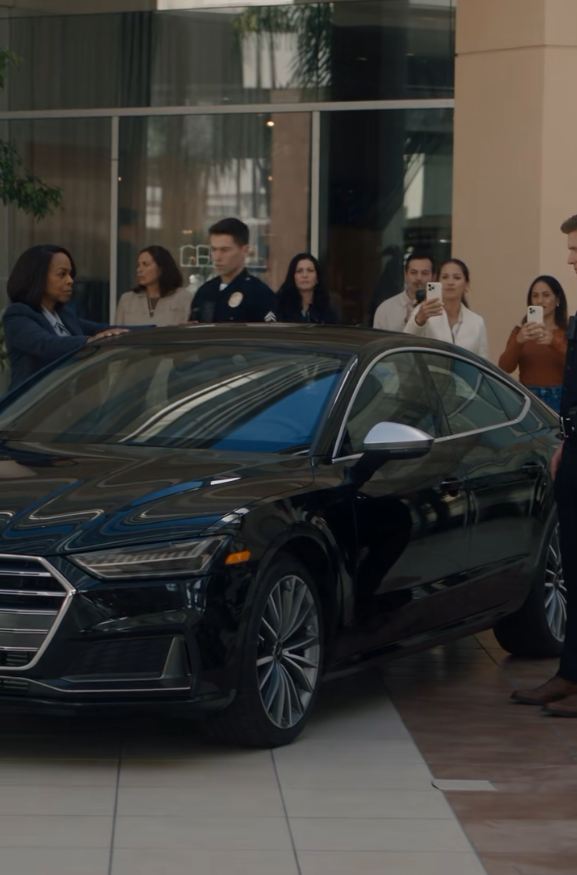
Recusal was obvious.
Necessary.
Still, something about it scraped at her.
Mitchell had behaved badly, and Valerie would now step away from a case examining his unit.
There would be people who saw that as proper judicial ethics.
Others would see surrender.
Some would claim she had invented outrage to damage the police.
Others would accuse her of protecting Mitchell by leaving the case.
None of that mattered legally.
But Valerie had spent long enough in public service to know that legality and narrative rarely traveled at the same speed.
Her phone vibrated again.
Another message.
Then another.
She turned it face down.
Across the room, her father’s engraved key holder caught the edge of the lamp light.
For my daughter, who will change the world.
Valerie walked over and picked it up.
“You could have been more specific,” she murmured.
Across town, Derek Mitchell watched the same video with the sound off.
He sat at his dining table still wearing uniform pants and a gray undershirt. His duty shirt hung over the back of a chair.
The clip had been reposted thousands of times.
He watched Valerie step out of the Mercedes.
Watched himself move closer.
Watched Reeves arrive.
Watched Valerie show the card.
He paused the video on his own face.
He hated what he saw.
Not guilt.
Fear.
That was what everyone would notice.
He locked the phone and pushed it away.
Five minutes later, he picked it back up.
His report remained unfinished.
The first version had started with suspicious vehicle occupancy.
He deleted that.
The second began with officer observed subject seated in high-value vehicle under circumstances—
He stopped.
Under what circumstances?
A woman sitting in a car?
Shopping bags in the passenger seat?
No damaged lock.
No broken window.
No alarm.
No mismatched plate.
He had nothing.
Mitchell rubbed both hands over his face.
He remembered first seeing the Mercedes while driving slowly through the shopping center lot.
There had been no dispatch call.
No theft report.
He had seen Valerie sitting inside.
He had seen her clothing.
Her posture.
The car.
And something in him had decided those pieces did not belong together.
He did not want to write that.
So he wrote around it.
Observed behavior inconsistent with normal parking-lot activity.
He stared at the sentence.
Then deleted it too.
His phone rang.
Reeves.
Mitchell let it ring three times before answering.
“What?”
“You finish your report?”
“Working on it.”
“Write what happened.”
Mitchell gave a humorless laugh.
“Thanks for the advice.”
“I’m serious.”
“So am I.”
Reeves’ voice remained level.
“Don’t turn it into something it wasn’t.”
Mitchell leaned back.
“You think I don’t know what this looks like?”
“I think that’s exactly the problem.”
Silence.
Mitchell stood and walked toward the window.
“You could’ve backed me up out there.”
“I did my job.”
“You embarrassed me in front of a crowd.”
Reeves took a second before answering.
“No, Derek.”
The pause was worse than the sentence.
“You did that yourself.”
Mitchell ended the call.
For a long time, he stood at the window looking at his reflection.
Then he returned to the report.
This time he started with the truth.
While conducting routine patrol through Willowbrook Heights shopping center, I observed a black Mercedes parked in the west lot. I approached the vehicle without receiving a prior dispatch regarding it.
He stopped.
The words were brutal because they were ordinary.
They left nowhere to hide.
Sunday morning, Valerie woke before dawn.
She had slept badly.
Not because of the video.
Because of the hearing.
She made coffee and opened the case file she was no longer going to hear.
The folder remained exactly as she had left it Friday.
She should not have read further.
Once she decided to recuse, the cleanest course was to stop.
Instead, she looked at the first page.
The allegations concerned incomplete reports, undocumented rationales for stops, inconsistencies between officer testimony and recorded dispatch traffic.
Language that had seemed procedural on Friday now felt uncomfortably familiar.
Valerie closed the file.
That was precisely why she had to step away.
Personal experience was changing the temperature of the evidence.
A judge did not need actual bias to become compromised. Sometimes the appearance was enough.
She drafted a short recusal order.
No accusation.
No commentary.
Just facts.
Due to an extrajudicial encounter on Saturday involving a member of the police unit connected to this matter, the court finds that continued assignment could create a reasonable question regarding impartiality.
She read it twice.
Then added one sentence.
This recusal makes no finding regarding the merits of any allegation in the pending matter.
Clean.
Necessary.
Unsatisfying.
She signed it.
Monday morning brought cameras.
Not the quiet handful Valerie was accustomed to after high-profile rulings.
A crowd.
Reporters lined the courthouse steps. Satellite trucks occupied spaces along the curb. The video had gained millions of views by dawn.
Valerie entered through the secured judicial entrance.
Inside, the hallway felt unusually still.
People greeted her normally.
Too normally.
That was another form of attention.
In chambers, she placed her handbag beside the desk and removed her coat.
Her robe hung behind the door.
She touched the sleeve but did not put it on.
She would not be hearing Mitchell’s unit.
The administrator entered carrying the reassignment order.
“It’s done.”
Valerie nodded.
“Thank you.”
“There’s also a request from internal affairs.”
“For?”
“Your statement.”
“That’s appropriate.”
“And the city attorney wants to know whether you intend to file a civil complaint.”
Valerie looked up.
“Today?”
“They asked.”
“I haven’t decided.”
The administrator studied her.
“You don’t have to decide immediately.”
“I know.”
“Do you?”
Valerie almost smiled.
That was the problem with colleagues who had known her too long.
She turned toward the window.
Outside, reporters waited beneath a gray sky.
“I spent my career telling people that process matters most when emotions make shortcuts feel justified.”
The administrator said nothing.
Valerie continued.
“If I use my position to punish him personally, I become part of the problem. If I pretend nothing happened because I’m a judge, I become part of a different problem.”
“So what do you do?”
Valerie looked back at the signed recusal order.
“The boring thing.”
“What’s that?”
“Follow procedure.”
At 9:20 a.m., Derek Mitchell was ordered to report to internal affairs.
At 9:32, he surrendered his badge and service weapon pending review.
At 9:41, someone leaked that information to the press.
By ten, a new version of the story dominated local news.
OFFICER SUSPENDED AFTER CONFRONTING JUDGE.
Mitchell sat alone in an interview room beneath fluorescent lights while two investigators reviewed his report.
Reeves had been interviewed first.
Mitchell knew that because Reeves passed him in the hallway.
Neither man spoke.
The lead investigator slid a printed copy of Mitchell’s report across the table.
“You wrote that you approached without a dispatch call.”
“Yes.”
“No stolen vehicle alert.”
“No.”
“No plate irregularity.”
“No.”
“No visible damage.”
“No.”
“No report from store security.”
“No.”
“Did Judge Henderson commit a traffic offense?”
“No.”
“Did you observe her entering the vehicle?”
“No.”
“Did you observe her tampering with it?”