She stopped.
No applause was permitted.
Good.
She returned to her seat.
Twenty minutes later, Derek Mitchell was called.
A murmur moved through the room.
He took the witness chair.
No uniform.
No badge.
He looked toward Valerie once.
Then faced the committee.
“My name is Derek Mitchell. I was the officer involved in the Willowbrook Heights incident.”
A committee member asked whether he supported the proposed changes.
“Yes.”
“Even though critics argue they may slow officers in uncertain situations?”
“Yes.”
“Why?”
Mitchell glanced at his prepared statement.
Then pushed it aside.
“Because uncertainty was exactly what I had.”
The room quieted.
“I acted like certainty was a fact. It wasn’t.”
He described the parking lot.
He did not minimize.
He did not dramatize.
Then came the question everyone expected.
“Would you have treated Judge Henderson the same way if you had known who she was?”
Mitchell’s face tightened.
“No.”
The answer produced a stir.
He continued before anyone could ask more.
“And that’s the problem.”
Valerie looked at him.
Mitchell faced the committee.
“She should not have needed a judge’s identification card to make me slow down.”
A reporter’s keyboard clicked rapidly.
Mitchell continued.
“I lost my job because of what I did. I’m not here to ask for it back. I’m here because the policy you’re discussing would have forced me to do something I should have done on my own.”
“What?”
“Explain what I actually knew.”
He paused.
“Before I put someone else in a position where they had to prove they belonged.”
Valerie lowered her eyes.
Her father’s words came back unexpectedly.
You still have to listen.
Not change the world.
Listen.
That had always been the harder instruction.
The policy passed.
Not unanimously.
But it passed.
The city settled Valerie’s civil claim one week later.
The payment was significantly lower than the original confidential offer.
Valerie accepted it.
The agreement was public.
So were the policy commitments.
When her lawyer asked whether she was satisfied, Valerie considered the word.
“No.”
Her lawyer smiled.
“I thought you’d say that.”
“But I’m finished.”
“That’s different.”
“Yes.”
It was.
Part VI — Aftermath
Three months after the parking-lot encounter, Willowbrook Heights looked exactly the same.
That surprised Valerie.
Same polished storefronts.
Same rows of cars.
Same carts rattling over pavement.
Same weekend crowd moving between errands.
She had avoided the shopping center without consciously deciding to.
Then one Saturday morning, she drove there.
Not to prove anything.
She needed a birthday gift for Mrs. Patterson.
That was all.
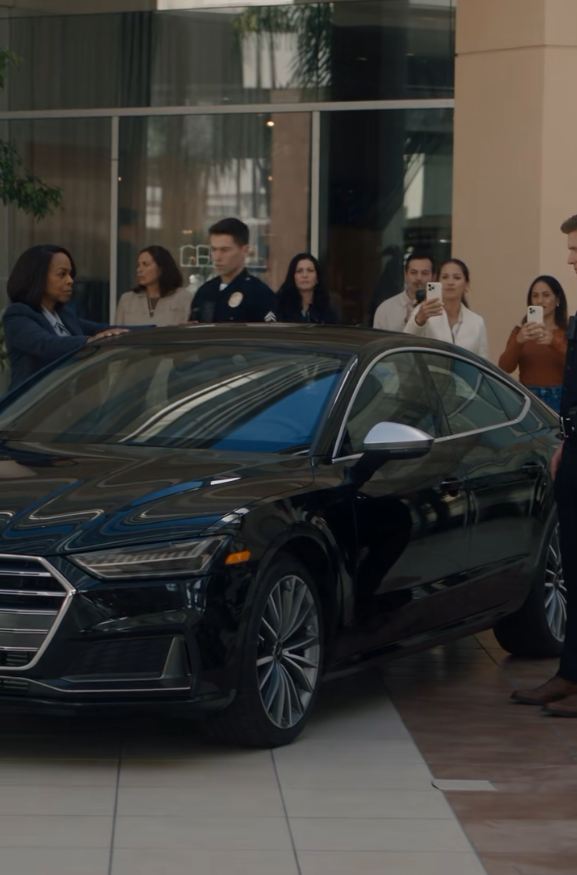
Valerie parked the black Mercedes near the same section where Mitchell had approached her.
She turned off the engine.
For several seconds, she remained seated.
The passenger seat held two shopping bags from an earlier stop.
The resemblance was almost absurd.
She looked through the windshield.
Nothing happened.
A family walked past.
A teenager pushed carts toward the entrance.
Somewhere, a car alarm chirped.
Valerie opened the door and stepped out.
No cameras.
No commands.
No crowd.
Just a Saturday.
She locked the car.
As she turned away, a voice called behind her.
“Judge Henderson?”
Valerie stopped.
A woman in her thirties stood beside another vehicle with a small child holding her hand.
The woman looked embarrassed.
“Sorry. I don’t mean to bother you.”
“It’s all right.”
“I saw the video.”
Valerie nodded.
The woman hesitated.
“My husband’s a police officer.”
Valerie waited.
The woman smiled nervously.
“He hated what happened.”
“That must have made dinner conversations interesting.”
The woman laughed.
“Yeah.”
Then she became serious.
“He says their department changed training because of it. Not just your city. They showed the clip and asked everyone to identify the point where the officer should have stopped and checked himself.”
Valerie absorbed that.
“What did your husband say?”
“He said the first ten seconds.”
Valerie smiled faintly.
“That sounds right.”
The woman squeezed her daughter’s hand.
“I just wanted you to know.”
“Thank you.”
They parted.
Valerie walked toward the shopping center.
At the entrance, she passed the young employee who had been pushing carts that morning months earlier.
He recognized her.
This time he did not raise a phone.
He simply nodded.
She nodded back.
Inside, she found Mrs. Patterson’s gift, paid for it, and left.
No reporters waited.
No one followed.
At home, Mrs. Patterson opened the box at the kitchen table.
Inside was a new leather key holder.
The older woman laughed.
“This is very fancy.”
“You deserve fancy.”
Mrs. Patterson turned it over.
There was a small engraved plate.
For the woman who reminds me to eat dinner.
Mrs. Patterson burst out laughing.
“That is what you put?”
“Yes.”
“Not something inspirational?”
“I’ve had enough inspiration.”
They drank coffee.
Later, after Mrs. Patterson left, Valerie stood alone near the front door.
Her father’s old key holder remained on the table.
For my daughter, who will change the world.
She picked it up and ran one thumb across the worn engraving.
For years, she had interpreted the words as a challenge.
Win the case.
Write the opinion.
Make the ruling.
Do something large enough to justify another person’s faith.
Now she understood them differently.
Change was rarely a single dramatic act.
Sometimes it was an officer checking a license plate before giving an order.
A partner deciding that loyalty did not mean silence.
A judge stepping away from a case she had every instinct to control.
A man admitting that the authority he carried had outrun the facts he possessed.
A policy written in language so ordinary that most people would never know the event that created it.
Valerie set the key holder down.
Her phone buzzed on the table.
A court notification.
Monday’s docket.
She opened it.
Twenty-seven cases.
Nothing remarkable.
She smiled.
Then, beneath the docket notification, another message appeared.
It was from the court administrator.
You may want to see this.
Attached was a brief article.
Former Officer Derek Mitchell had accepted a civilian position assisting with scenario-based ethics training for a regional law-enforcement academy.
Valerie read the first paragraph.
Then the second.
The program used real encounters to teach recruits how assumptions could become actions before officers recognized what had happened.
Mitchell was quoted only once.
The sentence was short.
“Authority doesn’t turn suspicion into evidence.”
Valerie read it again.
She had never said those words to him.
That mattered.
It meant he had learned something that did not belong to her.
She closed the article.
No forgiveness ceremony.
No friendship.
No neat transformation.
Just a man living with what he had done and deciding what to do next.
That was enough.
Valerie turned off the kitchen light and carried her coffee toward her study.
On the shelf, her judicial robe waited for Monday.
Beside it sat the files of people whose worst decisions would soon be reduced to pages, arguments, evidence, and consequences.
She knew better now than to believe a title made anyone immune from error.
A badge did not.
A robe did not.
An apology did not.
What mattered was the moment after certainty cracked—the moment when a person chose whether to defend the mistake or examine it.
Valerie touched the edge of Monday’s first file.
Then she looked once more toward the little engraved key holder near the door.
For my daughter, who will change the world.
She smiled.
“Not the whole thing,” she said softly.
Then she opened the file.
“Just the part in front of me.”