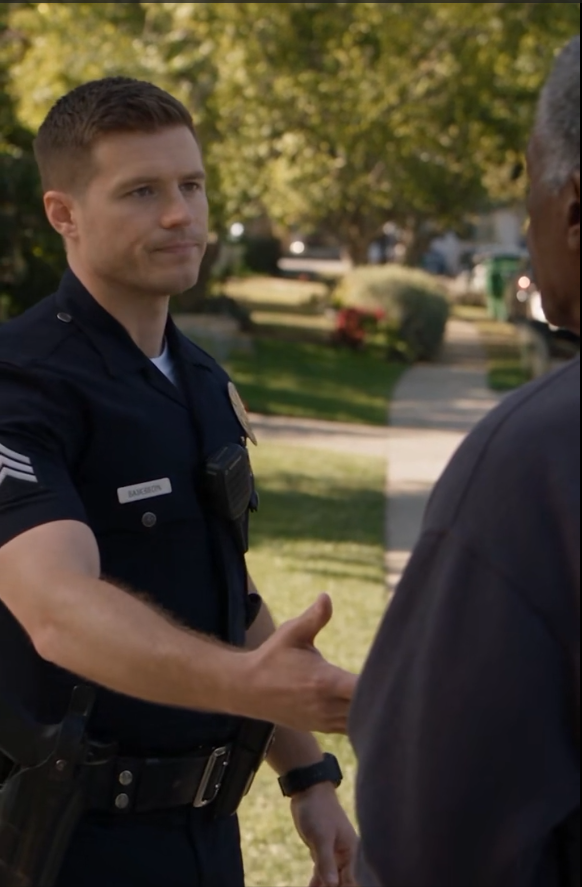
Part I — The Mailbox
The handcuffs became too tight before Officer Derek Rollins finished telling himself he had done nothing wrong.
I knew the difference.
After thirty years in law enforcement, you learn to separate what a person says from what his hands reveal. Rollins’s voice stayed flat and authoritative as he guided me toward the back seat of his cruiser. His grip did not. It kept changing—tightening, loosening, tightening again—as though some part of him understood the situation was slipping beyond the explanation he had chosen for it.
I was fifty-eight years old, standing in my own driveway on a Sunday morning, wearing an old Georgetown sweatshirt, gray sweatpants, and running shoes that should have been replaced two years earlier.
My newspaper lay open on the concrete behind us.
The garden hose was still running beside the hydrangeas.
My late wife had planted them nine years ago, the first spring after we moved into the house.
Rollins opened the cruiser door.
“Watch your head.”
I looked at him.
He took that as hesitation.
“Get in.”
His partner, Officer Greg Miller, stood several feet away with his coffee still in one hand. He had not touched me. He had not approved what was happening, either. But disapproval is not intervention, and every experienced officer knows the distance between those things can be measured in consequences.
“Derek,” Miller said again.
Rollins kept his eyes on me.
“What?”
Miller glanced toward the house, then toward the brick mailbox at the end of the driveway.
“We should run the address.”
“I said I’ve got it.”
“You’ve got what?”
Rollins’s head turned.
That was the first real challenge Miller had offered him.
For a moment, neither man spoke.
The quiet neighborhood continued around us with almost offensive normalcy. Water clicked through a sprinkler across the street. Somewhere behind a cedar fence, a dog barked once. A car rolled through the intersection at the end of the block, slowed at the sight of the patrol cruiser, then kept going.
Rollins lowered his voice.
“I’ve got the stop.”
Miller stared at him.
“This isn’t a stop.”
“It is now.”
I had heard versions of that sentence my entire career.
Not those exact words.
The logic behind them.
An officer makes a weak decision. Then, instead of correcting it, he begins building facts around it. The original question disappears. The officer stops asking, What happened? and starts asking, How do I prove I was right?
That was where Rollins was now.
I sat in the back of the cruiser.
The plastic bench was hard beneath me. My wrists pressed awkwardly against the cuffs.
Rollins shut the door.
Through the glass I watched him return to Miller.
Their conversation became muffled, but their body language did not.
Miller pointed once toward the house.
Rollins shook his head.
Miller said something longer.
Rollins answered with a short movement of his hand—dismissive, impatient.
Then he walked toward the front of the cruiser and keyed his radio.
I leaned my head back.
Sunday mornings were supposed to be the only hours I did not belong to the government.
No intelligence briefing.
No overnight threat summary.
No staff director telling me which senator wanted which answer by noon.
No encrypted call waiting beside the coffee maker.
For nine years, Sunday mornings had belonged to the paper, the garden, and my wife’s flowers.
For the last three years, after she died, they had become quieter.
But they were still mine.
Until 7:18 that morning.
Rollins had slowed his cruiser while I was standing beside my own mailbox. He had looked at me, then at the house behind me, then back at me.
The house had cost a little more than six million dollars when I bought it.
It was not ostentatious by the standards of the neighborhood. Brick, slate roof, deep front lawn, old trees. The kind of place that looked established rather than expensive.
Rollins had studied it before asking whether I belonged there.
That mattered.
Not legally, perhaps.
But it mattered.
He had asked my name.
“Arthur Pendleton.”
Then the homeowner’s name.
“Arthur Pendleton.”
He had laughed.
That mattered too.
My wallet was inside, on the small table near the kitchen.
I told him where.
He refused to retrieve it.
I offered the property records.
He refused.
The vehicle registration on the SUV parked in the garage.
He refused.
Dispatch.
He refused.
Each option had threatened something more important to him than certainty.
It threatened control.
He returned to the cruiser and opened the driver’s door.
Miller got into the passenger seat more slowly.
Rollins started the engine.
I leaned slightly forward.
“Officer Miller.”
Both men looked toward the partition.
Miller turned in his seat.
“Yes?”
“My newspaper is in the driveway.”
Rollins gave a short laugh.
Miller did not.
“I’ll get it,” he said.
Rollins looked at him. “Leave it.”
“It’s a newspaper.”
“We’re transporting.”
Miller stayed still for a second.
Then he opened the door, stepped back out, walked up my driveway, and picked up the paper.
He folded it once and carried it back.
That small act told me something.
Miller was not weak.
Not exactly.
He was deciding, second by second, how much conflict he was willing to absorb.
He placed the newspaper on the floor in front of his seat.
Rollins said nothing.
We pulled away from my house.
I watched the hydrangeas disappear through the rear window.
The hose was still running.
I thought of my wife.
She would have turned it off first.
No matter what else was happening.
That thought nearly made me smile.
Nearly.
Instead, I shifted my wrists again.
The cuffs bit deeper.
“Officer Rollins.”
His eyes met mine in the rearview mirror.
“They’re too tight.”
“You’ll be fine.”
“I’m telling you they’re too tight.”
“You said you’ve worked in law enforcement?”
“I said no such thing.”
He looked away.
He had assumed it.
Interesting.
Miller glanced at him.
“Check them.”
Rollins drove another half block.
“Derek.”
“What?”
“Check the cuffs.”
“They’re double-locked.”
“That’s not what I said.”
Rollins exhaled sharply and pulled to the curb.
He got out, opened my door, and tested the cuffs with one finger.
“They’re fine.”
“They are not.”
“You’ve got circulation.”
“That is not the standard.”
His expression changed.
For the first time, I had given him language he recognized.
Not accusation.
Procedure.
He looked at me more carefully.
“Who are you?”
“Arthur Pendleton.”
“I mean what do you do?”
“That wasn’t one of your original questions.”
His face hardened.
“Don’t play games.”
“I’m not.”
Miller had stepped from the other side of the cruiser.
“Loosen them one notch.”
Rollins looked at him.
Miller held his gaze.
“One notch.”
Rollins finally did it.
The relief was immediate but minor.
He closed the door.
As he walked back to the driver’s seat, I looked through the glass at Miller.
“Thank you.”
Miller’s face tightened.
Not with pride.
With something closer to embarrassment.
We drove the rest of the way in silence.
I could have ended it then.
I carried numbers in my head that would have changed the morning within minutes. I knew people who could verify my identity through systems Rollins had never heard of. One call from me, one properly phrased sentence, and this would no longer have been Officer Rollins investigating a suspicious man near a mailbox.