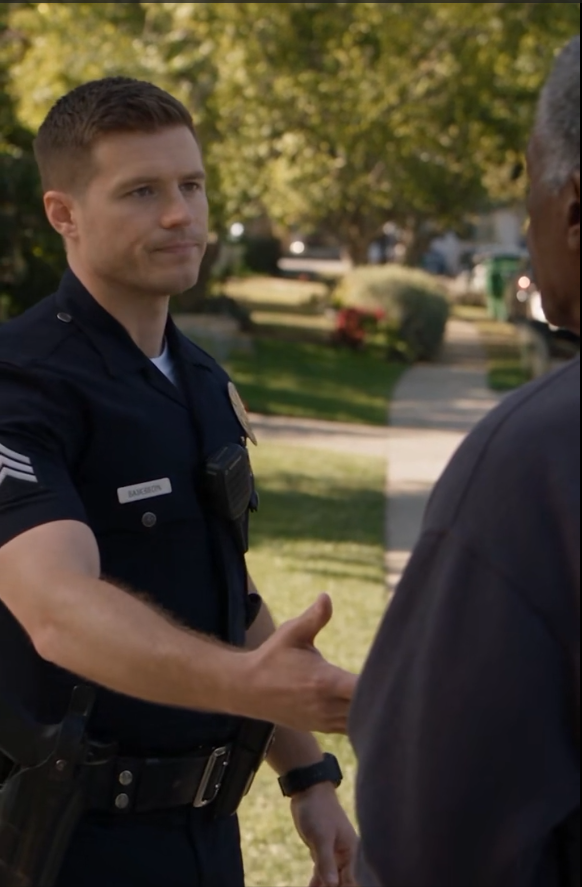
It would have been a local officer explaining why he had handcuffed the Director of the Federal Bureau of Investigation outside his own home.
But that was exactly why I stayed quiet.
Because if my title rescued me, we would learn nothing.
Rollins would become careful only when power entered the room.
I wanted to know what happened before that.
What happened when he believed I had none.
So I sat in the back of his cruiser and let him drive.
Part II — Procedure
The station was quieter than I expected.
Sunday morning staffing.
Fluorescent lights.
A desk officer drinking from a paper cup. A printer running somewhere behind a half-open door. The faint smell of disinfectant and old coffee.
Rollins brought me through a side entrance.
Miller followed.
The desk officer looked up.
“What’ve you got?”
“Suspicious person, possible package theft, failure to identify.”
I looked at Rollins.
He did not look at me.
The desk officer frowned.
“Package theft?”
“Possible.”
“Victim?”
“Not confirmed yet.”
“Complainant?”
Rollins paused.
Miller answered.
“No complainant.”
The desk officer’s eyes moved between them.
“No complainant?”
Rollins pulled a form from a tray.
“He was on residential property and couldn’t produce identification.”
“I identified myself,” I said.
Rollins turned.
“You’ll have your chance.”
The desk officer looked at me.
“Name?”
“Arthur Pendleton.”
He began typing.
Rollins stepped closer to the counter.
“He claims he owns the residence.”
The desk officer stopped typing.
“Did you run it?”
“I’m getting to it.”
The desk officer looked at Miller.
Miller said nothing.
The room changed slightly.
Not dramatically.
No one gasped. No music swelled. No sudden revelation dropped from the ceiling.
Professional environments rarely fracture that cleanly.
They tighten.
People speak more carefully.
The desk officer looked at Rollins again.
“You transported before verifying the address?”
Rollins’s shoulders rose a fraction.
“He was evasive.”
“How?”
Rollins looked toward me.
“He kept challenging the investigation.”
I almost laughed.
Instead, I said, “I answered every question you asked until you began refusing methods of verification.”
The desk officer’s fingers rested above the keyboard.
“Sir, I need you to let me process this.”
“Of course.”
That surprised him.
Rollins looked irritated.
The desk officer entered my name.
Then he paused.
He stared at the monitor.
His face did not change much, but his eyes did.
“Date of birth?”
I gave it.
He typed again.
Miller stepped closer.
Rollins leaned toward the screen.
The desk officer angled it away.
“Hold up.”
Rollins frowned. “What?”
“Just hold up.”
He typed another command.
Then another.
I knew what he was seeing.
Not my title.
That would not appear in the ordinary local return.
But my identity was protected in ways that produced flags. Certain records did not populate normally. Certain queries triggered instructions. Sometimes those instructions were obvious. Sometimes they were deliberately vague.
The desk officer picked up the phone.
Rollins’s expression sharpened.
“What’s the issue?”
The desk officer held up one finger.
“Dispatch, this is front desk. I need verification on a subject.”
He gave my name and date of birth.
Listened.
Looked at me.
“Address?”
I gave him my address.
He repeated it.
Listened again.
His posture changed.
Not fear.
Attention.
“Understood.”
He hung up.
Rollins said, “Well?”
The desk officer looked at me.
“Sir, are you willing to state your occupation?”
“No.”
Rollins gave a humorless laugh.
“There. See?”
The desk officer ignored him.
“Are you willing to confirm that the residence you provided is your primary residence?”
“Yes.”
“And that your identification is inside?”
“Yes.”
“Where?”
“Entry table near the kitchen. Brown leather wallet.”
The desk officer turned to Miller.
“Go verify.”
Rollins cut in.
“We don’t need—”
“Yes,” the desk officer said, “we do.”
Rollins stared at him.
Miller reached for the keys.
“I’ll go.”
The desk officer pointed toward my cuffs.
“And before you do, take those off.”
Rollins stepped forward.
“He’s detained.”
“For what?”
“Failure to identify.”
“He gave you a name.”
“No physical ID.”
“That’s not the same thing.”
I looked at Miller.
He looked at me.
It was the exact sentence I had used in my driveway.
The desk officer had said it without knowing.
Rollins heard that too.
His face reddened.
“He was on property.”
“Whose property?”
“That’s what we’re determining.”
“Which is why Miller is going to verify it.”
Rollins’s jaw moved.
The desk officer did not raise his voice.
“Take off the cuffs.”
For one second, I thought Rollins might refuse.
Then he unlocked them.
Blood returned more fully to my hands.
I rubbed my wrists once.
Miller looked at the red marks.
His eyes moved away.
“I’ll get the ID,” he said.
“No,” I said.
Everyone looked at me.
I turned to the desk officer.
“You may verify the address. Do not enter my home without me.”
Rollins sighed.
“Oh, come on.”
I ignored him.
The desk officer nodded.
“That’s fair.”
Miller said, “I can check the vehicle registration from the driveway.”
“Yes.”
“And property records.”
“Yes.”
He left.
I sat in a molded plastic chair.
Rollins remained standing.
The desk officer returned to his computer.
For a while, no one spoke.
That silence was useful.
Rollins paced once toward the hallway, then back.
He wanted movement. Paperwork. Something that would restore a sense of momentum.
Instead, he had to stand in the uncertainty he had created.
Finally he looked at me.
“Why won’t you say what you do?”
“Why should my occupation determine whether you believe I own my house?”
“It doesn’t.”
“Then you don’t need it.”
“You’re making this difficult.”
“No. I offered you three simple verification methods before you placed me in handcuffs.”
“I had a suspicious person call in the area.”
That was new.
I looked at him.
The desk officer looked up too.
“You said no complainant.”
“I said possible package theft.”
“That isn’t the same thing.”
Rollins folded his arms.
“There’ve been thefts.”
“In the neighborhood?” I asked.
“Yes.”
“When?”
“Recently.”
“How recently?”
“You’re not interviewing me.”
I nodded.
“No. I’m trying to understand the basis for what you did.”
“I saw you near a mailbox.”
“My mailbox.”
“You say.”
The desk officer stopped typing.
Rollins realized too late how that sounded.
He corrected himself.
“At the time, that was unverified.”
I looked toward the station clock.
8:02.
Less than forty-five minutes had passed since I turned off the hose.
It felt longer.
A phone rang in the back.
Someone answered.
Rollins shifted his weight.
The desk officer glanced at the screen again.
“You want water?”
He was asking me.
“Yes, thank you.”
He brought me a bottle.
Rollins watched.
Not because water mattered.
Because courtesy did.
He had put me into a category when he saw me.
The desk officer was allowing that category to loosen.
I opened the bottle.
“My newspaper?”
The desk officer looked confused.
Miller had carried it into the building and left it on the counter.
Rollins stared at me as I picked it up.
“You’re going to read?”
“I was reading before you arrived.”
The desk officer looked down to hide a reaction.