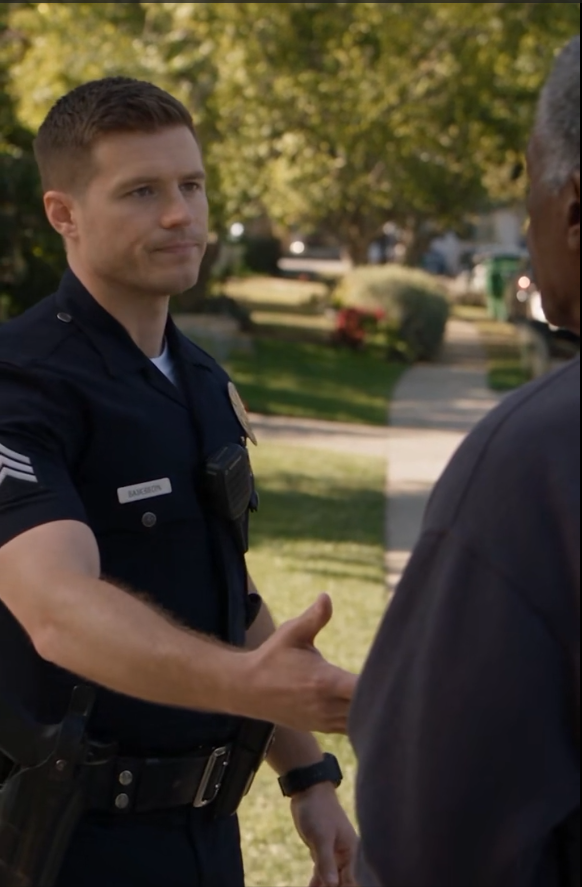
It did not.
But because it revealed something.
Even while participating in the detention, Miller had imagined the possibility that I was telling the truth.
He had simply failed to let that possibility control his actions.
“Did you think I lived there?”
He nodded.
“Before we left.”
“How sure?”
“Maybe sixty percent.”
“Sixty.”
“Yes.”
“And you still got into the cruiser.”
His face fell.
“Yes.”
I let the silence stay.
Then I asked, “What happens to someone without my title?”
He looked at me.
“That’s what I keep thinking about.”
I said nothing.
He continued.
“If you’d been somebody nobody cared about…”
He stopped.
“Finish it.”
His voice became quieter.
“Maybe Rollins writes the report and I sign it.”
“Maybe?”
He shook his head.
“I probably sign it.”
“And the report says?”
He looked toward the legal pad but did not touch it.
“Suspicious behavior. Refusal to provide identification. Uncooperative attitude.”
“Was I uncooperative?”
“No.”
“Did you know that then?”
“Yes.”
That answer landed harder than most.
Because it was clean.
I closed the legal pad.
“What do you want me to do with you?”
He looked confused.
“I don’t know.”
“Should you keep your badge?”
His face changed.
He had not expected me to ask directly.
“I don’t know.”
“That’s not humility. That’s avoidance.”
He breathed out through his nose.
“I think I can do the job.”
“That wasn’t the question.”
“No.”
He sat straighter.
“I think I should face whatever discipline comes from what I did. And if I keep the badge, I shouldn’t be allowed to pretend this was just Derek’s mistake.”
That was the first answer I believed completely.
I stood.
So did he.
At the door, I stopped him.
“Greg.”
“Yes?”
“If something like this happens again, what do you do?”
He did not hesitate.
“I choose sooner.”
I opened the door.
“That would be a start.”
Part V — The Hearing
The department’s internal hearing took place six weeks later.
By then, the incident had become public.
Not because I leaked it.
Someone else had.
The body-camera video appeared first in fragments, then in full. The phrase you don’t look like the owner became the line everyone repeated.
Television panels argued over it.
Commentators turned me into symbols I had never volunteered to become.
Some insisted the incident proved everything.
Others insisted it proved nothing except one officer made a bad call.
Both versions annoyed me.
Real institutions are rarely explained by one event.
But one event can expose how an institution responds when there is nowhere left to hide.
That mattered.
I refused most interview requests.
I released one statement.
It was four sentences.
The third mattered most:
“The issue is not that the officer failed to recognize the FBI Director. The issue is that he believed the man standing in front of him did not deserve verification before restraint.”
The department opened a formal disciplinary process.
Rollins obtained counsel.
Miller accepted responsibility for failing to intervene and was placed on temporary administrative assignment.
The prior complaints against Rollins were reopened, not as proof of guilt but as context for supervisory review.
The hearing room was smaller than the media outside would have suggested.
No grand chamber.
No dramatic architecture.
Just a municipal conference room with a long table and bad acoustics.
I attended as a witness.
Rollins sat across from me beside his attorney.
He looked different out of uniform.
Smaller somehow.
Not physically.
Context changes people.
The department representative began with procedure.
Body-camera timeline.
Dispatch records.
Property verification.
Transport.
Station entry.
Then came the central question.
Why had Rollins placed me in handcuffs?
His attorney argued officer safety and investigative control.
The department asked what threat I had presented.
Rollins said uncertainty itself created risk.
The department asked what conduct suggested violence.
None.
Flight?
None.
Concealment?
None.
Contraband?
None.
Known criminal activity?
None.
Then why cuffs?
Rollins answered, “He was challenging my authority during an active investigation.”
The room changed.
His attorney leaned toward him.
Too late.
The department representative repeated the answer.
“Challenging your authority?”
Rollins corrected.
“Challenging lawful commands.”
“Which command did he disobey?”
Rollins paused.
“He was argumentative.”
“Which command?”
He looked toward the table.
“I told him to step away from the mailbox.”
“Did he?”
“Yes.”
“You asked his name?”
“Yes.”
“Did he provide it?”
“Yes.”
“You asked whether he lived there?”
“Yes.”
“Did he answer?”
“Yes.”
“You requested identification?”
“Yes.”
“He said it was inside?”
“Yes.”
“Did you permit him to retrieve it?”
“No.”
“Did you retrieve it?”
“No.”
“Did you run his name?”
“Not immediately.”
“Did you run the address?”
“No.”
“Did you run the vehicle?”
“No.”
“Did you call dispatch to verify ownership?”
“No.”
“Did you ask a neighbor?”
“No.”
“Then what part of the investigation was he preventing?”
Rollins’s face tightened.
“He was controlling the interaction.”
The department representative looked at him.
“No, Officer. He was answering you.”
Rollins leaned back.
His lawyer touched his arm.
He ignored it.
“You weren’t there.”
The representative’s tone stayed level.
“We have the video.”
“You don’t know what it felt like.”
That sentence caught my attention.
Feelings.
After six weeks of procedural arguments, Rollins had finally arrived at the real thing.
The representative asked, “What did it feel like?”
Rollins looked across the room.
His eyes found mine.
I did not look away.
“He was too calm.”
No one spoke.
Rollins continued.
“He kept talking like he knew better.”
His attorney said quietly, “Derek.”
But Rollins had crossed some internal threshold.
“He kept giving me options. Run this. Check that. Call dispatch. Like he was supervising the stop.”
I heard my wife’s voice in memory.
Arthur, you get quieter when you’re angry.
Rollins had mistaken my restraint for dominance.
My knowledge for disrespect.
My calm for challenge.
The representative asked, “Did you know his occupation?”
“No.”
“Did you know his law-enforcement background?”
“No.”
“Then why did you interpret procedural suggestions as a threat to your authority?”
Rollins looked down.
“I don’t know.”
The same answer he had given at the station.
But this time, it did not sound honest.
It sounded exhausted.
His attorney requested a recess.
The panel granted it.
People stood.
I remained seated.
Miller, waiting as a separate witness outside the main table, approached me.
“You okay?”
I looked at him.
“That’s an odd question.”
He almost smiled.
“I know.”
“I’m fine.”
He nodded toward Rollins, who was speaking intensely with counsel near the far wall.
“I don’t think he gets it.”
“Maybe.”
“You think he does?”
“I think understanding is more expensive than regret.”
Miller looked at me.
I continued.
“Regret asks, ‘How do I get out of this?’ Understanding asks, ‘What did I do?’”
Miller looked toward Rollins again.
“And if he never asks?”
“Then the department has its answer.”
After recess, Miller testified.
His voice shook once.
Only once.
He described the driveway.
His recommendations to verify the address.
His reluctance to contradict his partner.
His decision to retrieve the newspaper.
His failure to demand the cuffs come off sooner.
Rollins stared at him.
When Miller finished, Rollins’s attorney asked, “Officer Miller, you did not believe Director Pendleton was in physical danger, correct?”