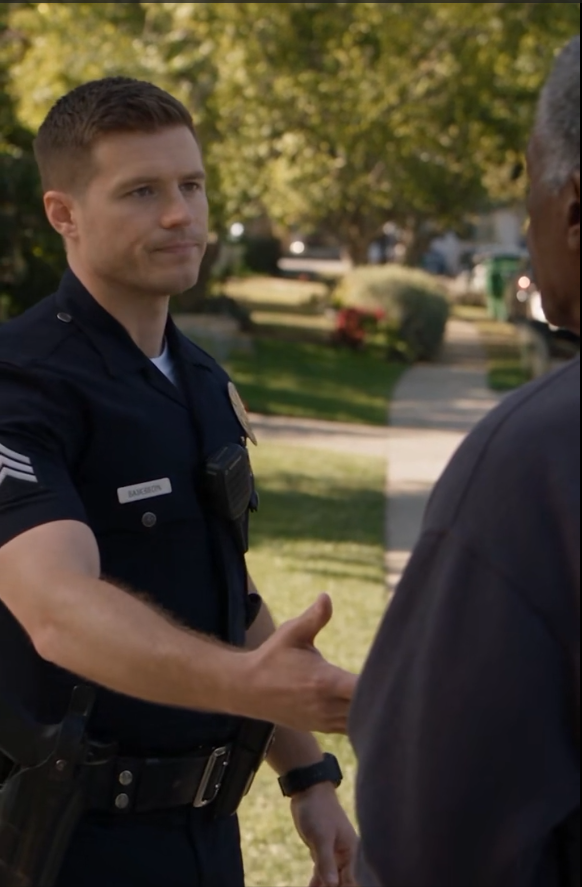
Miller looked at me.
Then back at the attorney.
“No.”
“So you did not intervene because you believed the situation, while perhaps procedurally imperfect, remained safe.”
“No.”
The attorney paused.
“That’s not your position?”
“No.”
“Then explain.”
Miller swallowed.
“I didn’t intervene because I was afraid of creating a conflict with my partner.”
Rollins’s face changed.
Miller continued.
“That’s not the same as believing what he was doing was right.”
The attorney asked, “You’re saying this now after learning the detained individual was the FBI Director.”
Miller’s expression hardened.
“No.”
“No?”
“I wrote it Sunday night.”
The attorney looked at his notes.
“Yes.”
“Before any public statement. Before the video became news. Before I knew what discipline I’d face.”
The attorney leaned back.
Miller looked at Rollins.
“I should’ve stopped you.”
It was the first time anyone in the hearing had addressed him directly.
Rollins’s attorney objected.
The panel chair allowed limited response.
Rollins stared at Miller.
“So now you’re the good cop?”
Miller shook his head.
“No.”
“You get to sit there and dump it all on me?”
“No.”
“Then what are you doing?”
Miller’s answer was quiet.
“Telling the truth about my part.”
Rollins laughed bitterly.
“Your part.”
“Yes.”
“You went along with it.”
“I did.”
“You transported him.”
“I did.”
“You stood right there.”
“I did.”
Rollins leaned forward.
“Then stop acting like you’re different.”
Miller looked at him for a long moment.
“I’m trying to be.”
The room went still.
Not because the sentence was dramatic.
Because it was simple.
Rollins leaned back.
For the first time, he looked tired.
The panel called me last.
I took the chair.
The department representative asked me to describe the encounter.
I did.
No speeches.
No adjectives I could not defend.
I described the patrol cruiser slowing.
Rollins’s command.
My compliance.
The questions.
My answers.
The verification methods I offered.
The cuffs.
The transport.
The station.
Then the representative asked the question everyone had been waiting for.
“Director Pendleton, why didn’t you disclose your position?”
I looked toward the panel.
“Because my position should not have been necessary.”
“Did you intentionally withhold it?”
“Yes.”
“Why?”
I thought carefully before answering.
“Because I realized in the driveway that once he knew, the encounter would no longer tell me what it had been telling me.”
“What had it been telling you?”
“That Officer Rollins believed my ordinary answers were less credible than his unsupported suspicion.”
Rollins shifted in his chair.
I continued.
“If I had said, ‘I’m the FBI Director,’ and he immediately removed the cuffs, what would that prove?”
The representative waited.
“It would prove he recognized power.”
I looked at Rollins.
“It would not prove he recognized error.”
His attorney rose slightly.
“Director, are you suggesting my client discriminated against you based on race?”
“I’m describing what he did.”
“That is not my question.”
“I know.”
“Do you believe race caused the detention?”
I paused.
This was the question television wanted.
It was also the question evidence could not answer cleanly.
“I cannot testify to what was inside Officer Rollins’s mind.”
The attorney nodded, almost satisfied.
Then I continued.
“I can testify that he looked at me, looked at my house, told me I did not look like the owner, rejected every available method of verification, and restrained me despite my compliance.”
The attorney’s expression changed.
“I believe those facts require examination.”
“Not accusation?”
“Examination.”
He sat down.
The panel chair asked, “Director, what outcome are you seeking?”
There was the second hard choice.
I could ask for Rollins’s badge.
No one in that room would have misunderstood.
But I had spent my career arguing that systems become dangerous when consequences depend on the status of the injured person.
I could not demand a special punishment without betraying my own argument.
“I’m not seeking a specific punishment.”
Rollins looked at me.
The panel chair seemed surprised.
“Then what are you seeking?”
“An honest finding.”
“Meaning?”
“If his actions violated policy, say so. If they violated law, address that through the proper process. If supervision failed, include it. If training failed, fix it. If prior complaints were mishandled, review them.”
I paused.
“But do not punish him more because I am the FBI Director.”
The room was silent.
“And do not punish him less because admitting what happened is embarrassing.”
The chair nodded slowly.
I looked toward Miller.
“Also, do not treat Officer Miller’s eventual honesty as though it erased his earlier failure.”
Miller accepted that without visible reaction.
“He should face consequences for what he did.”
I returned my attention to the panel.
“And he should receive credit for telling the truth when it was personally costly.”
Rollins’s attorney folded his hands.
The chair asked one final question.
“What do you think should change?”
I looked at Rollins.
Then at Miller.
“Officers are trained to control uncertainty. They should also be trained to recognize when control becomes the objective rather than the tool.”
The chair waited.
I added, “And partners must understand that loyalty is not silence.”
I stood.
That was all.
Three weeks later, the findings arrived.
Officer Derek Rollins had violated department policy governing investigative detention, handcuffing, verification, and report accuracy.
The department concluded there was insufficient evidence to make a definitive finding about discriminatory intent.
It also concluded that his statement about an active suspicious-person call was inaccurate and unsupported by dispatch records.
He was terminated.
Not because I requested it.
Because the panel found that the central problem was not one mistaken suspicion.
It was what he did when evidence contradicted him.
Greg Miller received a suspension, remedial training, and probationary monitoring.
He was not praised.
He was not destroyed.
He remained accountable for failing to intervene.
That mattered too.
The department revised its field-supervision procedures.
Partners were given explicit authority—and duty—to interrupt detentions when legal grounds became unclear.
I read the final report alone in my office.
Then I closed it.
There should have been satisfaction.
There was some.
Mostly, there was quiet.
Part VI — The Hydrangeas
By autumn, the marks on my wrists were long gone.
The hydrangeas had begun to fade.
Sunday mornings returned.
Not exactly as before.
Nothing returns exactly as before.
The house felt different after the incident—not unsafe, but observed. For several weeks, unfamiliar cars slowed more often. Reporters occasionally waited near the entrance to the neighborhood until local residents complained.
I stopped reading online commentary entirely.
That was one of the few decisions everyone on my staff supported.
One Sunday in October, I walked down the driveway just after seven.
Same sweatshirt.
Different running shoes.
The air had turned cool.
The newspaper was beside the mailbox.
I bent to pick it up.
A patrol cruiser appeared at the far end of the street.
For a second, my body reacted before thought.
Not fear.
Recognition.
The brain keeps records the conscious mind does not request.
The cruiser slowed.
Then continued.
No lights.
No window lowering.
No officer stepping out.
Just a car passing through a neighborhood.
I stood there holding the newspaper until it disappeared around the corner.