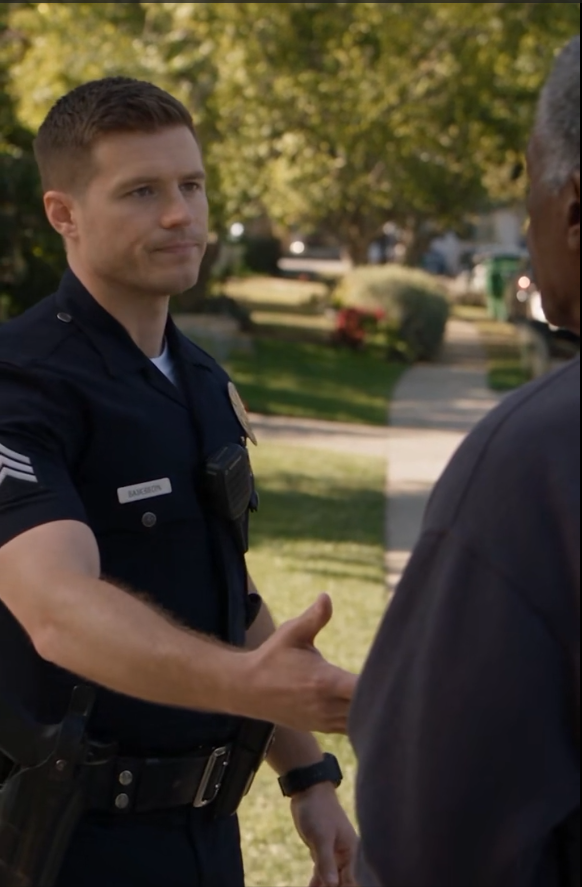
Then I heard a voice behind me.
“Arthur?”
My neighbor from across the street was walking toward his driveway carrying a travel mug.
He had been the one who later confirmed I lived in the house.
“Morning.”
“Morning.”
He looked toward the vanished cruiser.
Then at me.
“You all right?”
There was something almost funny about the question now.
“I’m fine.”
He nodded.
Neither of us mentioned the incident.
That was kindness.
I walked back toward the house.
Halfway up the driveway, I stopped beside the hydrangeas.
One branch had grown too far over the walkway.
My wife would have cut it weeks ago.
I set the newspaper down, went to the garage, and brought back pruning shears.
I worked for twenty minutes.
Trimmed dead stems.
Cleared leaves.
Adjusted the hose.
Simple work.
Useful work.
When I finished, I sat on the front step with my coffee and opened the paper.
My phone buzzed inside the house.
I ignored it.
A few minutes later, it buzzed again.
Then stopped.
The sun came through the trees.
I turned a page.
Near the bottom of the national section was a short article about the department’s revised intervention policy.
No photograph of me.
No photograph of Rollins.
Just a description of the change.
Partner officers were now required to document disagreements over detention grounds in real time whenever practical. Supervisors had to review any case involving transport when identity or property ownership was disputed but readily verifiable.
I read the article twice.
Then I folded the page.
That should have been the end.
It almost was.
Two weeks later, I received a handwritten envelope at headquarters.
No return address I recognized.
Inside was a single sheet of paper.
The handwriting was blocky.
Controlled.
Director Pendleton,
I have rewritten this letter six times.
I kept trying to explain why I did what I did.
Every version sounded like I was asking you to agree that I had reasons.
I did have reasons.
They were just bad ones.
I thought being questioned meant I was losing control. I thought changing course in front of you would make me look weak. I cared more about being right than finding out whether I was right.
I don’t expect a response.
Derek Rollins
I read it once.
Then again.
There was no apology in the conventional sense.
No request for forgiveness.
No statement about race.
No claim of transformation.
I trusted it more because of that.
I placed the letter in my desk drawer.
For three days, I did nothing.
On the fourth, I took it home.
Sunday morning arrived cold and clear.
I carried the letter outside with my coffee.
The hydrangeas were nearly bare.
I sat beside them and read it one last time.
Then I thought about Miller.
I thought about the desk officer.
The supervisor.
The hearing.
The body-camera footage.
I thought about my wife and how impatient she had been with false binaries.
People are not lessons, Arthur, she used to say.
They are people.
I had disagreed with her often enough to remember exactly how she said it.
I went inside and found stationery.
I wrote one sentence.
Officer Rollins,
Understanding begins where explanation stops.
I signed my name.
Nothing else.
I did not invite further contact.
I did not offer absolution.
Forgiveness is not a substitute for accountability, and accountability is not the same thing as permanent condemnation.
Some choices cost a career.
Some failures reveal a person.
What they do afterward reveals something else.
I sealed the envelope.
Then I returned outside.
The newspaper waited beside my chair.
I picked it up.
For a long time, I sat without opening it.
The most disturbing part of that Sunday in August had never been the handcuffs.
It had not been the cruiser.
It had not even been the sentence about not looking like the owner.
It was how quickly an ordinary man’s word became worthless once an officer decided what kind of man he was looking at.
My title had eventually changed the room.
It had brought lawyers, supervisors, preservation orders, hearings, headlines, and institutional reform.
But none of those things could answer the question that stayed with me.
What if I had been exactly who Rollins thought I was?
A man with no title.
No credential.
No federal staff waiting by the phone.
No institution capable of forcing the morning to be remembered accurately.
The answer was uncomfortable because Miller had already given it to me.
Maybe Rollins writes the report and I sign it.
That sentence had done more to change policy than my title ever could.
Not because it described corruption in some grand, cinematic form.
Because it described something smaller.
Ordinary.
A colleague staying quiet.
A report becoming cleaner than the truth.
A weak suspicion turning into official fact because no one chose the harder moment soon enough.
I looked down the street.
A mail truck moved slowly past the intersection.
A dog pulled its owner toward a patch of grass.
Sprinklers clicked on somewhere across the road.
Normal Sunday sounds.
I opened the newspaper.
Then I noticed the hose.
I had left it running.
I laughed.
Actually laughed.
Out loud.
I stood, crossed the yard, and turned it off.
For a moment, my hand rested on the brass valve.
The hydrangeas moved slightly in the morning breeze.
My wife had planted them because she said the west side of the house needed color.
At the time, I had told her no one would notice from the street.
She had looked at me like I had missed the point entirely.
“They’re not for the street,” she had said.
I understood that now in a way I had not then.
Some things are not done for the people watching.
You tell the truth because it is true.
You interrupt your partner because the stop is wrong.
You change your mind because the evidence changed.
You loosen the cuffs because the man says they hurt.
You verify the address because you can.
You correct the report because memory is weak and power is persuasive.
You do the right thing before you know who is standing in front of you.
Especially then.
I picked up my coffee and newspaper and walked toward the house.
At the door, I looked back once.
The brick mailbox stood at the end of the driveway, ordinary and quiet beneath the trees.
Six weeks earlier, beside that mailbox, Officer Derek Rollins had looked at me and decided I did not belong.
He had been wrong about the house.
Wrong about the newspaper.
Wrong about the man.
But the most important thing he had been wrong about was far simpler.
He believed a person’s power determined how carefully he deserved to be treated.
It doesn’t.
And on that quiet Sunday morning, with the hose finally off and my wife’s hydrangeas moving in the wind, I stepped inside knowing that was the only part of the story worth carrying forward.