Part I — The Stop
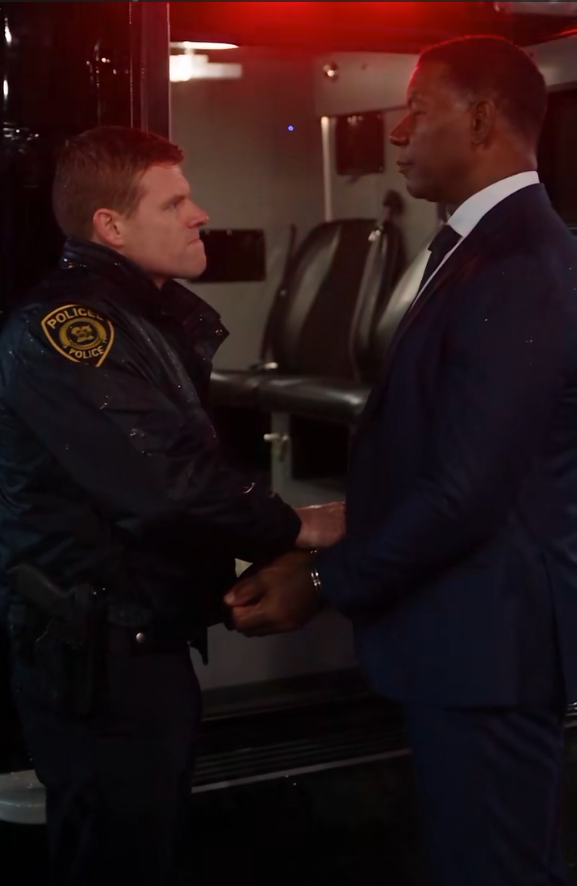
The handcuffs closed around David Harrison’s wrists with enough force to cut skin, and the young officer behind him said the words David had heard too many times in too many reports.
“Stop resisting.”
David was not moving.
Rain ran from the back of his neck beneath the collar of his white dress shirt. His suit jacket lay on the passenger seat of the black government Tahoe six feet away. Red and blue light pulsed across the wet pavement, turning the narrow shoulder of Georgetown Pike into alternating strips of blood and ice.
David looked down at his shoes sinking slightly into the mud.
Then he looked at the patrol car.
Then at Officer Bradley Jenkins’s reflection in its rain-streaked window.
He did not turn around.
“I’m not resisting,” David said.
Jenkins tightened his grip anyway.
“I said stop.”
David stopped speaking.
At fifty-four years old, he had spent enough of his life around armed men to recognize the point at which explanation became fuel.
He had also spent enough of his life around authority to understand something else.
Some people became calmer when they realized they might be wrong.
Others became more dangerous.
Bradley Jenkins belonged to the second group.
Ten minutes earlier, David had been thinking about a shower.
That was all.
Not the White House.
Not the summit that had consumed nearly three days.
Not foreign protective details, motorcade timing, credential lists, restricted elevators, rooftop overwatch, emergency routes, or threat assessments that changed every six hours.
He had been awake for close to seventy-two hours, sleeping in fragments on an office couch and once, for eleven minutes, in the rear seat of an armored Suburban while a deputy director took a call beside him.
Now the summit was over.
The principals were secure.
Foreign delegations were leaving.
His immediate responsibilities had finally narrowed to one simple act.
Drive home.
The black up-armored Chevrolet Tahoe moved through the rain at exactly forty-five miles per hour.
David knew that because he had spent most of his adult life noticing details other people discarded.
Speed.
Distance.
Mirrors.
Hands.
Doors.
Exits.
Vehicles that appeared twice.
Faces that looked away too quickly.
The Tahoe’s wipers worked at full speed. Water hissed beneath the tires. The road was dark except for occasional porch lights behind trees and the glow of oncoming headlights.
Two civilian vehicles followed at a reasonable distance.
Then a patrol cruiser appeared behind them.
It passed one vehicle.
Then the other.
Too fast for the weather.
David noticed it without concern.
When the cruiser settled behind him, he checked his speed.
Forty-five.
He checked the lane.
Centered.
His government plate was clean.
His lights were functioning.
He had consumed nothing stronger than coffee in three days.
Thirty seconds later, red and blue lights erupted in the mirror.
David exhaled through his nose.
Not fear.
Not irritation.
Fatigue.
He put on his turn signal and searched for a safe shoulder.
There wasn’t much of one.
He reduced his speed, traveled another hundred yards, then eased the Tahoe onto a muddy strip beside the road.
Engine off.
Interior light on.
Windows down.
Hands visible at ten and two.
He had trained young agents to do the same thing.
Make the stop boring.
Make the officer comfortable.
Remove ambiguity.
Keep everyone alive.
The patrol cruiser stopped behind him with its headlights and takedown lights burning.
David watched the officer approach in the mirror.
Young.
Broad shoulders.
Rain jacket open over his uniform.
Flashlight in left hand.
Right hand riding close to his holster.
A second officer came up on the passenger side.
Younger still.
Nervous.
David recognized nervousness immediately.
The first officer stopped behind the driver’s door instead of beside it.
“License, registration, proof of insurance.”
His tone arrived before his face did.
David kept both hands on the wheel.
“Officer, my identification is in my suit jacket on the passenger seat. I need to reach for it slowly.”
“I didn’t ask for a speech.”
David waited.
The flashlight shifted.
“Get it.”
David turned his torso carefully and reached toward the jacket.
From the passenger side, the second officer leaned closer to the window.
His gaze went first to David’s hands.
Then to the interior.
Encrypted communications console.
Secure docking hardware.
Reinforced panels.
Government equipment that did not belong in an ordinary SUV.
David retrieved his wallet and black credential case.
He extended both through the driver’s window.
Officer Jenkins took them.
The driver’s license came first.
“David Harrison.”
“Yes.”
“Address says McLean.”
“Yes.”
Jenkins opened the credential case.
The gold badge caught the flashlight beam.
Beside it sat David’s federal identification.
The expression on Jenkins’s face changed, but not in the way David expected.
He smiled.
Not pleasantly.
“Secret Service?”
“Yes.”
Jenkins gave a short laugh.
David studied him.
“Those are federal credentials. You can confirm the number through dispatch.”
Jenkins looked up sharply.
“You don’t advise me how to run a traffic stop.”
David said nothing.
The officer on the passenger side shifted his weight.
“Brad.”
Jenkins ignored him.
“Brad,” the younger officer said again, quieter. “Maybe we should verify it.”
Jenkins turned his head.
“Did I ask you something, Higgins?”
“No.”
“Then watch the passenger side.”
Officer Higgins swallowed and looked through the open window again.
David could see the uncertainty in his face.
He had seen that expression on inexperienced agents before. The moment when instinct and hierarchy collided.
Jenkins handed the credential case back through the window.
“Step out of the vehicle.”
David did not take it.
“What is the reason for the stop?”
“Step out.”
“I’m asking why you stopped me.”
“Failure to maintain lane.”
David looked past him at the road.
“I have been centered in my lane since I turned onto this road.”
Jenkins leaned closer.
“And now you’re arguing.”
“No. I’m documenting.”
Something hardened in Jenkins’s face.
“Out of the car.”
David knew the moment had changed.
Rain.
Limited shoulder.
Night.
An inexperienced second officer.
A primary officer whose pride had become part of the stop.
David could keep questioning him.
Legally, he had grounds to.
Practically, that would accomplish nothing useful.
He opened the door slowly.
“Both hands where I can see them.”
“They are.”
“Face the vehicle.”
David complied.
Rain soaked the back of his shirt almost instantly.
Jenkins patted him down with more force than necessary.
When his hand reached David’s right side beneath the soaked shirt, he stopped.
“What’s this?”
“My service weapon.”
Jenkins stepped back.
“Gun!”
Higgins flinched on the passenger side.
David’s voice stayed even.
“I told you I’m a federal agent. The firearm is agency-issued. My credentials are in your hand.”
“Don’t move.”
“I’m not moving.”
Jenkins drew David’s pistol from its holster.
David heard the handling and turned his head slightly.
“Keep your finger outside the trigger guard.”
Jenkins shoved his shoulder into the Tahoe.
“I said don’t move.”
David faced the vehicle again.
“Then secure it properly.”
“Hands behind your back.”
Higgins moved around the front of the Tahoe.
“Brad, wait.”
“Hands behind your back now.”