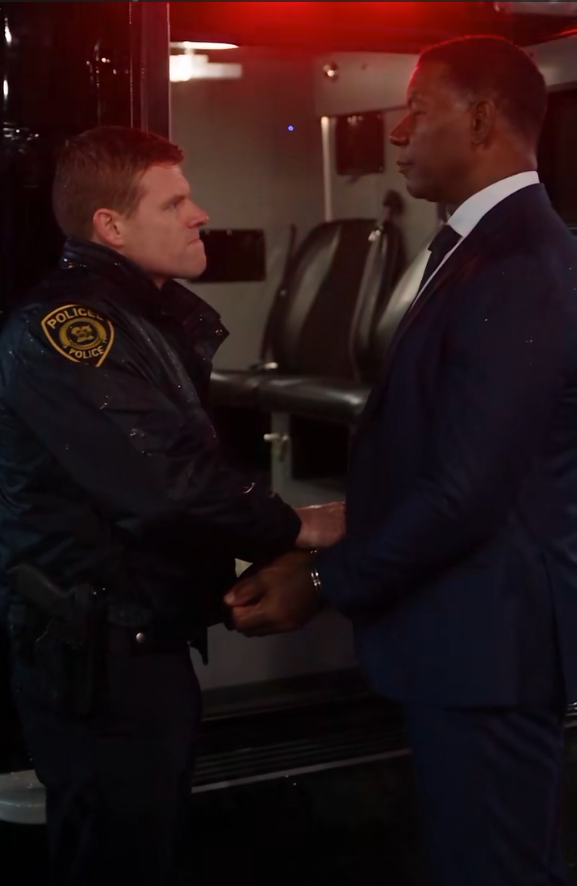
David looked once at Higgins.
The rookie’s face had gone pale.
Then David put his hands behind him.
The first cuff bit down.
Then the second.
Too tight.
David felt the metal catch skin near the bone.
Jenkins pulled his arms upward.
“Stop resisting.”
David’s exhaustion disappeared.
Not because adrenaline flooded him.
Because clarity did.
The road sharpened.
The sound of rain sharpened.
The cruiser’s unit number.
Jenkins’s badge.
Higgins’s position.
The time displayed on the Tahoe dashboard before Jenkins closed the door.
David memorized all of it.
“I am not resisting,” he said.
Jenkins pulled the cuffs once more.
David stopped speaking.
Jenkins searched him again.
Phone.
Keys.
Secure access card.
A small encrypted communications device clipped inside his belt.
“What the hell is this?”
“Government property.”
Jenkins held it up.
“What does it do?”
“I’m not discussing secure equipment on the roadside.”
Jenkins looked at Higgins as though David had just confessed to something.
“You hear that?”
Higgins did not answer.
Jenkins turned back.
“Who are you really?”
David looked at him.
“You’re holding my identification.”
“That doesn’t answer the question.”
“Yes, it does.”
For the first time, Jenkins seemed angry at David’s calm rather than suspicious of it.
He reached inside the Tahoe and began searching the front compartment.
David’s tone changed by half a degree.
“Officer.”
Jenkins ignored him.
“There is classified-capable equipment in that vehicle. You need to stop searching until your supervisor is present.”
Jenkins turned.
“Classified?”
“I said classified-capable.”
“What are you hiding?”
David’s expression did not change.
“Nothing. But you are creating a problem you do not understand.”
Higgins stepped closer.
“Brad, seriously.”
Jenkins rounded on him.
“You want to run this stop?”
“No.”
“Then stop telling me how.”
Higgins looked at David.
David gave him nothing.
No appeal.
No encouragement.
He would not make the rookie choose sides on a dark road with an armed, angry partner.
Jenkins opened the rear door of the patrol cruiser.
“In.”
David stood still for one second.
“Officer Jenkins.”
The use of his name made Jenkins pause.
David had read the badge.
“Before you transport me, call your supervisor and verify my federal credential.”
“I don’t take orders from suspects.”
“I am giving you an opportunity to correct this.”
Jenkins smiled without humor.
“You think you’re important?”
David glanced toward his own Tahoe.
Rain ran down its armored glass.
“No,” he said. “I think the situation is.”
Jenkins pushed him into the rear of the cruiser.
The door slammed.
For the first time that night, David was alone.
He looked through the wire partition.
Higgins remained near the Tahoe.
Jenkins stood in the rain talking into his radio.
David could not hear the words.
He leaned back carefully to reduce pressure on his wrists.
His shoulders ached.
He was more tired than he wanted to admit.
But beneath the fatigue, his mind was moving.
His secure phone was in Jenkins’s possession.
His personal movements were not continuously monitored when he was off protective duty, but his government vehicle contained systems that would eventually register an anomaly if moved, accessed improperly, or left active in the wrong status.
That did not mean cavalry would suddenly appear.
David did not want cavalry.
He wanted competent local supervision.
He wanted his credentials verified.
He wanted the officer to stop escalating.
He wanted to go home.
Instead Jenkins climbed into the driver’s seat.
Higgins opened the passenger door.
“Brad, what about his vehicle?”
“Tow it.”
Higgins hesitated.
“That’s a government vehicle.”
“So?”
“So maybe we call the supervisor before a tow company—”
Jenkins twisted toward him.
“He has fake credentials, an unregistered firearm until we confirm otherwise, and some kind of secure communications equipment. We’re done standing in the rain.”
David spoke through the partition.
“The weapon is federally issued. Do not enter it into a public-facing evidence workflow before confirming jurisdiction.”
Jenkins laughed.
“There he goes again.”
Higgins said nothing.
The cruiser pulled away.
Through the rear window, David watched his Tahoe disappear in the rain.
He had spent decades preventing small errors from becoming large emergencies.
Tonight, he was watching one grow in real time.
And he was handcuffed in the back seat.
The precinct was warm, fluorescent, and almost empty.
It smelled of old coffee, wet uniforms, printer paper, and the faint chemical scent of floor cleaner.
Jenkins walked David through the side entrance with one hand gripping his elbow.
There was no need for it.
David knew that.
Higgins knew that.
Sergeant Miller, sitting behind the front desk, knew it before anyone said a word.
Miller was in his late forties, heavy through the shoulders, gray beginning at his temples. He looked first at David’s cuffs.
Then his soaked dress shirt.
Then Jenkins.
“What do we have?”
Jenkins spoke quickly.
“Traffic stop. Suspicious credentials. Concealed firearm. Refusal to cooperate. Claims federal.”
Miller’s eyes moved to David.
“Claims what?”
“Secret Service.”
Miller’s face became still.
Jenkins dropped the credential case on the desk.
“Fake, probably.”
Miller did not touch it immediately.
“Probably?”
“He wouldn’t follow instructions.”
“That wasn’t my question.”
Jenkins’s jaw tightened.
Miller opened the case.
He looked at the badge.
Then the identification.
Then at David.
“What’s your full name, sir?”
“David Harrison.”
“Position?”
“Special Agent in Charge, Presidential Protection Division.”
Higgins looked toward Jenkins.
Jenkins folded his arms.
Miller stared at the credentials for another second.
“Did you verify these?”
“I was going to.”
“At the station?”
“Yes.”
Miller’s eyes lifted.
“After you put him in cuffs.”
Jenkins said nothing.
Miller sat down at the terminal.
“Credential number?”
David recited it from memory.
Miller typed.
The system thought for less than two seconds.
Then the monitor changed.
A red federal alert filled the screen.
Miller stopped breathing for a moment.
Jenkins leaned closer.
“What is that?”
“Back up.”
“What?”
“Back away from the terminal.”
Miller’s voice had lost all warmth.
Jenkins took one step back.
The desk phone rang.
Not the public line.
The secure administrative line.
Miller looked at it.
Then at David.
Then at the red warning on his screen.
He picked up.
“Fairfax County Police, Great Falls substation. Sergeant Miller speaking.”
He listened.
His posture changed.
“Yes, sir.”
Another pause.
“Yes, he is here.”
Miller looked directly at David.
“Yes, sir. He is currently restrained.”
Silence.
Miller’s eyes closed briefly.
“No, sir. I understand.”
He listened for another ten seconds.
“Yes. We will not access the vehicle. We will secure all property. Yes.”
He set the receiver down carefully.
Jenkins stared at him.
“Who was that?”
Miller looked at David’s wrists.
“Take the cuffs off.”
Jenkins did not move.
“What?”
“Now.”
David watched the argument happen silently on Jenkins’s face.
Pride.
Confusion.
Fear trying not to look like fear.
“Sergeant, he—”
“Take. The cuffs. Off.”
Higgins stepped forward.
“I’ll do it.”
Jenkins turned.
“I put them on.”
“Then remove them,” Miller said.
Jenkins reached for his key.
David turned around.
The cuffs came free.
Blood had gathered in narrow lines along both wrists.
Miller saw it.
So did Higgins.
Jenkins saw it and looked away.