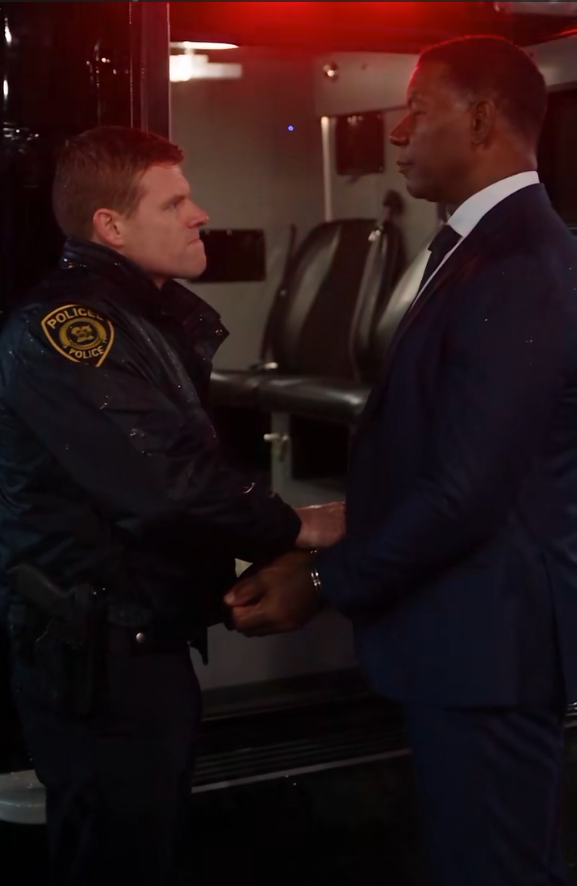
Another supervisor spoke.
“Would you have handled it differently if you weren’t law enforcement?”
David considered.
“I don’t know.”
The answer surprised the room.
“I know what training told me to do. I know what experience told me to do.”
He looked down briefly.
“But none of you should assume everyone you stop has my training.”
He looked up.
“That matters too.”
A younger lieutenant asked, “Do you think Higgins should have intervened more forcefully?”
“Yes.”
Miller shifted in his seat.
David continued.
“But I also think organizations often tell junior people to intervene without honestly preparing them for what it costs to challenge a senior colleague in real time.”
The lieutenant nodded.
“So what should he have done?”
“Called a supervisor sooner. Clearly stated his concern. Verified the credential independently if policy allowed. Created a documented pause.”
“Physically intervene?”
“Only if necessary to prevent immediate unlawful harm.”
David folded his arms.
“Peer intervention is not theater. It is judgment.”
Another hand.
“Do you forgive Jenkins?”
That question irritated him more than the others.
Not because it was inappropriate.
Because he still did not have a clean answer.
David looked toward the back.
Ellis watched him.
Miller did too.
He returned his attention to the room.
“Forgiveness is not part of your policy manual.”
A few people smiled.
David did not.
“And it is not necessary for accountability.”
He paused.
“Officer Jenkins lost his job because of choices he made. He may face additional consequences for those choices. My personal feelings do not alter the evidence.”
The supervisor waited.
“But personally?”
David glanced at his wrists.
The marks were gone.
“I believe people are more than the worst decision they make.”
He paused.
“I also believe some decisions permanently change what responsibilities they can be trusted with.”
That was the closest answer he had.
Maybe the only honest one.
Afterward, Ellis approached him.
“You realize half the room is going to quote you badly.”
“I expected three-quarters.”
“You did well.”
“I hate that sentence.”
“I know.”
Miller joined them.
“You forgot one thing.”
“What?”
“To tell them I was heroic.”
David looked at Ellis.
“Was he heroic?”
“No.”
“Then I did not forget.”
Miller laughed.
For the first time, the incident felt like something that had actually ended.
Not vanished.
Ended.
There was a difference.
Two months later, David was driving home on Georgetown Pike again.
Same road.
Different weather.
A cold, clear evening.
His government Tahoe had been returned after a full security inspection.
The encrypted console glowed softly.
Traffic was light.
He was tired, though not seventy-two-hours tired.
He had slept six the night before.
A luxury.
As he passed the stretch where Jenkins had stopped him, David noticed the narrow shoulder.
Mud had dried along the edge.
Nothing marked the place.
No sign.
No scar in the road.
Cars moved through it without knowing anything had happened there.
David preferred that.
His secure phone buzzed.
He glanced at the display.
Hale.
David pressed the hands-free control.
“What?”
“Nice to hear your warm voice too, boss.”
“What do you need?”
“Nothing. Just letting you know the evening movement is complete.”
“Then why are you calling me?”
“Because Keane said you’d ask.”
“He was right.”
“I hate when that happens.”
“Anything unusual?”
“No.”
“Good.”
Hale hesitated.
“Also, I heard from Miller.”
David frowned.
“Why are you talking to Miller?”
“He called the office.”
“Why?”
“Higgins got his field-training certification.”
David said nothing.
Hale continued.
“Apparently he wanted you to know.”
David looked at the road.
“Okay.”
“That’s it?”
“What do you want me to do, send balloons?”
“You could be happy.”
“I am driving.”
“That is not an emotion.”
“It is currently my priority.”
Hale laughed.
“Good night, boss.”
“Good night.”
The call ended.
David drove another mile.
Then another.
At a traffic light near home, he stopped beside a marked patrol cruiser.
Different department.
Different officer.
The officer looked over casually.
David looked back.
For half a second, memory placed rain where there was none.
Flashlight glare.
Cold metal.
Stop resisting.
He felt no rush of anger.
No fear.
Only recognition.
The light changed.
The patrol cruiser moved forward.
David remained still for one extra second before accelerating.
At home, the porch light was on.
His wife had left it that way for him.
He parked, turned off the engine, and sat in the quiet vehicle.
The secure systems powered down one by one.
For years, David had believed control came from seeing problems early enough to stop them.
That night on Georgetown Pike had reminded him of the limit in that belief.
Sometimes you saw the mistake clearly.
Sometimes you warned the person making it.
Sometimes you did everything right.
And the cuffs still closed.
The lesson was not that preparation failed.
It was that control had never been the same thing as certainty.
What mattered was what happened after the mistake.
Who told the truth.
Who stayed silent.
Who corrected the record.
Who chose pride.
Who chose accountability.
Who learned.
David opened the door.
Cold air entered the Tahoe.
Before stepping out, he looked once at his wrists.
Nothing remained there.
No bruises.
No cuts.
No visible proof.
Then his eyes moved toward the house.
The front door opened.
His wife stood there.
“You planning to sleep in the car?”
David got out.
“I was thinking.”
“That’s usually expensive.”
He shut the door.
She looked at him.
“You okay?”
David glanced back toward the road.
A patrol car passed the entrance to the neighborhood and disappeared beyond the trees.
Then he looked at her.
“Yes.”
This time, it was true.
He walked toward the porch.
Behind him, the black Tahoe sat dark and silent in the driveway, just another vehicle beneath an ordinary suburban night.
And for the first time since the rain, David did not see handcuffs when he looked at it.
He saw the road home.