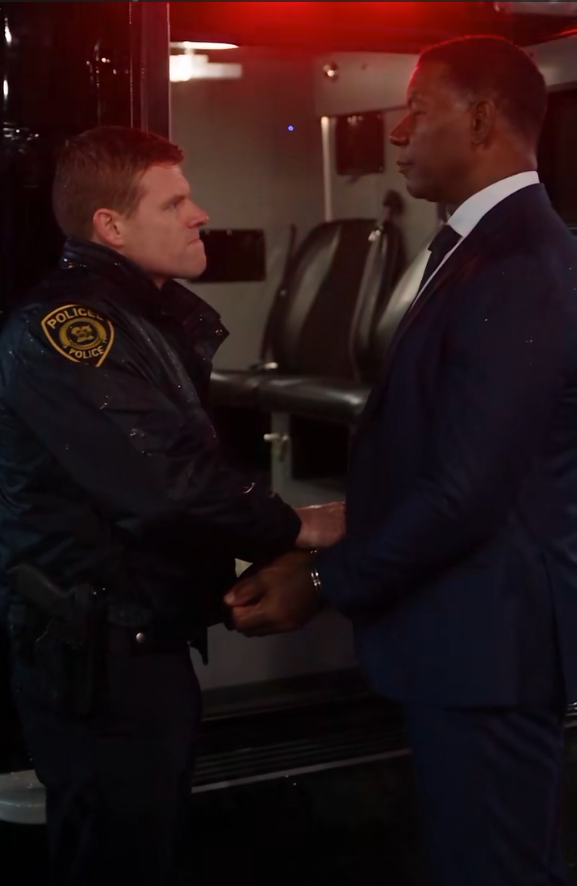
David said nothing.
Jenkins’s voice dropped.
“I’m making the facts fit what I need.”
David looked at the door.
His five minutes were almost over.
Jenkins said, “I know you don’t owe me anything.”
“No.”
“I know.”
“What do you expect me to do with this?”
“Nothing.”
“That isn’t possible.”
“I mean I’m not asking you to help me.”
David studied him.
“You understand that admitting intentional deactivation may affect more than your employment.”
“Yes.”
“Discipline.”
“Yes.”
“Potential charges related to the report.”
“I know.”
“And you still haven’t told investigators.”
“No.”
David stepped closer.
“Then your apology is worthless.”
Jenkins recoiled slightly.
David’s voice remained quiet.
“You came in here because confession feels like action. It isn’t.”
Jenkins looked down.
“You want to make one correct decision?”
“Yes.”
“Walk into that hearing and tell the truth before they ask another question.”
Jenkins looked at him.
David pointed toward the door.
“Not to me. To them.”
Jenkins breathed through his nose.
“What if that ends my career?”
David’s face did not change.
“You should have thought about that before you turned off the camera.”
The words were harsh.
He let them remain harsh.
Jenkins nodded.
David turned toward the door.
“Agent Harrison.”
David stopped.
“I’m sorry.”
David did not turn around.
“For which part?”
Jenkins had no immediate answer.
That was good.
Eventually he said, “For needing you to be guilty so I could stay right.”
David closed his eyes for half a second.
Then opened the door.
“Tell them.”
Jenkins did.
That became the decisive act of the hearing.
Not because confession erased anything.
It did not.
But it resolved the one remaining uncertainty.
The camera deactivation had been intentional.
The search had been knowingly unsupported.
The later report had been written to protect the decision.
The department terminated Bradley Jenkins that afternoon.
The local prosecutor opened a review of the inaccurate report and related conduct.
David neither asked for prosecution nor opposed it.
Higgins remained with the department.
Miller later told David he had enrolled voluntarily in a de-escalation and peer-intervention course that was not required for his assignment.
“Trying too hard?” Miller asked.
“Maybe.”
“That bad?”
“No.”
David thought for a moment.
“Trying too hard is sometimes how people learn before it becomes natural.”
Miller laughed.
“I’m writing that down.”
“Don’t.”
Too late.
The incident should have ended there.
Administrative finding.
Termination.
Potential legal consequences.
Security review completed.
Public controversy fading.
But one final decision remained.
The department asked David to speak at a closed training session for supervisors.
David refused.
Then Brooks asked him why.
They were walking through a secure corridor after an afternoon briefing.
“You’ve turned them down twice,” she said.
“You’ve been reading my schedule.”
“It’s my job to know where senior people are.”
“Not me.”
“You count.”
David gave her a look.
She continued.
“Why won’t you do it?”
“Because I’m not a police trainer.”
“They aren’t asking you to teach traffic stops.”
“They want the story.”
“So?”
“I don’t want to become the story.”
Brooks considered that.
“Too late.”
David stopped walking.
She stopped too.
“You have developed an alarming amount of confidence.”
“You promoted me.”
“That is not the same as permission.”
“It kind of is.”
He resumed walking.
Brooks matched him.
“What are you afraid of?”
David looked sideways.
“Careful.”
“You told me to ask the question I actually meant.”
He remembered.
Unfortunately.
She continued.
“Are you afraid people will turn it into a race story?”
“Some already have.”
“Or that they won’t?”
David looked at her.
Brooks shrugged.
“You keep correcting everyone when they make it too simple.”
“Because it is not simple.”
“No.”
They reached the elevator.
She pressed the button.
“But complicated doesn’t mean meaningless.”
The doors opened.
David stepped inside.
Brooks stayed out.
“Aren’t you coming?”
“No.”
She smiled.
“That sounded like a training line.”
The doors closed.
David stared at his reflection in the brushed metal.
The next morning, he accepted the invitation.
Part VI — Aftermath
The training room held forty-two people.
Patrol supervisors.
Training officers.
Field commanders.
No press.
No cameras.
David had required that.
Lieutenant Ellis sat in the back.
Sergeant Miller sat near the aisle.
Higgins was not in the room.
That had also been David’s request.
This was not about making him relive the stop.
David stood at the front without slides.
No podium.
No prepared statement.
He looked at the room for a long moment.
Then he said, “The least important fact about the night Officer Jenkins arrested me is that I was the Special Agent in Charge of the Presidential Protection Division.”
No one moved.
“That fact made the phone ring faster. It made the story larger. It made senior people pay attention.”
He paused.
“But it should not have changed how the traffic stop was handled.”
A supervisor near the front took notes.
David continued.
“I gave Officer Jenkins valid federal credentials. He could have verified them. He chose not to.”
He looked across the room.
“The problem was not that he failed to recognize an important person.”
A longer pause.
“The problem was that he decided verification was less valuable than being right.”
Miller watched him from the back.
David continued.
“There were several opportunities to stop the sequence.”
“Before the stop, he could have questioned whether lane movement in heavy rain justified intervention.”
“After seeing the credentials, he could have verified them.”
“When his partner raised concerns, he could have slowed down.”
“After finding the weapon, he could have recognized that its presence supported the identity I had already provided.”
“Before searching the vehicle, he could have called a supervisor.”
“Before writing the report, he could have told the truth.”
David let the pattern settle.
“The incident did not become serious because of one dramatic mistake. It became serious because each opportunity to correct the previous mistake was treated as a threat.”
Ellis lowered her pen.
David looked toward her, then back to the room.
“That is what I want you to remember.”
He did not mention Jenkins’s private apology.
That did not belong to them.
He did not describe the intentional camera deactivation beyond what had already been established in the disciplinary findings.
He did not speculate about racial bias.
Eventually a captain raised a hand.
David nodded.
“Do you believe race played a role?”
The room tightened.
David had known the question would come.
He answered carefully.
“I cannot tell you what was inside Officer Jenkins’s mind beyond what he said and did.”
The captain waited.
David continued.
“I can tell you that I am a Black man who was stopped without adequate documented basis, presented valid credentials, complied with instructions, and was still treated as though my calmness and identification were evidence of deception.”
He paused.
“Those facts matter.”
No one wrote for a moment.
“I can also tell you that evidence matters more than whatever conclusion makes us most comfortable. If bias contributed, it should be confronted. If pride, poor training, fear, or another factor contributed, those should be confronted too. These explanations are not mutually exclusive.”