Part I — The Watch
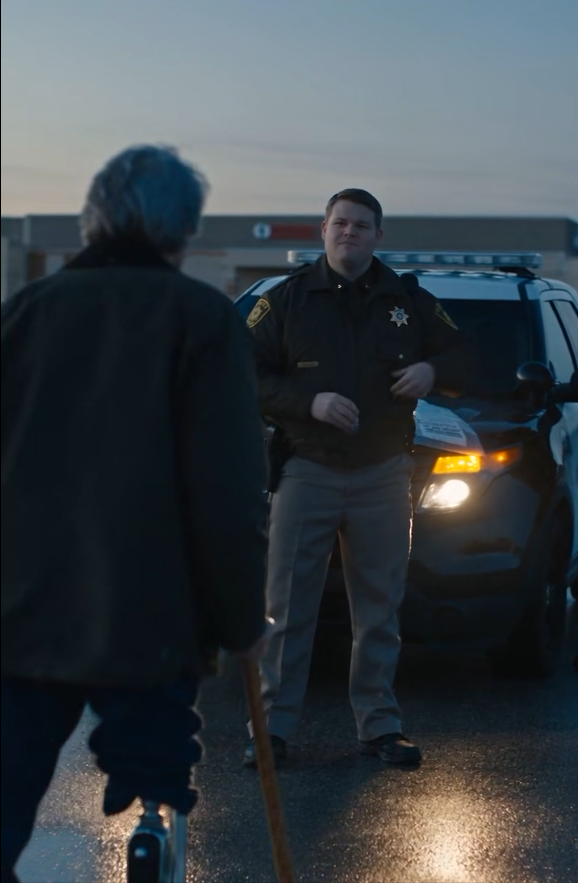
The moment Officer Miller slid my dead son’s watch into his own pocket, I stopped wondering whether I had misunderstood him.
The heavy silver timepiece disappeared beneath the Velcro flap of the cargo pocket on his tactical pants, bypassing the clear evidence bags spread across the hood of the patrol cruiser as if they were decoration.
I shifted my weight onto my carbon-fiber prosthetic.
Cold November asphalt had a way of finding every old injury. The ache started beneath my right knee and traveled upward in a slow, familiar line. At seventy-one, I had learned which pains deserved attention and which ones were simply reminders that the body kept records longer than the mind wanted to.
This one I ignored.
The empty strip mall had already closed for the night. Most of the storefronts behind us were dark, their windows reflecting blue-white cruiser headlights and the weak red glow of a pharmacy sign several units down. Wind pushed dry leaves across the parking lot. Somewhere behind the building, a loose metal panel tapped at uneven intervals.
Three days earlier, someone had broken into my house.
They had taken cash from a kitchen drawer, an old camera, two service medals I had never bothered to frame, and the watch from my nightstand.
The money didn’t matter.
The medals could be replaced.
The watch could not.
My son had worn it for twelve years.
After he died, I kept it wound even though I rarely wore it. Every Sunday morning, I sat at the kitchen table, turned the crown between my fingers, and listened to the small mechanical movement come alive.
A stupid ritual, maybe.
But grief makes archivists out of people.
You preserve handwriting on grocery lists. You keep voicemail messages nobody else would understand. You remember the way someone folded a jacket over a chair.
And you wind a watch.
Officer Miller pressed his palm over his pocket until the Velcro sealed.
“Like I said, old man, the serial numbers are filed off.” His voice held the practiced fatigue of someone delivering a conclusion rather than discussing one. “It’s undocumented property. Standard civil asset forfeiture rules apply. We hold it pending a broader investigation. You’re free to go.”
I looked at him.
Then at his pocket.
Then at the unused evidence bags.
“I brought the original purchase receipt.”
“I heard you.”
“The engraving inside the casing matches the document.”
“I heard that too.”
“You haven’t opened the casing.”
Miller gave a short laugh without humor.
“I don’t need to open anything.”
He stepped closer.
He was broad through the shoulders and heavier through the middle, maybe thirty-five, with the compact self-confidence of someone accustomed to people moving when he entered their space. The badge, the vest, the radio, the duty belt—he wore all of it aggressively, not carelessly. There was a difference.
I smelled peppermint gum and old coffee on his breath.
“I explained how this works,” he said. “You should be grateful we recovered anything at all. Now get back in your vehicle.”
His partner stood several yards behind him near the passenger door.
Officer Davis looked younger, maybe late twenties. Clean haircut. Leaner build. A few minutes earlier he had been trying not to smile when Miller made a joke about my cane.
Now he wasn’t smiling.
His eyes had dropped to the device in my left hand.
It resembled a radio more than a phone. Matte-black casing. Rubberized edges. External antenna. No bright commercial screen, no camera lens, no polished logo.
One recessed transmit button sat beneath my thumb.
Davis stared at it for half a second too long.
That was the first useful thing he did all evening.
Miller noticed.
“What?” he said.
Davis straightened away from the cruiser.
“Nothing.”
“You look like you saw a ghost.”
Davis glanced at me again.
Not at my face.
At the device.
Miller followed his gaze.
“What’s that?” he asked.
“Communication equipment.”
His expression changed almost imperceptibly.
“Department-issued?”
“Not yours.”
That irritated him.
He leaned closer.
“You recording me?”
“No.”
“Then put it away.”
I didn’t move.
His hand drifted toward the device, not quite reaching.
I lowered my voice.
“Officer Miller, I’m asking you one final time to place the watch into an evidence bag and record the recovery properly.”
His face hardened.
“One final time?”
“Yes.”
“Who exactly do you think you are?”
The wind pushed another cluster of leaves between us.
I could hear the cruiser engine idling.
Davis said quietly, “Miller.”
Miller ignored him.
“I asked you a question.”
I looked directly at him.
“I’m the owner of the watch.”
“That’s not what I asked.”
“It’s the answer that matters.”
His jaw moved.
For the first time, I saw something behind the arrogance.
Not fear.
Calculation.
He was deciding what he could do next while still calling it procedure.
Then he pointed toward my truck.
“Leave.”
I looked down at the radio.
My thumb found the recessed button.
Miller’s hand twitched toward his belt.
Davis pushed off the cruiser.
“Miller, wait.”
I pressed the button.
“Confirm.”
The word was barely above a whisper.
For half a second, nothing happened.
Then every radio in the parking lot erupted.
“UNIT TWELVE, DISENGAGE. DO NOT TOUCH THE CIVILIAN. REPEAT, DISENGAGE IMMEDIATELY.”
Miller froze.
The voice over his shoulder microphone was loud enough to echo against the dark storefront windows.
Another transmission crashed over it before he could respond.
“SUPERVISOR EN ROUTE. MAINTAIN POSITIONS. OFFICER MILLER, KEEP YOUR HANDS VISIBLE AND STEP AWAY FROM THE COMPLAINANT.”
Miller stared at his own radio.
Davis stared at Miller.
I released the button.
The parking lot became quiet again except for the cruiser engine.
Miller’s confidence didn’t vanish.
It fractured.
“What the hell is this?”
I said nothing.
His eyes returned to my device.
Then to my face.
“You set me up.”
“No.”
My voice remained level.
“You made a choice while someone was listening.”
He glanced sharply at the surrounding buildings.
Davis took one step away from him.
That was when Miller understood the problem was larger than the watch.
Part II — The Recording
Miller’s right hand hovered near the front of his duty belt.
Not his weapon.
Not yet.
But close enough that Davis noticed.
“Miller,” Davis said again.
This time his voice had changed.
No amusement.
No uncertainty.
Just warning.
“Hands out.”
Miller turned his head slowly.
“You giving me commands now?”
“I’m telling you what dispatch just said.”
“You don’t even know what’s happening.”
Davis looked at the silver watch concealed in Miller’s pocket.
“I’m starting to.”
Miller’s eyes sharpened.
“Watch yourself.”
Davis swallowed.
Then stepped another foot away.
That small movement mattered more than anything either of them had said.
Men like Miller depended on borrowed confidence. They wore authority collectively. A partner laughing at the right joke, standing in the right place, repeating the same version later—those things mattered.
Davis had stopped lending him his.
Miller looked back at me.
“What agency?”
I rested both hands over the head of my cane.
“What?”
“Who are you working for?”