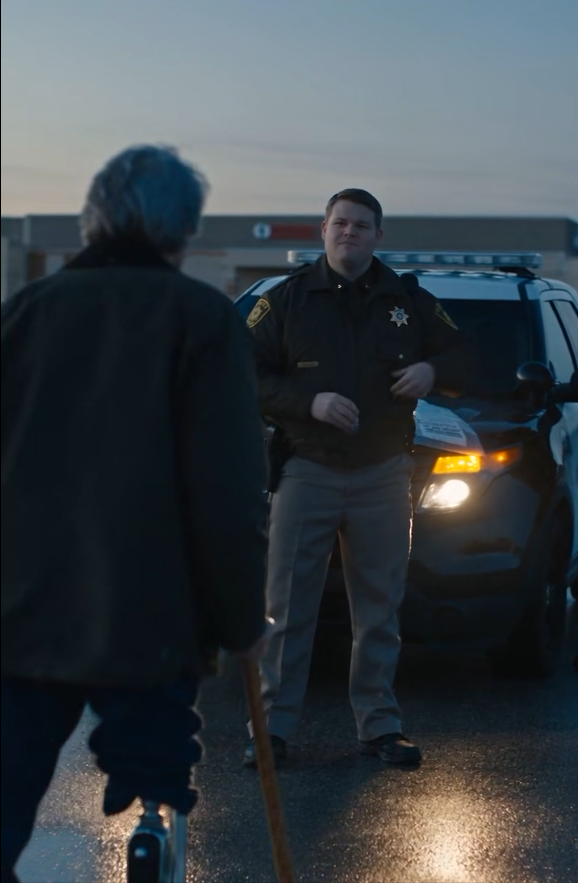
“I’m retired.”
“Retired from what?”
“More things than you need to know tonight.”
His nostrils flared.
“You don’t get to play games with me.”
“No,” I said. “You were playing the game.”
A flash of headlights appeared at the far entrance to the lot.
Then another.
Miller looked over his shoulder.
Two unmarked dark vehicles turned in without sirens.
Behind them came a marked supervisor’s SUV.
Davis exhaled through his nose.
Miller muttered something I didn’t catch.
The first unmarked vehicle stopped twenty yards away.
The doors opened.
Four people stepped out.
Plain clothes under outer vests.
No dramatic rush. No shouting. No weapons pointed.
Professionals rarely looked like television.
They spread just enough to control the space.
A woman in a dark jacket walked forward with a small digital recorder in her hand.
She didn’t introduce herself to Miller.
She looked at me.
“Sir.”
I nodded.
“You all right?”
“Yes.”
“Did he take possession of the identified property?”
“Yes.”
“Where is it?”
I pointed with my cane.
“Left cargo pocket.”
Miller’s mouth opened.
The woman raised one hand.
“Don’t.”
One syllable.
He stopped.
The marked SUV arrived behind her.
A uniformed sergeant climbed out and approached quickly, expression tight.
“Miller.”
“Sergeant, this is insane.”
“Hands where I can see them.”
“I’m a police officer.”
“I know.”
Miller gave a disbelieving laugh.
“So now what? You’re arresting me because some old guy claims a watch is his?”
Nobody answered immediately.
That silence bothered him more than an accusation would have.
The plainclothes woman finally spoke.
“No one said you were under arrest.”
“Then tell these people to back off.”
“No.”
Miller looked around the lot.
“Why?”
She held up the recorder.
“Because the recovery meeting was monitored under authorization.”
His face changed.
Not much.
But enough.
Davis turned toward her.
“Monitored?”
“Yes.”
Miller shook his head.
“No. Absolutely not.”
The woman continued.
“The complainant reported suspected mishandling during prior property contacts. Tonight’s exchange was documented.”
I studied Miller.
That statement was accurate, but intentionally incomplete.
Miller had not been selected because of me.
I had been selected because of him.
That distinction would come later.
Three days earlier, after the burglary, I had called the normal number, filed the normal report, and done everything an ordinary citizen was supposed to do.
The responding officer had been courteous.
The next afternoon, Miller called.
He said a watch matching mine had surfaced.
He asked me detailed questions about value, markings, insurance, proof of ownership.
Nothing strange about that.
Not until he told me not to come to the station.
He wanted to meet outside normal hours.
Said it would “save everybody paperwork.”
I had spent too many years listening to people explain why rules suddenly needed to bend for convenience.
The phrase stayed with me.
So did the number he called from.
I made one phone call after that.
Not to complain.
To ask whether a certain pattern was already known.
The answer was yes.
That was why the black radio was now in my hand.
Miller pointed toward me.
“He baited me.”
The woman’s expression did not change.
“With his own stolen property?”
Miller’s mouth closed.
Davis turned away slightly.
The sergeant said, “Remove the watch.”
Miller didn’t move.
“Miller.”
“I’m not reaching into my pocket with four people staring at me.”
“Fair enough.”
The sergeant looked at the plainclothes woman.
She nodded.
“Miller, keep your hands visible. I’ll retrieve it.”
Miller’s face reddened.
“You touch me and I’m filing—”
“Then file.”
The sergeant stepped forward.
Miller finally raised both arms slightly.
The Velcro tore open with a loud ripping sound in the cold air.
The sergeant removed the watch.
Even from several feet away, I recognized the worn scratch near the crown.
He placed it into a clean evidence bag.
The motion should have brought relief.
Instead I felt something colder.
Because the watch had been in Miller’s pocket for less than five minutes.
And he had done it easily.
No hesitation.
No glance toward his partner.
No improvised excuse until after the fact.
Habit leaves fingerprints long before evidence does.
The woman sealed the bag.
“Sir, can you identify this visually?”
“Yes.”
“Without touching it.”
“Yes.”
She held it at chest level.
I looked through the clear plastic.
The second hand had stopped.
I hated that.
“It’s mine.”
“How can you tell?”
“Scratch near the crown. Small crescent mark on the lower left lug. My son damaged it changing a tire in 2009.”
Miller rolled his eyes.
The woman noticed.
“So you don’t dispute this is the same watch recovered in the burglary investigation?”
“I dispute ownership.”
I looked at him.
He kept talking.
“People make claims all the time. Receipts can be fabricated. Engravings can be added. Serial numbers are gone.”
The woman looked at me.
“Receipt?”
Inside my coat pocket, protected by a plastic sleeve, was the original sales document.
I handed it over.
She read it.
Then looked through the evidence bag at the watch.
“Interior inscription?”
I recited it.
She wrote the words down.
Miller laughed again.
“You’re taking his word for something nobody can see.”
I looked at him.
“You could have opened the casing.”
His eyes met mine.
I added, “But then you would have had to document what was inside.”
He said nothing.
The woman turned to the sergeant.
“Body cameras?”
The sergeant looked at Davis first.
“Status?”
Davis touched his chest.
“Active.”
Then Miller.
Miller hesitated.
The sergeant’s face changed.
“Miller.”
“Battery issue.”
“Since when?”
“Earlier.”
“You reported it?”
“I was going to.”
The plainclothes woman looked at the cruiser.
“Vehicle camera?”
Miller said quickly, “System glitches.”
Davis closed his eyes for one second.
That was the moment I knew this was no longer about one bad choice.
Part III — The Pattern
They asked me to stay.
I sat in my truck with the door open while technicians documented the scene.
The prosthetic always stiffened if I stood too long in the cold. I removed the lower section, rubbed the pressure point below my knee, then reattached it while trying not to watch Miller.
He stood beside the cruiser with his arms crossed.
Nobody had handcuffed him.
That seemed to bother him almost as much as being detained.
An arrest would have allowed him to become the injured party in his own mind. Restraint would have given him something visible to resent.
Instead, they made him wait.
Waiting leaves a man alone with sequence and consequence.
Davis was interviewed first.
He sat in the supervisor’s SUV.
His silhouette moved behind the windshield.
Once, he covered his face with both hands.
I looked away.
I knew something about being young beside the wrong person.
Decades ago, in a desert so bright it seemed colorless, I had followed a man I trusted into a place we had been specifically ordered not to enter.
We thought we were solving a problem faster.
We thought experience gave us permission.
The explosion took part of my leg and most of his hearing.
Authority does not protect you from consequences.
Sometimes it simply delays them long enough to make you arrogant.